Two transactions, one business result
The bakery buys flour from its usual supplier and closes its futures with an offsetting trade. These are separate transactions. A supplier does the reverse: sell the physical flour and close a short futures position. We now let the physical price differ from the futures quote.
Use a 100-bag need and fictional 25-bag flour futures. Enter futures at $22 per bag; close them when the business buys or sells its flour, before futures delivery.
Predict the result, run the calculation, then make the requested change. Use signed numbers without units for numeric checks. Each calculation stands alone.
For decimal answers, round to two decimal places; trailing zeros are optional.
How do long and short futures hedges work?
A planned buyer uses a long hedge to offset rising purchase costs. An owner planning a sale uses a short hedge to offset falling sale proceeds. Futures P&L is counted once: daily settlement distributes it along the way rather than adding a second profit when the position closes.
What do the symbols mean?
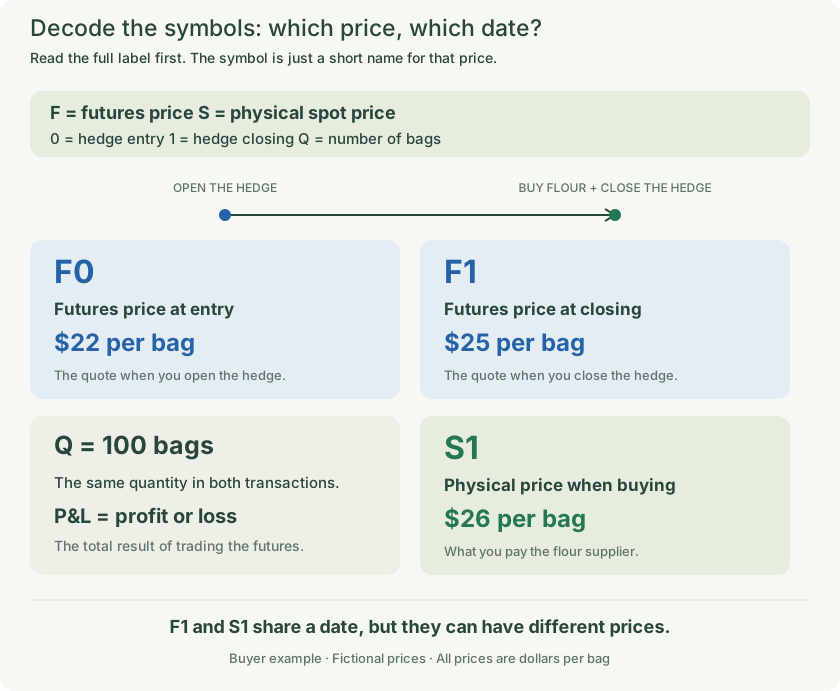
F means futures price; S means the physical spot price. The number marks the date: 0 = entry, 1 = closing. All three prices use the same unit, here dollars per bag.
- Q — quantity hedged: 100 bags in this example.
- F0 — futures price when you open the hedge: $22 per bag.
- F1 — futures price when you close the hedge: $25 per bag in the buyer example.
- S1 — physical price when you buy or sell the flour: $26 per bag in the buyer example.
- P&L — profit or loss: the total futures trading result.
Combine the two cash flows
For a matching physical and futures quantity:
- Long futures P&L = Q × (F1 − F0)
- Effective purchase cost = Q × S1 − long futures P&L
- Short futures P&L = Q × (F0 − F1)
- Effective sale proceeds = Q × S1 + short futures P&L
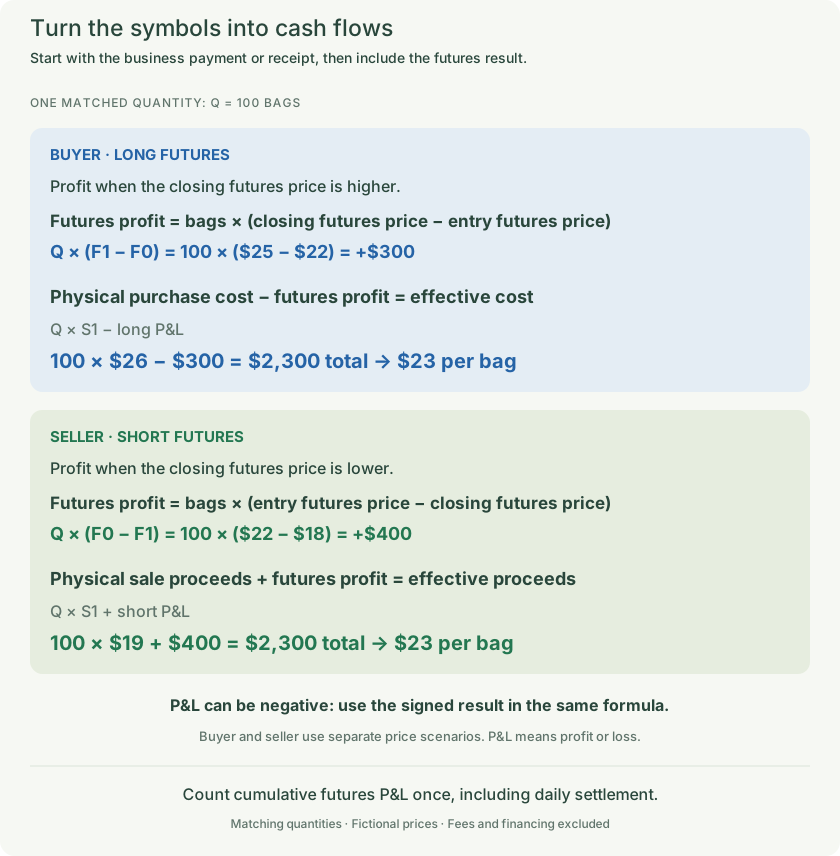
Both effective prices per unit equal F0 + (S1 − F1). The difference S1 − F1 is the closing basis; it need not be zero before delivery. Quotes are fictional. These examples exclude fees, financing, interest on margin and contract failure; they do not remove interim funding needs.
Exercise 1 — Start with the business need
A 100-bag buyer is hurt when the flour price rises from $21 to $26. Calculate the extra physical purchase cost. Choose the futures direction that gains when its quote rises; the aim is to offset the purchase exposure, not to forecast the price.
Exercise 2 — Convert the need into contracts
Each fictional contract covers 25 bags. Divide 100 by 25. Then change the need to 150 bags. Matching units comes before comparing contract gains with a physical bill. Here the quantity divides exactly; there is no rounding decision.
Exercise 3 — Calculate a long hedge’s gain
Return to four contracts, representing 100 bags. Futures were bought at $22 and closed at $25. Compute cumulative futures P&L. Then change only the closing quote to $24. Do not multiply the entire physical purchase price into this futures gain.
Long and short hedges: follow the cash flows
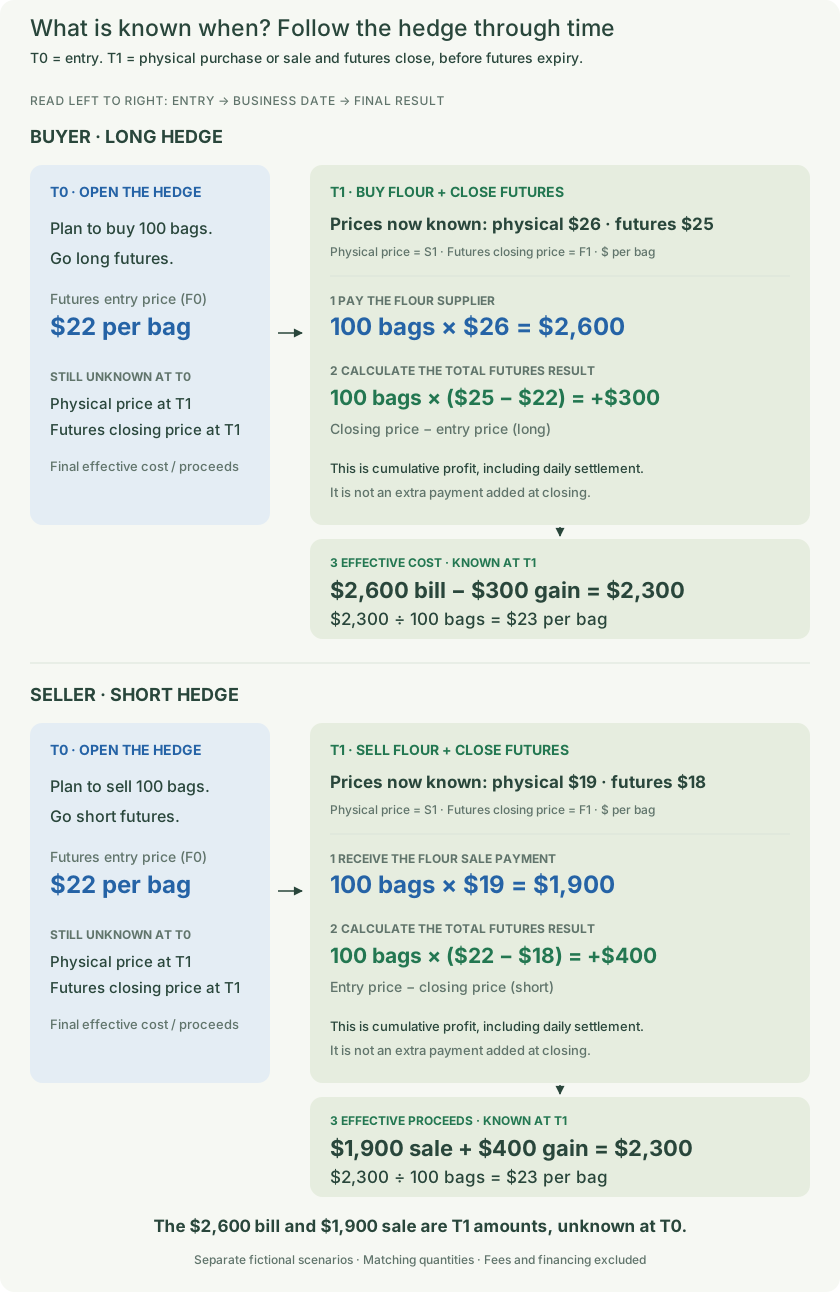
The diagram shows the stated worked example. Editing a calculation does not update the picture.
Exercise 4 — Combine the purchase and the hedge
At the original closing quotes, flour costs $26 and futures close at $25. Subtract the $300 futures gain from the $2,600 physical bill. Next change only the physical flour price to $27. Leaving futures unchanged introduces a larger closing mismatch.
Exercise 5 — Keep the sign when futures lose
Use a lower-price scenario: flour is $19, futures close at $18 and entry was $22. The long futures loss is −$400. Subtract the signed P&L from the physical bill. The loss makes the effective bill higher than the cash purchase alone.
Exercise 6 — Stand beside the seller
A supplier sells 100 bags at $19 and closes a matching short at $18 after entry at $22. Add the short gain to the sale proceeds. Then change the physical price to $20 and closing futures to $19 together. The $1 closing basis stays unchanged.
Closing basis: why the effective price differs
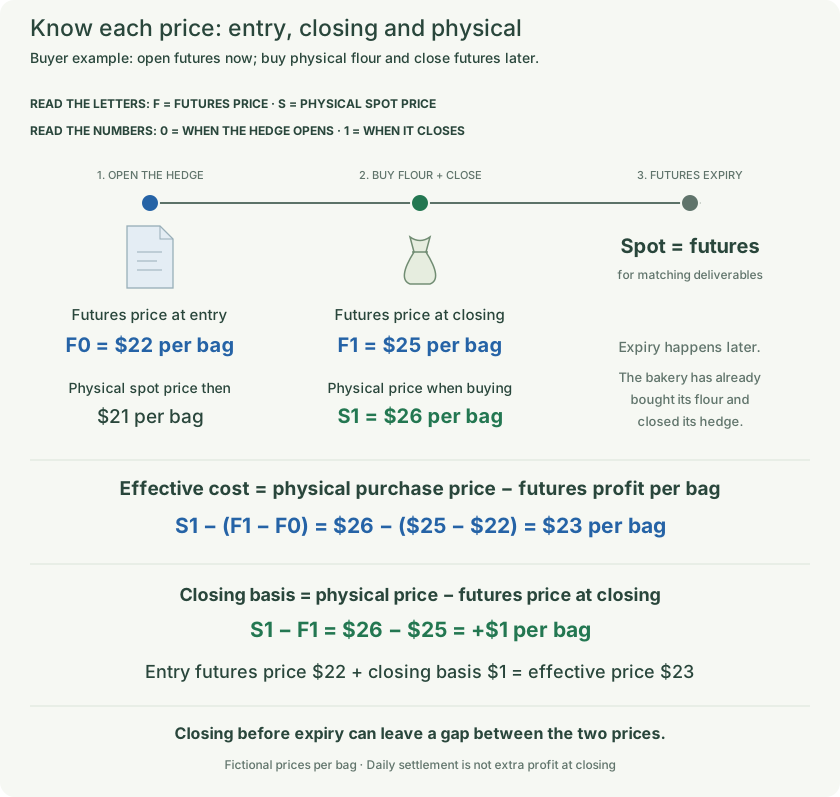
The diagram shows the stated worked example. Editing a calculation does not update the picture.
Exercise 7 — Identify what the price lock still depends on
At entry F0 = $22; at the business date S1 = $26 and F1 = $25. Calculate effective price per bag. Quantity and timing are aligned, but the futures have not expired. A $23 effective price can be explained by $22 entry plus $1 closing basis.
Remember
A hedge combines the physical transaction and the signed futures P&L. Equal quantity does not guarantee an exact price lock. Do not count daily settlement and cumulative P&L twice.