The gap can change before the hedge ends
The futures hedge from the previous lesson ended at a different price from the flour purchase. That gap has a name: basis. We use one convention throughout: physical spot price minus the quote of the futures contract used for hedging.
The same futures contract starts at $22. At entry, physical flour is $21. Close the hedge on the business transaction date, before the futures contract expires.
Predict the result, run the calculation, then make the requested change. Use signed numbers without units for numeric checks. Each calculation stands alone.
For decimal answers, round to two decimal places; trailing zeros are optional.
What is basis risk?
Basis = spot price of the asset being hedged − futures price of the contract used. A rise in basis is strengthening; a fall is weakening. Other markets sometimes reverse the sign convention, so always check the definition.
For a one-for-one quantity hedge, effective price = entry futures quote + closing basis. An uncertain closing basis makes the eventual effective price uncertain even when the entry quote is known.
| Closing basis, with entry futures $22 | Effective purchase price or sale price |
|---|---|
| −$0.50 per bag | $21.50 per bag |
| $0 | $22 per bag |
| +$1 per bag | $23 per bag |
A lower effective price helps a buyer; a higher one helps a seller. Convergence toward zero applies to matching deliverables at contract expiry, not automatically to a different grade, location or an earlier hedge close. We exclude fees, financing and default and assume matching quantities.
Exercise 1 — State the sign convention
At entry the physical price is $21 and the chosen futures quote is $22. Subtract in the stated order. A negative basis is a price difference, not a negative commodity price and not a measure of the whole contract’s gain.
Exercise 2 — Calculate basis at the business date
When the bakery buys its flour, the physical price is $26 and the same futures contract is quoted at $25. The two quotes moved differently. Compute the closing basis without substituting the old entry futures quote.
Exercise 3 — Measure strengthening
The basis moved from −$1 to +$1. Calculate closing minus entry basis. A move across zero still has an ordinary signed change. Strengthening does not mean that both quoted prices must rise; it describes the difference between them.
Read the picture
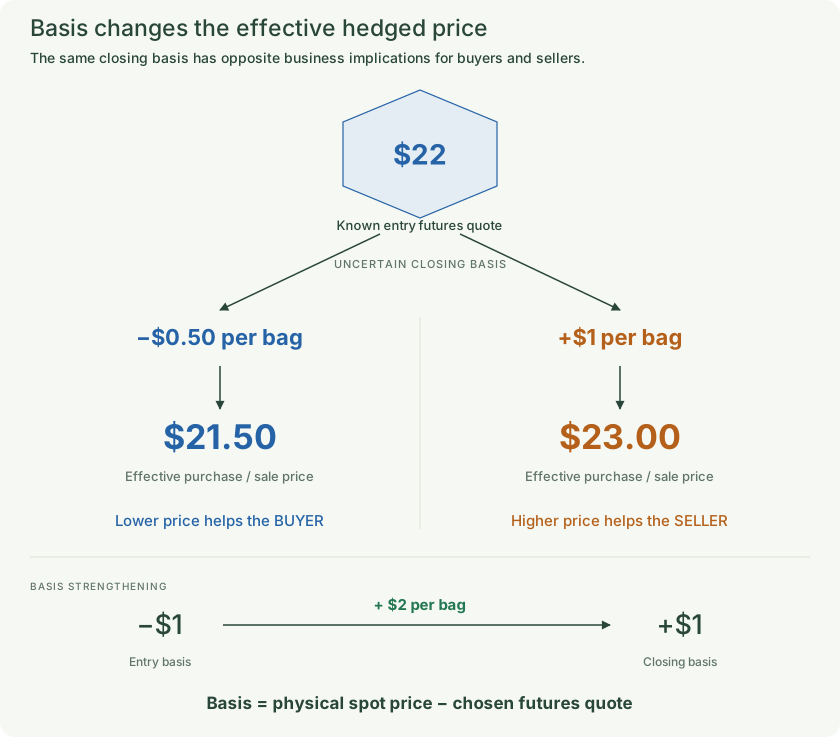
The diagram shows the stated worked example. Editing a calculation does not update the picture.
Exercise 4 — Translate basis into an effective price
The entry futures quote is fixed at $22. Add the original +$1 closing basis. Then replace the closing basis with −$0.50. You are comparing two possible outcomes, not assuming either was known at entry.
Exercise 5 — Distinguish the buyer from the seller
Compare the $23 and $21.50 effective prices. Both follow the same formula, but the business objective is different. The buyer pays the effective price; the seller receives it. Evaluate the stronger basis relative to the weaker one, holding entry futures fixed.
Exercise 6 — Do not substitute the entry basis
Consider a different early close: spot is $24 and futures are $23.50. Calculate their gap. With entry futures still at $22, this makes effective price $22.50; the −$1 basis observed at entry is not the closing gap.
Read the picture
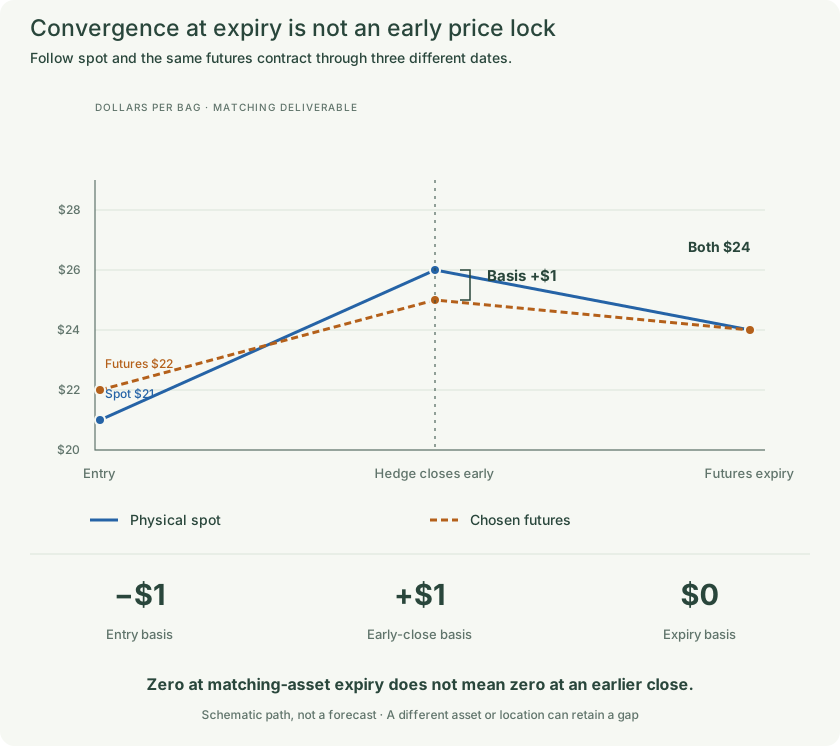
The diagram shows the stated worked example. Editing a calculation does not update the picture.
Exercise 7 — Check when convergence applies
If the same deliverable spot asset and futures meet at expiry, a zero basis would give a $22 effective price in our model. An earlier transaction does not inherit that zero automatically. Different grades and locations can also retain a price difference.
Remember
Basis risk is uncertainty about the closing gap, not simply the existence of a gap today. State spot minus futures before interpreting strengthening or weakening. An early close is not contract expiry.