A related contract is not the same ingredient
The bakery now needs 100 bags of specialty flour. The only contract in our fictional market is a standard-flour future, covering 25 bags. The two products have related prices, but they are different grades and their price changes need not match.
Specialty flour starts at $30 per bag; standard-flour futures start at $22. We begin with four long contracts, then examine what remains exposed.
Predict the result, run the calculation, then make the requested change. Use signed numbers without units for numeric checks. Each calculation stands alone.
For decimal answers, round to two decimal places; trailing zeros are optional.
What is cross hedging?
Cross hedging uses a derivative on a related asset to offset exposure in another asset. A similar name or equal bag count does not establish an effective hedge. What matters is the relationship between price changes over the hedge horizon.
Let h be futures units per physical unit. For a buyer, change in effective cost per unit = change in physical price − h × change in futures price. This is a change from the starting physical-price budget, not the final full purchase bill.
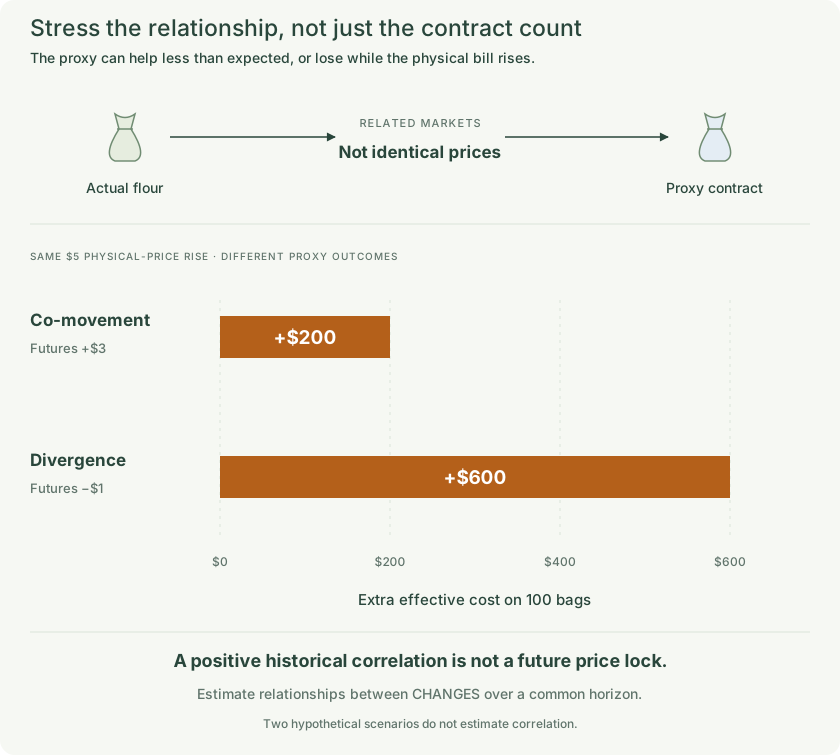
Correlation measures how changes move together; it is not a conversion factor or a promise. Correlation of price levels can be misleading. Estimates can change, and two scenarios cannot establish a reliable historical correlation.
All prices and contracts here are fictional. Bags are comparable quantity units, but grade risk remains. We exclude fees, financing and default. Later we choose h from estimated volatility and correlation rather than assuming h = 1.
Exercise 1 — Measure the actual ingredient’s change
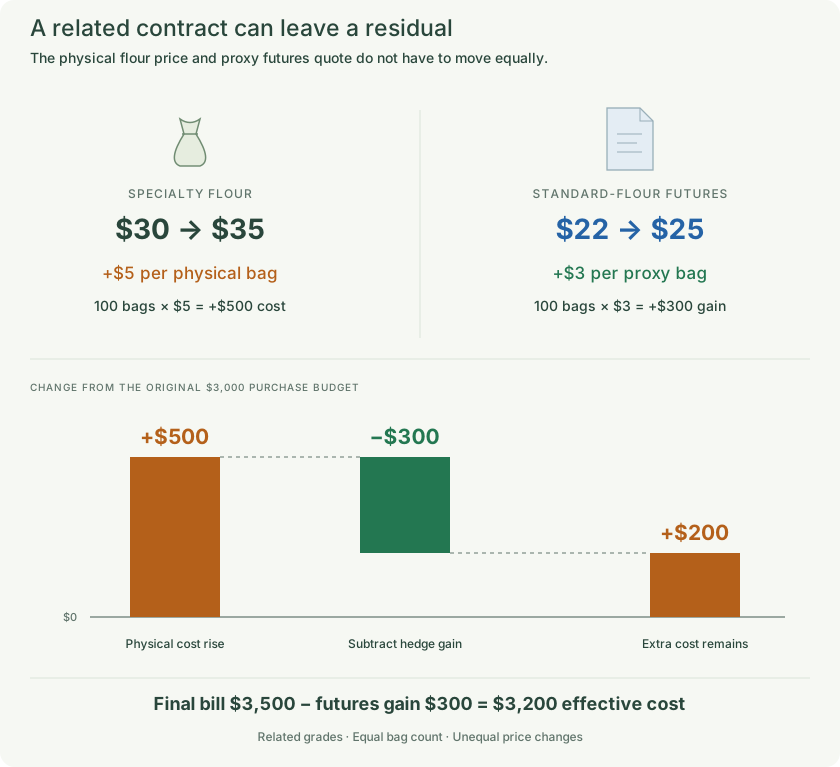
Specialty flour rises from $30 to $35. Calculate the change per bag. Then change the ending specialty price to $36. This measures the bakery’s actual exposure, not the price change of the substitute futures.
Exercise 2 — Measure the proxy separately
Standard-flour futures rise from $22 to $25. Compute the change in the chosen contract. The starting $8 difference between specialty flour and standard futures does not tell you how their future changes will compare.
Exercise 3 — Find the unmatched change
With h = 1, subtract the $3 futures gain per unit from the $5 physical-price increase. Then change the futures increase to $4 while keeping the physical increase at $5. A positive remainder means the effective purchase cost rose.
Read the picture
The diagram shows the stated worked example. Editing a calculation does not update the picture.
Exercise 4 — Scale the residual to the whole purchase
Return to the original $5 physical increase and $3 futures increase. Multiply each by 100 bags. Subtract to find the increase in effective total cost relative to the original $3,000 specialty-flour budget.
Exercise 5 — Stress a breakdown in co-movement
Keep specialty flour at $35 but let standard-flour futures fall from $22 to $21. The long futures now lose money while the physical bill rises. Compute the extra effective cost. A relationship that helped historically need not help in every future scenario.
Exercise 6 — Compare correlations under a stated model
Suppose two equally available proxies have the same price-change volatility and costs. Estimated positive correlations with specialty-flour changes are 0.90 for A and 0.40 for B. At each proxy’s minimum-variance ratio, the idealized variance reduction is correlation squared. Compare the two fractions; this is a model comparison, not a guarantee.
Read the picture
The diagram shows the stated worked example. Editing a calculation does not update the picture.
Exercise 7 — Keep final cost separate from its change
For the original scenario, pay $3,500 for specialty flour and subtract $300 futures P&L. The effective bill is $3,200, compared with the starting $3,000 budget. A positive futures gain can coexist with an increase in effective business cost.
Remember
Choose a proxy using price-change relationships, not similar labels or matching contract counts alone. Measure the residual on the business exposure. Cross hedging can reduce estimated risk without fixing the effective price.