Give an interest rate its units
The bakery has $1,000 available today and wants to compare how it grows. A quoted annual rate needs a compounding convention: crediting interest once a year differs from crediting it every six months. Start with 10% and change one ingredient at a time.
Predict first, run the calculation, then make the requested change. Each calculation stands alone. Enter numeric answers without units. Round to two decimal places unless the check specifies otherwise; trailing zeros are optional.
What does compounding mean?
Compounding earns interest on earlier interest as well as the original deposit. A rate quotation must specify how often interest is credited. We assume a fixed rate and that every interest payment stays invested.
| Symbol | Meaning | Example |
|---|---|---|
| A | Amount invested today | $1,000 |
| R | Quoted annual rate as a decimal | 10% = 0.10 |
| m | Number of compounding periods per year | 2 for semiannual |
| T | Time in years | 2 for two years |
Future value = A × (1 + R/m)^(m × T). For annual compounding, m = 1. In Java, Math.pow(base, exponent) calculates a power. Use decimal rates: 0.10, not 10.
Continuous compounding uses future value = A × exp(r × T), where r is the continuously compounded annual rate and Math.exp(x) means e raised to x. Math.log(x) is the natural logarithm, which reverses Math.exp.
Effective annual rate = (1 + R/m)^m − 1. The continuous rate equivalent to an effective annual rate a is r = log(1 + a). Equal quoted numbers under different conventions need not produce equal cash amounts. Equivalent rates do produce equal cash amounts.
Exercise 1 — Convert the percentage first
A 10% annual rate earns $100 on $1,000 during the first year. Calculate interest only, then change 0.10 to 0.08. Keep the principal separate from the interest: the result here is the addition, not the ending balance.
Exercise 2 — Include the original money
Restore 10% annual compounding. Multiply the principal by one plus the rate to find the year-end balance. The multiplier 1.10 includes both the original 100% and the extra 10%. Compare this with the interest-only result.
Exercise 3 — Let the interest earn interest
Keep the money invested for two full years at 10% annual compounding. The second year starts with $1,100, so it earns $110. Compare the compounded balance with $1,200, which would credit $100 in each year without reinvesting the first interest payment.
Read the picture
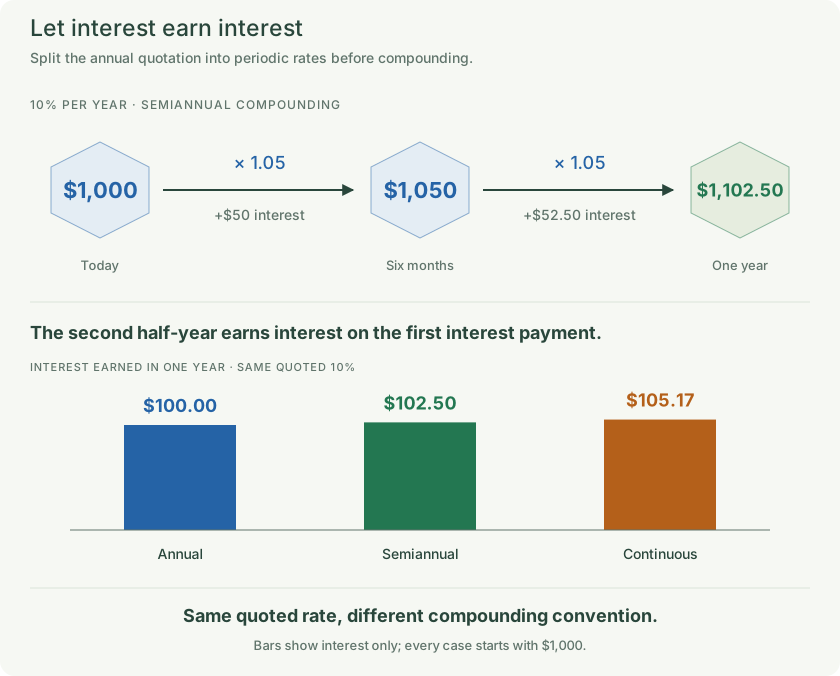
Follow the same $1,000 through two half-years and compare one-year balances on a shared scale.
The figure uses the stated original values. Editing a calculation does not change the illustration.
Exercise 4 — Split the year into two periods
Now quote 10% per year with semiannual compounding. Each half-year earns 5%, and there are two half-years in one year. The second half-year earns interest on $1,050. Use 0.10 / 2 for the periodic rate rather than crediting 10% twice.
Exercise 5 — Measure the effective annual increase
Divide the final balance by the original amount and subtract one, or directly calculate the growth multiplier minus one. Multiply by 100 to report percentage points. This translates the semiannual quotation into a comparable one-year increase.
Exercise 6 — Try continuous compounding
Use a continuously compounded rate of 10% for one year. Math.exp handles the exponential calculation; do not type the mathematical constant e yourself. This uses the same quoted number as before, with a different convention. Round the dollar result to two decimals.
Read the picture
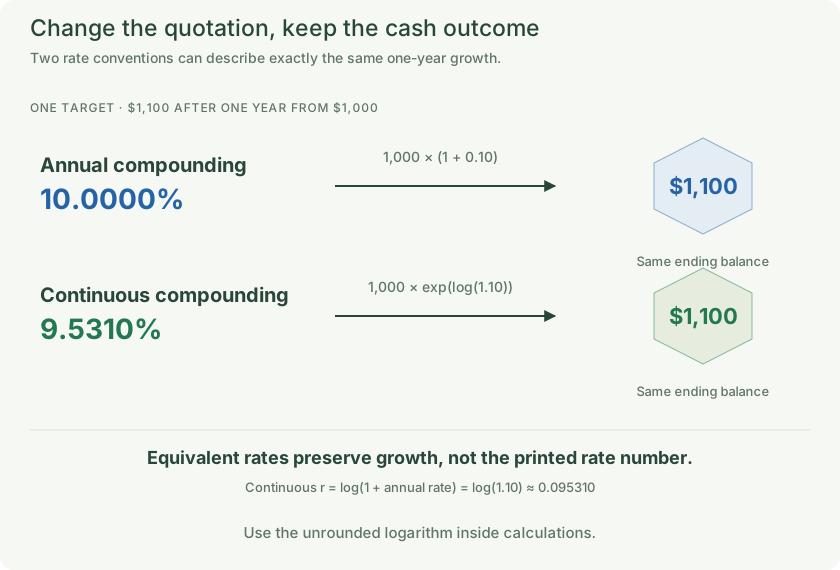
Equivalent quotations preserve the ending balance; the compounding label belongs with the rate.
The figure uses the stated original values. Editing a calculation does not change the illustration.
Exercise 7 — Convert a quotation without changing its outcome
Find the continuous rate that gives exactly the same one-year growth as 10% annual compounding. Math.log(1.10) returns the rate as a decimal. Convert it to a percentage. Unlike keeping both quotations at 10%, this conversion preserves the final balance.
Remember
Always pair a rate with its convention. The same quoted 10% produces different growth under annual, semiannual and continuous compounding.
All prices and rates are fictional teaching inputs. Keep full precision inside calculations and round only the final answer.