Bring tomorrow’s money back to today
The bakery knows a payment will arrive later. How much money today grows into that amount? Reverse the compounding calculation rather than subtracting a percentage from the future payment. Dates matter even when two cash flows have the same dollar amount.
Predict first, run the calculation, then make the requested change. Each calculation stands alone. Enter numeric answers without units. Round to two decimal places unless the check specifies otherwise; trailing zeros are optional.
What is a discount factor?
A discount factor is today’s value of one currency unit paid at a specified future date, under the stated rate model. Multiply a future cash amount by its discount factor to obtain present value.
| Convention | Growth factor to T | Discount factor D(T) |
|---|---|---|
| Annual compounding at a | (1 + a)^T | 1 / (1 + a)^T |
| Continuous compounding at r | exp(r × T) | exp(−r × T) |
Present value = future cash × D(T). A discount factor has no currency units; present value has the same currency as the payment. Here T is measured in years and all rates are fixed fictional model inputs. At a positive rate a later certain payment has a smaller present value. At zero rates the factor is one; a negative rate can produce a factor above one.
Discount each dated payment separately before adding them. The examples assume certain payments in one currency, with no default, fees or taxes. Annual and continuous rates are explicitly labeled; identical quoted numbers across those conventions are not equivalent rates.
Exercise 1 — Reverse a known growth calculation
At 10% annual compounding, $1,000 becomes $1,210 in two years. Divide $1,210 by the two-year growth factor to recover today’s amount. Discounting reverses multiplication by a growth factor; it does not simply deduct 20% of the future payment.
Exercise 2 — Price one future dollar
Calculate the two-year discount factor at 10% annual compounding. It is the present value of $1, not of the whole $1,210 payment. Multiply it by any certain cash amount at that date. For this check only, round the factor to four decimal places.
Exercise 3 — Keep the payment and change the date
Value a $1,100 receipt one year away at 10% annual compounding. Then change the exponent from 1 to 2 while keeping the future receipt at $1,100. The same promised dollars are worth less today when you wait longer at a positive rate.
Read the picture
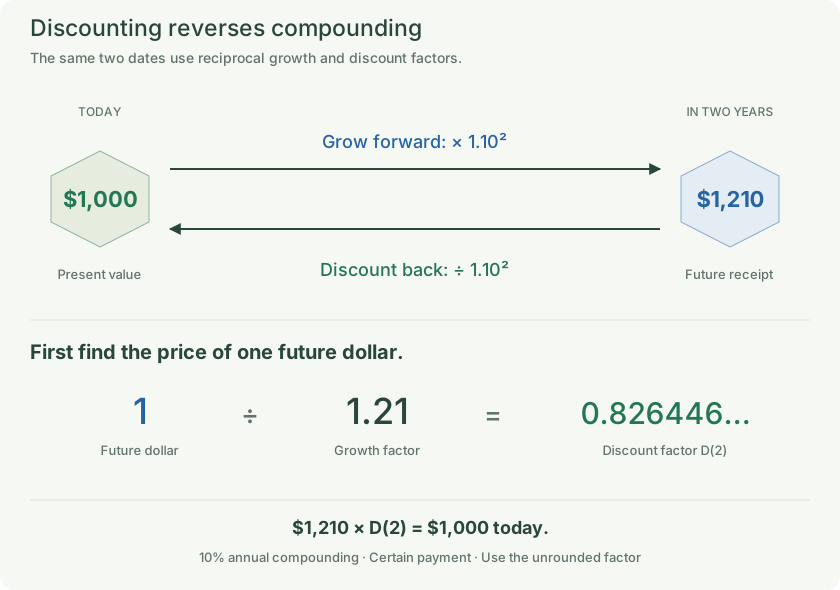
Move a future receipt left along the timeline by dividing by its growth factor.
The figure uses the stated original values. Editing a calculation does not change the illustration.
Exercise 4 — Discount with a continuous rate
Switch to a 5% continuously compounded annual rate. A certain $1,000 payment arrives in two years. Use a negative exponent to undo growth. A positive exponent would move today’s money forward and answer a different question.
Exercise 5 — Test a higher discount rate
Keep the $1,000 payment and two-year date. Increase the continuous rate from 5% to 8%. Predict the direction before running the cell: when money can grow faster, less is needed today to reach the same future amount.
Exercise 6 — Add values at a common date
Return to 10% annual compounding. One certain receipt is $110 in one year and another is $121 in two years. Discount each to today and add. Adding the future amounts first and then applying one factor would wrongly give both payments the same date.
Read the picture
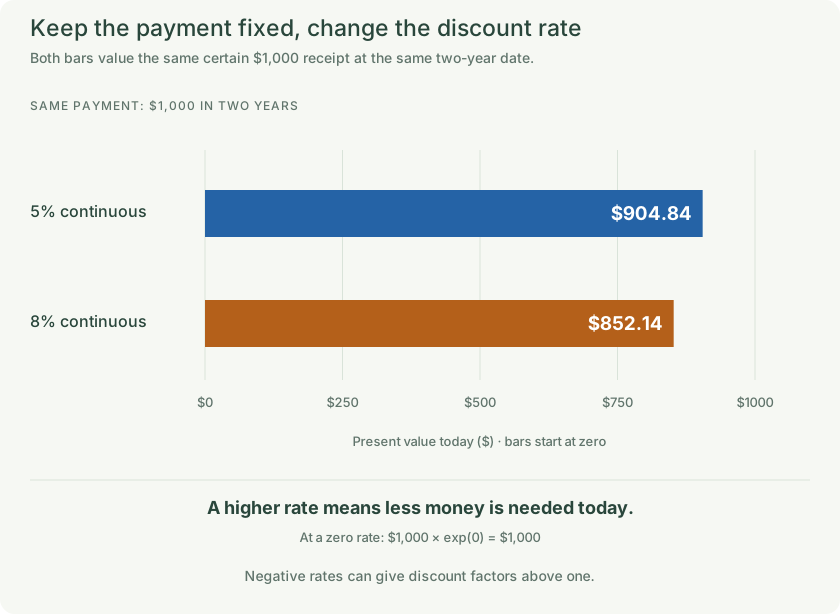
Compare the present value of the same $1,000 payment under two discount rates.
The figure uses the stated original values. Editing a calculation does not change the illustration.
Exercise 7 — Check the zero-rate boundary
At a zero continuous rate, calculate the value of $1,000 arriving in two years. There is no growth to reverse. This is a useful boundary check on the formula; positive rates are an assumption in earlier comparisons, not a mathematical requirement.
Remember
Discounting reverses compounding. Keep the rate convention and payment date explicit, and bring payments to a common date before adding them.
All prices and rates are fictional teaching inputs. Keep full precision inside calculations and round only the final answer.