A bond is a set of dated payments
A fictional bond promises a $50 coupon at the end of year one and $1,050 at the end of year two. That final amount contains both the second coupon and the $1,000 face value. Price the promised payments one at a time, using the discounting tools you just practiced.
Predict first, run the calculation, then make the requested change. Each calculation stands alone. Enter numeric answers without units. Round to two decimal places unless the check specifies otherwise; trailing zeros are optional.
How do you price a fixed-coupon bond?
Bond price = sum of the present values of its promised coupons and principal. We value the bond on a coupon date immediately after any current coupon payment, so accrued interest is zero. All examples assume certain payments and no default or fees.
| Item | Meaning in this lesson |
|---|---|
| Face value | $1,000 principal repaid at maturity |
| Annual coupon rate | 5% of face, giving $50 per year |
| Year-one payment | $50 coupon |
| Year-two payment | $50 coupon + $1,000 face = $1,050 |
| Zero rate for T | Rate used to discount a single payment at T |
For annually compounded zero rates and , the bond price is:
A flat 5% curve means both zero rates are 5%. With a non-flat curve, use the rate for each payment’s maturity.
The coupon rate determines promised payments; the discount rates determine today’s value. A bond’s yield to maturity is the single rate that discounts all its promised payments to its observed price. A maturity-specific zero curve need not equal that one yield. We do not solve for yield here.
Exercise 1 — Calculate the coupon from face value
Multiply the $1,000 face value by the 5% annual coupon rate. The coupon is based on face value, even if the bond trades for more or less than $1,000. Change the coupon rate to 0.04 and keep face value unchanged.
Exercise 2 — Restore the original final payment
Return to the 5% coupon bond. Add its $50 second-year coupon to the $1,000 principal. The first-year coupon was already paid a year earlier. Do not include it again at maturity or forget the final coupon.
Exercise 3 — Discount the first coupon
Use a flat 5% annual-compounded zero curve. The first $50 coupon arrives in one year, so divide it by 1.05 once. Its present value is smaller than $50. Keep this contribution separate before pricing the maturity payment.
Read the picture
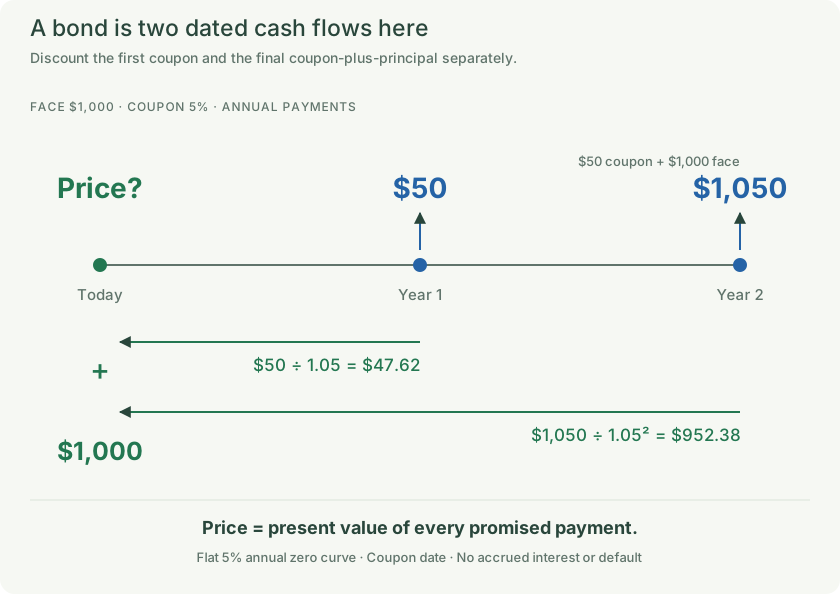
Locate each promised payment and bring both back to the pricing date.
The figure uses the stated original values. Editing a calculation does not change the illustration.
Exercise 4 — Combine the two dates
Discount $1,050 over two years at 5% annual compounding, then add the first coupon’s present value. Keep full precision inside the calculation. When the annual coupon rate equals a flat annual discount rate, this bond is priced at face value.
Exercise 5 — Raise discount rates without changing the promise
Reprice the same $50 and $1,050 payments using a flat 8% annual zero curve. Coupon and principal stay fixed. A higher discount rate reduces each present value, so the bond trades below its $1,000 face value.
Exercise 6 — Lower the curve instead
Keep the original payments and use a flat 3% annual zero curve. The bond’s 5% coupon exceeds this discount rate, so its present value exceeds face value. Compare the result with the 5% and 8% prices, rather than treating the coupon as a current return guarantee.
Read the picture
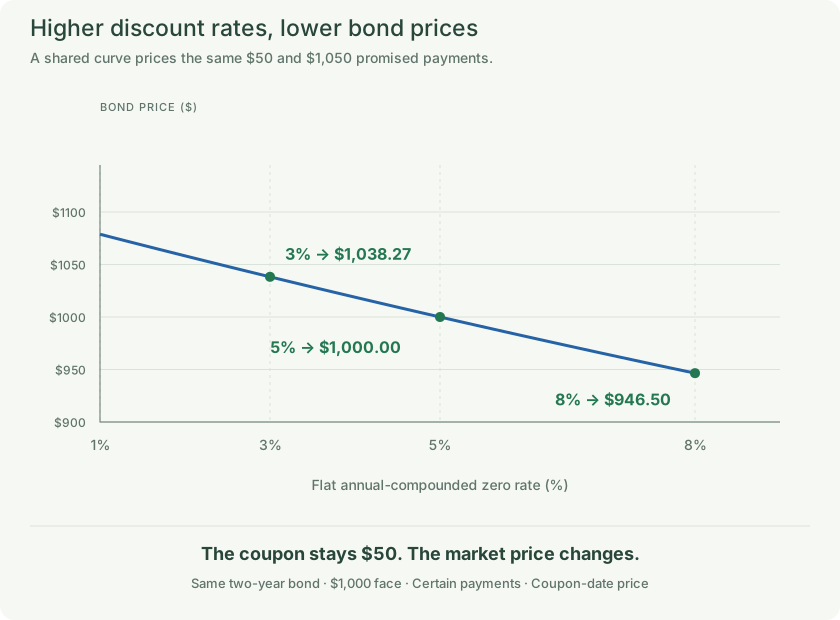
The same cash flows give a premium, par or discount price as the flat discount curve changes.
The figure uses the stated original values. Editing a calculation does not change the illustration.
Exercise 7 — Give each date its own zero rate
Now the one-year annual-compounded zero rate is 4% and the two-year zero rate is 6%. The 6% is an annual rate applied over both years to the maturity payment; it is not just the second year’s rate. Discount each cash flow with its own maturity’s zero rate.
Remember
A bond’s price comes from its dated cash flows. Coupon rate sets the payments; the zero curve discounts them. Face value and market price can differ.
All prices and rates are fictional teaching inputs. Keep full precision inside calculations and round only the final answer.