Compare buying today with agreeing to buy later
Earlier lessons chose a forward delivery price to explore payoffs. Now ask what delivery price would leave no arbitrage in a simple financing model. Use one unit of a fictional tradable investment asset worth $100 today. It pays no income and costs nothing to store.
Predict first, run the calculation, then make the requested change. Each calculation stands alone. Enter numeric answers without units. Round to two decimal places unless the check specifies otherwise; trailing zeros are optional.
How does financing determine a forward price?
Buying an asset now and financing it until delivery replicates receiving the asset through a forward. With spot price , a fixed continuous annual financing rate and time in years, the fair forward price is:
| Symbol | Full meaning | Base example |
|---|---|---|
| Price for buying the asset today | $100 per unit | |
| Continuous annual borrowing and lending rate | 5% = 0.05 | |
| Time until delivery, in years | 1 | |
| No-arbitrage delivery price for a new forward | About $105.13 per unit |
The model assumes executable matching trades, identical borrowing and lending rates, no income, storage costs, taxes, transaction costs, default or collateral funding costs. For reverse cash-and-carry, assume the asset can be borrowed and short-sold at no fee, the proceeds can be invested, and one identical unit can be returned at maturity.
If the quoted forward is too high, borrow, buy the asset and sell it forward. If it is too low, short the asset, invest the proceeds and buy it forward. Count both cash and asset obligations. This pricing relation is a replication result, not a forecast of the future spot price. Consumption commodities can require additional storage and convenience-yield treatment; the flour hedge examples do not automatically satisfy this model.
Exercise 1 — Finance today’s purchase
Borrow $100 today at a 5% continuous rate for one year and use it to buy one unit. Calculate the loan repayment at maturity. The interest belongs in the comparison even though the forward itself has no delivery payment today.
Exercise 2 — Shorten the financing period
Keep spot at $100 and the continuous annual rate at 5%, but make delivery six months away. Enter the time as 0.5 years. The quote should be closer to spot because financing lasts half as long.
Exercise 3 — Separate spot from the financed amount
Return to one year. Increase the spot price to $120 while keeping the continuous rate at 5%. The financing factor stays the same, but it now applies to a larger asset purchase. Do not add a fixed $5 interest amount regardless of spot.
Read the picture
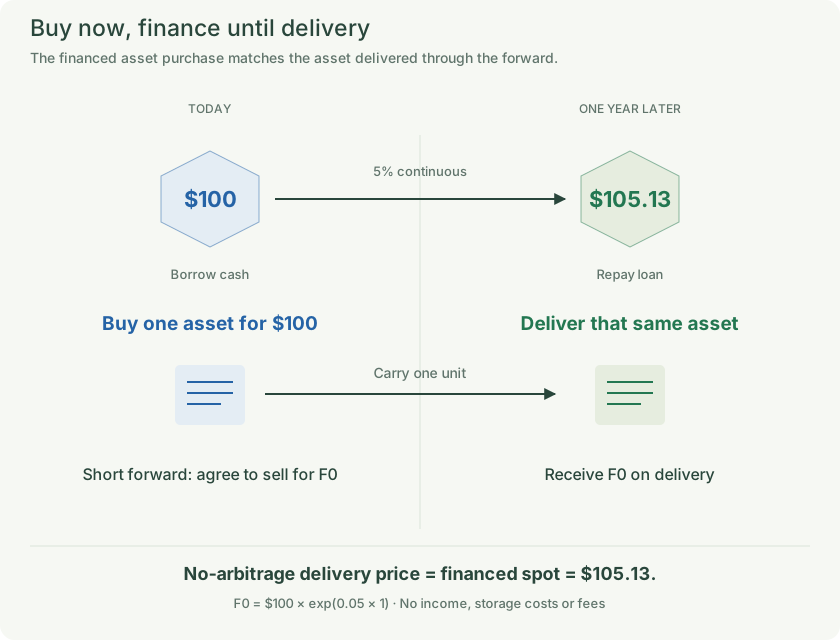
Trace the cash and the physical asset from a financed purchase to forward delivery.
The figure uses the stated original values. Editing a calculation does not change the illustration.
Exercise 4 — Sell an overpriced forward
Restore spot $100 and a one-year horizon. An executable forward quote is $108. Borrow $100, buy one asset and enter a short forward at $108. At maturity deliver that asset, receive $108 and repay the loan. The asset received today is the asset delivered later.
Exercise 5 — Check why no spot forecast was needed
Repeat the overpriced-forward cash calculation. Regardless of the eventual spot quote, the bought asset satisfies delivery and the short forward pays the agreed $108. This is different from merely buying now and hoping to sell at a higher unknown spot price.
Exercise 6 — Buy an underpriced forward
Instead the one-year forward quote is $102. Borrow and short-sell one asset for $100 today, then invest that $100 at 5% continuous compounding. Enter a long forward at $102. At maturity pay $102, receive one asset and return it to the asset lender. Keep the investment balance minus the delivery payment.
Read the picture
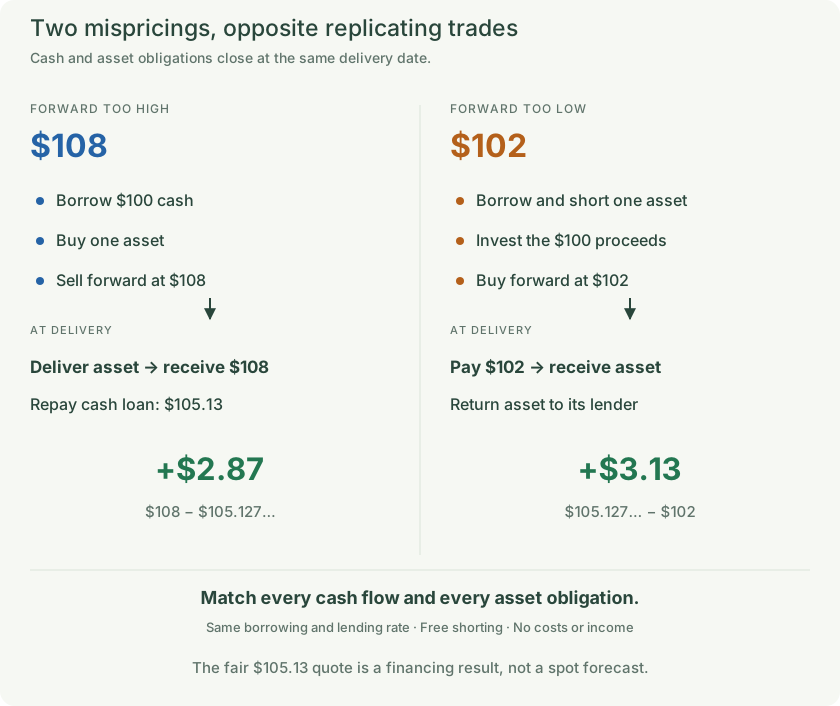
Compare overpriced and underpriced forwards, including the asset that must be delivered or returned.
The figure uses the stated original values. Editing a calculation does not change the illustration.
Exercise 7 — Remove financing and check the formula
At a zero rate, calculate the fair one-year forward price for a $100 asset with no income or storage cost. The financing factor becomes one. This boundary test also shows why a forward premium is not, by itself, a prediction of an asset-price increase.
Remember
For a no-income investment asset in this model, the forward price equals financed spot. Arbitrage requires executable trades and all cash and asset obligations to match.
All prices and rates are fictional teaching inputs. Keep full precision inside calculations and round only the final answer.