A fixed promise can gain or lose value
A forward’s delivery price stays fixed after agreement. The market’s fair delivery price for a new matching forward can change. Compare those two prices to find the value of the old promise today, before it settles. Use a no-income investment asset and the financing assumptions from the previous lesson.
Predict first, run the calculation, then make the requested change. Each calculation stands alone. Enter numeric answers without units. Round to two decimal places unless the check specifies otherwise; trailing zeros are optional.
What is the value of an existing forward?
| Symbol | Meaning | Existing-contract example |
|---|---|---|
| Fixed delivery price in the old contract | $105 per unit | |
| Current spot price | $110 per unit | |
| Remaining time to delivery, in years | 0.5 | |
| Current continuous annual rate for that time | 5% | |
| Fair delivery price for a new matching forward | ||
| Present value of one unit of the old long forward |
The long forward’s value per unit is:
The difference is due at delivery; discount it to value the contract today. The short’s value is . For units, multiply the per-unit value by .
A new forward struck at its fair delivery price starts with zero value in this model, even though its delivery price is positive. The example’s old dollars per unit is an already agreed term; it is not the unrounded $105.127… fair quote from the previous lesson.
Assume the same no-income asset, certain settlement, a fixed current rate over the remaining horizon, no fees or collateral funding effects, and the ability to take offsetting matching positions. This is a forward valued before a single settlement, not an extra payment on top of daily-settled futures gains. At maturity and long payoff is .
Map the formula to the contract
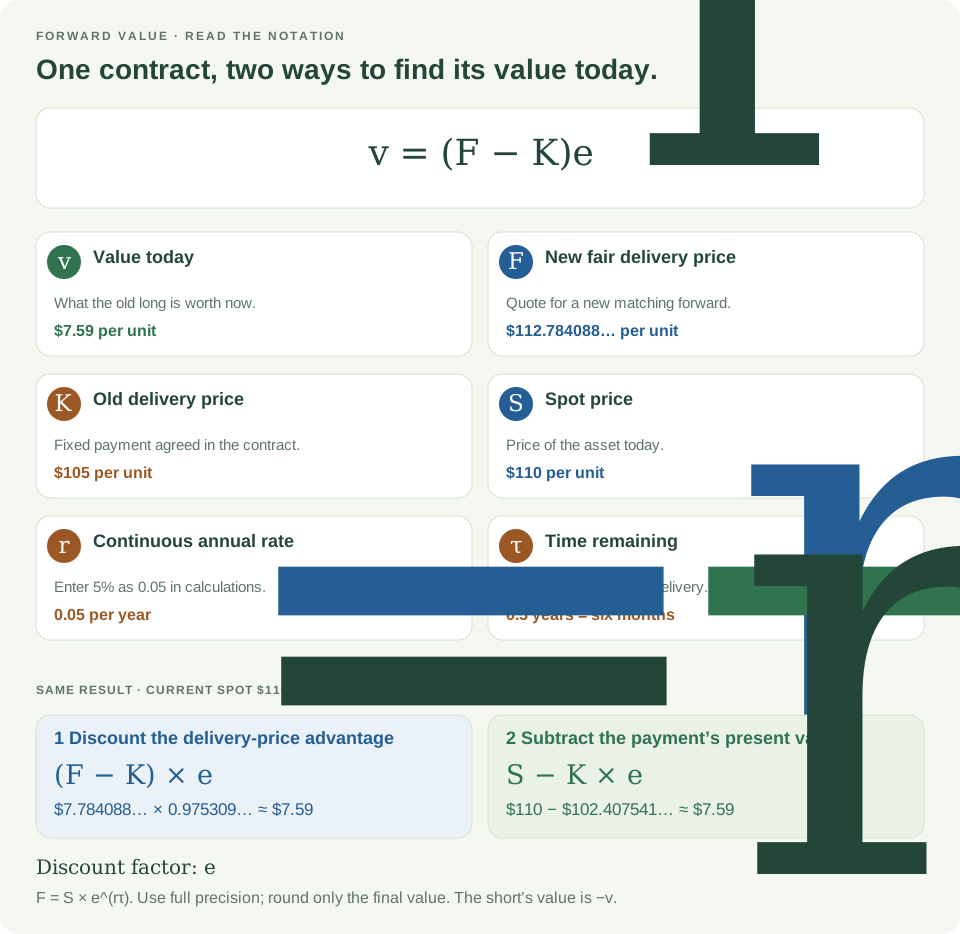
This diagram uses the existing-contract example: spot $110, fixed delivery price $105, and six months remaining.
Exercise 1 — Start a new contract at zero value
At inception spot is $100, the continuous rate is 5% and delivery is one year away. Use the exact fair delivery price inside the formula. Discounting that future obligation gives $100, which offsets the spot asset’s value. Avoid rounding the delivery price before the calculation.
Map the code to the formula
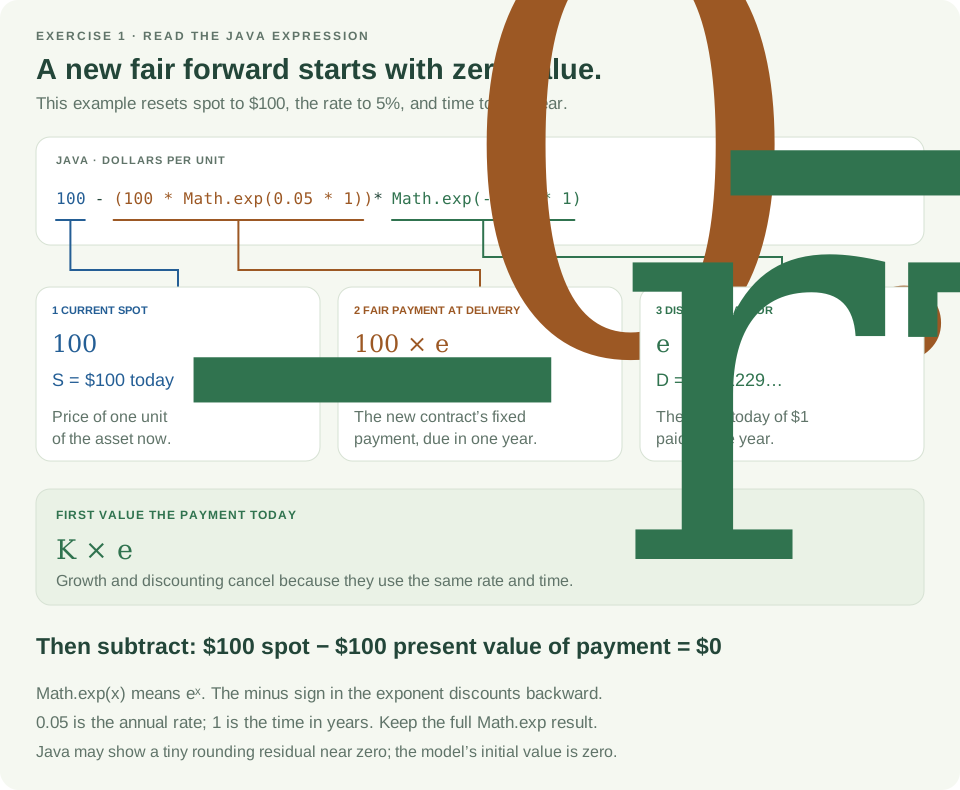
This diagram uses Exercise 1’s separate inception example: spot $100, a 5% continuous annual rate, and one year to delivery. The labels explain the original code; editing the code does not update the diagram.
Exercise 2 — Find a new quote for the remaining time
Now consider the old contract with K = $105. Current spot is $110, there are six months left, and the current continuous rate is 5%. Find the fair delivery price for a new contract with that same delivery date. This changes the market quote, not the old contract’s K.
Exercise 3 — Discount the fixed obligation
Value the existing long directly as current spot minus the present value of its $105 payment. At current rates that payment has present value about $102.41. Subtract this from $110. The value is positive because the old long receives an asset on favorable terms.
Read the picture
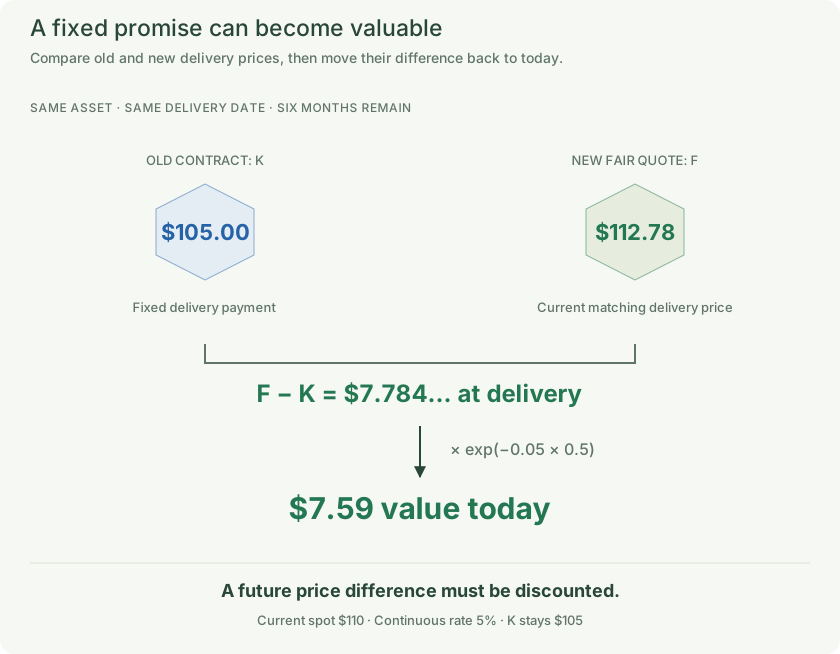
Keep the old delivery price fixed while comparing it with a new matching forward quote.
The figure uses the stated original values. Editing a calculation does not change the illustration.
Exercise 4 — Value the same promise through a matching quote
Subtract K = $105 from the exact new forward quote and discount the difference for six months. An offsetting short at the new quote would receive F and pay the asset that the old long receives, leaving F − K in cash at delivery. That difference is future cash, not today’s value.
Exercise 5 — Reverse the counterparty’s sign
Under the same conditions the old short must deliver for $105 while new matching forwards quote higher. Its value is the negative of the old long’s value. This sign reversal applies to the same contract terms and valuation date; do not change K or use a different maturity.
Exercise 6 — Change spot while holding the promise fixed
Keep K = $105, six months remaining and the current 5% continuous rate. Change spot to $90. The long must still pay $105 at delivery, so the old contract can now have a negative value. A long forward has an obligation, unlike the buying right in a call option.
Read the picture
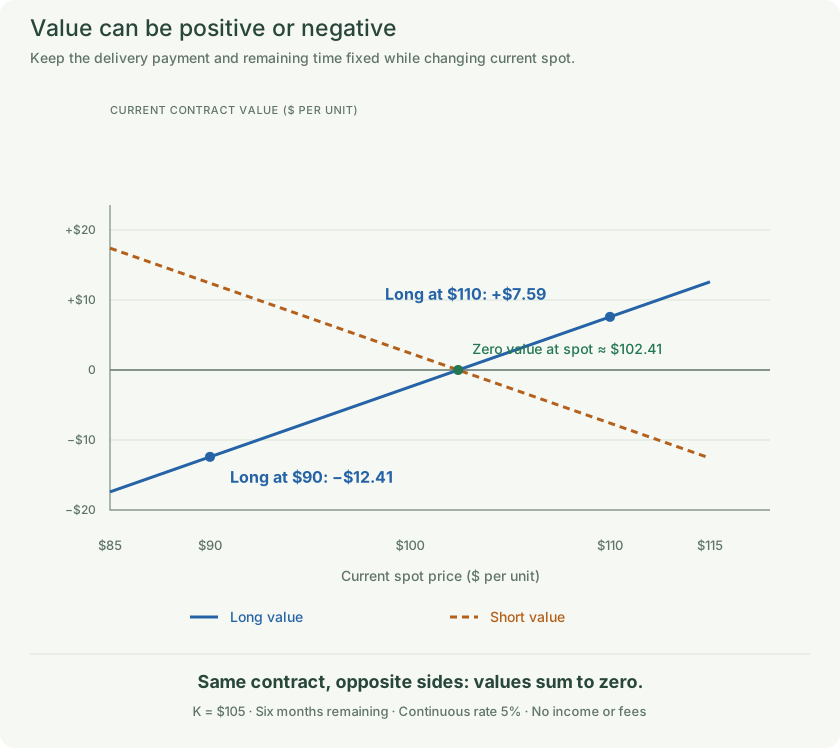
The long’s current value rises dollar for dollar with spot; the short has the opposite value.
The figure uses the stated original values. Editing a calculation does not change the illustration.
Exercise 7 — Let the remaining time reach zero
At maturity spot is $115 and K remains $105. Set the remaining time to zero, so the discount factor becomes one. Scale the per-unit payoff to ten units. This maturity scenario is separate from the earlier six-month valuation, not an additional amount to add to it.
Remember
Delivery price K is a fixed future payment. Forward quote F is the market’s current fair delivery price. Contract value v is their discounted difference, with a sign for the position.
All prices and rates are fictional teaching inputs. Keep full precision inside calculations and round only the final answer.