Read a futures market screen
The bakery now knows how a futures hedge works. Its broker displays several prices, quantities and contract months. Reading the wrong field can change the apparent cost or profit before a trade even starts. Learn which numbers describe an executable trade, which update an account and which count activity.
Predict before running each calculation. Every cell stands alone. Make the requested edit before answering when an exercise specifies one. Enter numeric answers without units; round to two decimals unless stated otherwise. The calculations explain market mechanics, not a trading strategy.
What does a futures market screen tell you?
| Field | Meaning in our fictional flour market |
|---|---|
| Contract | 25 bags of one grade, quoted in dollars per bag |
| Tick | Minimum allowed price increment: $0.10 per bag |
| Bid / ask | $21.20 / $21.40 for the stated available quantity |
| Last trade | $21.60; a past execution, not a promise of execution now |
| Daily settlement | $21.30; the price used in our daily account update |
| Open interest | 800 outstanding contracts before the example trades |
| Volume | Contracts traded during the session, not positions still open |
Cash per tick per contract = tick size × contract quantity. Buying immediately uses the ask and selling immediately uses the bid, provided enough quoted quantity remains available. A spread is a cost of crossing those quotes, not a broker commission.
Each open contract has one long and one short, yet open interest counts it once. If both sides open new positions, open interest rises; if both close, it falls; if one opens and the other closes, it stays unchanged. Every executed contract adds one to volume in this lesson. Volume alone cannot reveal a change in open interest.
Hedgers, speculators, market makers and arbitrageurs may trade the same listed contract. A screen cannot reveal their motives. A row for another maturity is another contract: comparing its quote with the near month gives a price difference, not an automatic estimate of future spot.
Scenario and assumptions
All specifications and prices are fictional. Quotes in a calculation have sufficient size and remain available unless stated otherwise. We exclude fees, interest and slippage. A long four-contract account uses yesterday’s settlement of $21.00, not the last traded price. Open-interest examples are separate sessions starting at 800.
Exercise 1 — Value one tick
The tick is $0.10 per bag and one contract contains 25 bags. Multiply the price increment by the quantity. This is the smallest price-move P&L per contract, not its full notional value.
Exercise 2 — Cross the spread for several contracts
Buy four contracts at the $21.40 ask and immediately sell at the unchanged $21.20 bid. The displayed positive number is the spread cost. Run the cell, then change the contract count from 4 to 6. This edit changes quantity, not the quoted spread.
Exercise 3 — Use settlement rather than the last trade
The long account holds four contracts. Yesterday’s settlement was $21.00 and today’s official settlement is $21.30. The last trade of $21.60 is deliberately different. Calculate today’s variation cash from settlement to settlement.
Read the picture
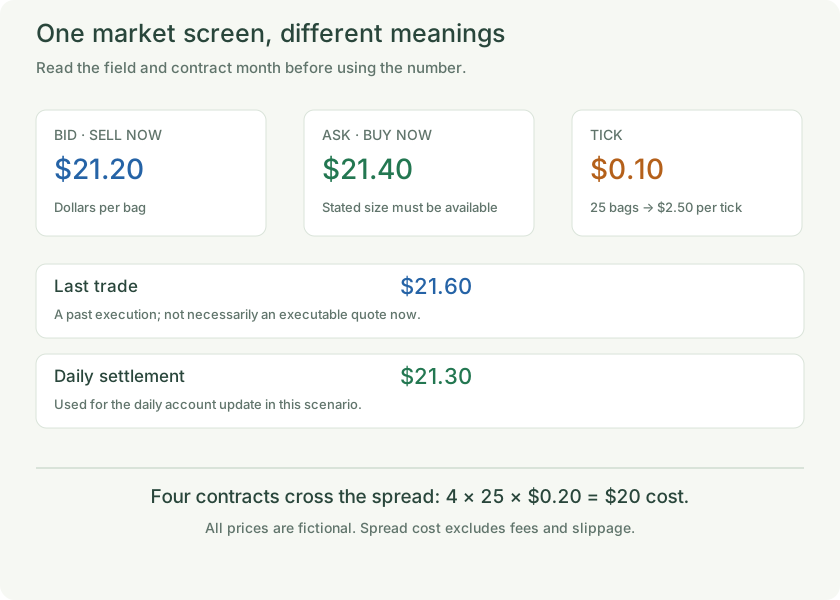
A fictional quote card separates bid, ask, last trade and settlement; crossing a $0.20 spread on 100 bags costs $20.
This illustration uses the stated worked example. Editing a calculation does not update the figure.
Exercise 4 — Count new positions once
Open interest starts at 800. A new buyer opens ten longs against a new seller opening ten shorts. Ten contracts trade. Add ten to open interest, not twenty: each contract already has two sides.
Exercise 5 — Transfer a position without creating another contract
Start again at 800. An existing long closes ten contracts by selling to a new long; the original shorts stay open. Ten contracts trade, but no outstanding contract is added or removed. The code displays the resulting count.
Exercise 6 — Close both sides
Start again at 800. An existing long sells ten to an existing short who is buying to close. Both positions disappear. Count ten trades in volume and remove ten outstanding contracts.
Read the picture
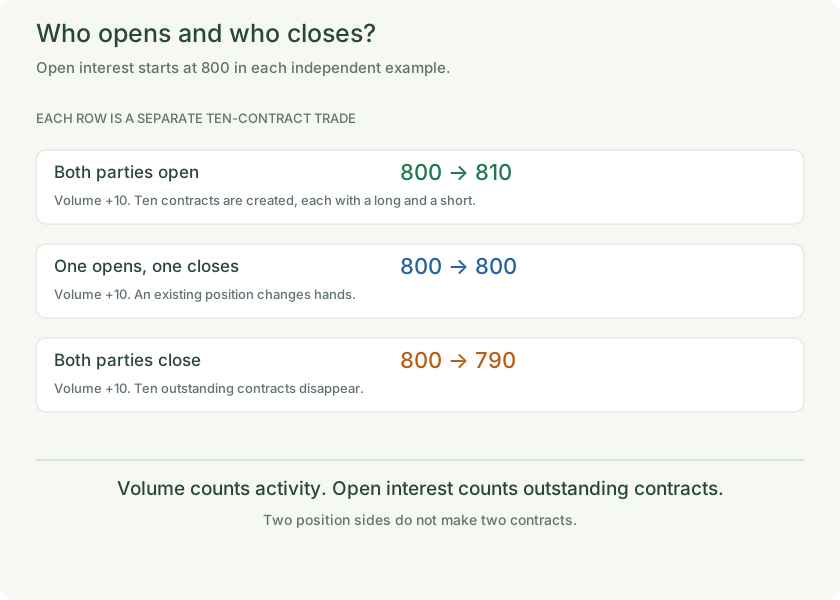
Ten executed contracts add ten to volume; open interest rises, stays unchanged or falls depending on whether both parties open, transfer or close.
This illustration uses the stated worked example. Editing a calculation does not update the figure.
Exercise 7 — Read two maturities without inventing a forecast
The near-month quote is $21.40 and a later-month quote is $22.10, in the same units. Calculate later minus near. The bakery wants flour in the later month; that date, storage and other contract terms matter alongside the price.
Remember
Name the field before using the number. Tick value converts quote units into cash; bid/ask shows executable sides; settlement updates the account. Volume counts trades, while open interest counts outstanding contracts once. Market data alone does not reveal a participant’s purpose or a future spot price.