Choose an order and understand its limits
A sensible hedge can still be executed badly. An order tells a broker what to do and under which conditions; it cannot force another trader to provide liquidity. Follow the bakery’s orders through a small market and separate protection against a bad price from certainty of getting a trade.
Predict before running each calculation. Every cell stands alone. Make the requested edit before answering when an exercise specifies one. Enter numeric answers without units; round to two decimals unless stated otherwise. The calculations explain market mechanics, not a trading strategy.
What does an order instruction control?
| Instruction | Our fictional execution rule | What it does not promise |
|---|---|---|
| Market buy | Take available asks, starting with the lowest | A fixed price or complete execution in an empty book |
| Buy limit | Buy only at or below the limit | That enough sellers will appear |
| Buy stop-market | A qualifying trade at/above the trigger releases a market order | Execution at the trigger price |
| Buy stop-limit | The trigger releases a buy limit order | Execution if prices gap above the limit |
A sale reverses the relevant price inequalities. Stop-trigger definitions and order handling are venue-specific; the rules above are the entire rulebook for these examples.
A price limit restricts allowed prices during a session; it is not insurance against loss. At a limit there may be no liquidity to close a position. A position limit restricts the outstanding position under specified aggregation rules; it is different from contract size or order quantity.
Average fill price = sum of (filled contracts × price) / filled contracts. Apply the 25-bag multiplier afterward to translate a quoted-price difference into cash. Keep filled and unfilled quantities separate.
Scenario and assumptions
Use 25-bag flour contracts, no fees, no competing orders and no hidden liquidity. Each exercise is a separate market snapshot. Stops trigger from trades, not quotes. Orders remain active only as described. All price and position limits are fictional instructional rules, not current exchange specifications.
Exercise 1 — A market order walks the book
The visible asks are two contracts at $21.40 and three at $21.60. Buy four immediately. Two fill at each price; the last displayed ask is not the price of the whole order. Calculate the average dollars per bag.
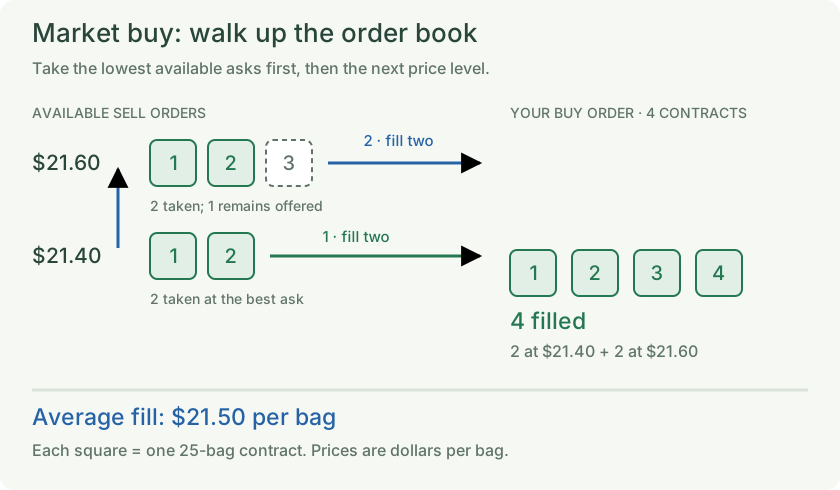
The diagram uses this exercise’s fixed snapshot; editing code does not update it.
Exercise 2 — Count a partial limit fill
Use the same asks. A four-contract buy limit at $21.40 can take only the two contracts offered at that price. The remainder stays unfilled in this snapshot. The code counts the remaining contracts.
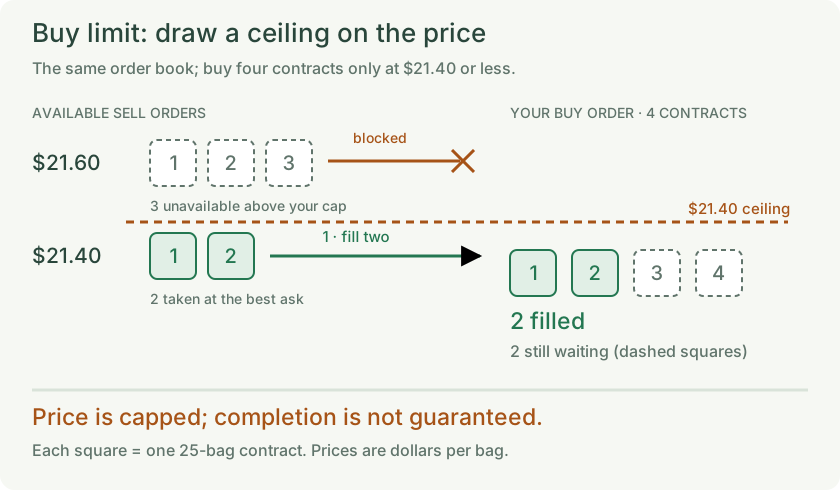
The diagram uses this exercise’s fixed snapshot; editing code does not update it.
Exercise 3 — Change the limit, then calculate the extra cost
With that unchanged book, raising the buy limit from $21.40 to $21.60 allows the remaining two contracts to fill at $21.60. Compare the four-contract average of $21.50 with the original best ask of $21.40. Then change quantity from 4 to 6 only as a cost-scaling thought experiment; this cell does not claim the book can fill six.
Exercise 4 — A stop-market can jump past its trigger
A bakery is short four contracts and uses a buy stop-market triggered at $22.00. The next trade jumps from $21.80 to $22.50. The trigger fires and the available ask for all four contracts is $22.60. Calculate the extra closing cost relative to assuming a $22.00 fill.
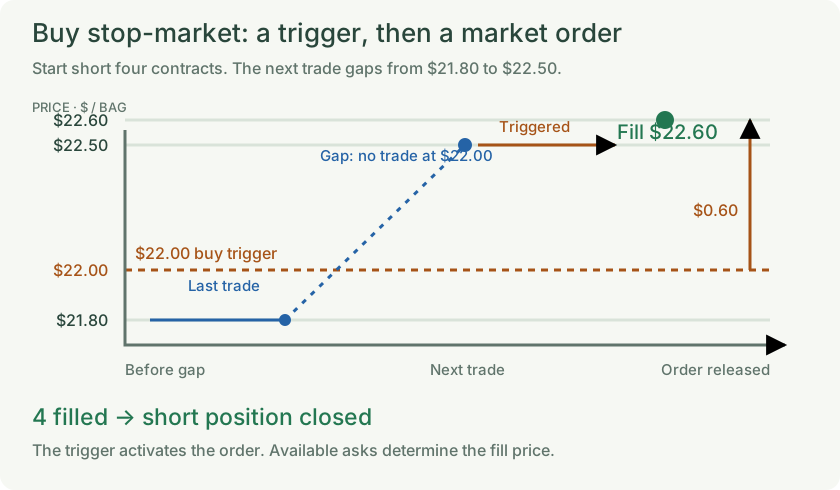
The diagram uses this exercise’s fixed snapshot; editing code does not update it.
Exercise 5 — A stop-limit can leave the hedge open
Replace that stop with a $22.00 buy trigger and a $22.20 limit. The next trade is still $22.50 and the best ask is $22.60. The released limit order cannot execute. The code counts the contracts still short.
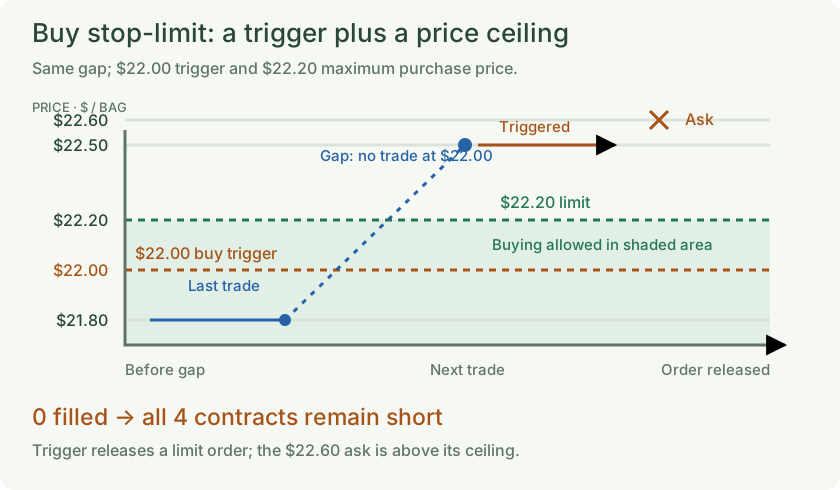
The diagram uses this exercise’s fixed snapshot; editing code does not update it.
Exercise 6 — A daily price limit is not exit liquidity
The short four-contract position entered at $21.00. Today the fictional upper price limit is $23.00, and buyers queue there with no sellers. Settlement reaches $23.00. Calculate the short’s daily loss from the $21.00 prior settlement; the inability to buy does not prevent the account debit.
Exercise 7 — Check a position limit before sending the order
Our fictional broker permits at most twelve net long contracts in this account. The bakery holds nine and requests five more. Ignore exemptions and aggregation across other accounts. Calculate how many additional longs fit under this rule.
Remember
Market orders face price and liquidity risk; limit orders face nonexecution risk. Stops are triggers, not guaranteed prices. Price limits and position limits constrain trading in different ways. Always inspect the remaining position after a partial fill or failed exit.