Deliver the asset or settle in cash
Closing a future before expiry is common, but the final contract terms still matter. They connect the futures price to something that can actually be delivered or paid. Follow a fictional flour contract into its delivery window, then compare it with a cash-settled index future.
Predict before running each calculation. Every cell stands alone. Make the requested edit before answering when an exercise specifies one. Enter numeric answers without units; round to two decimals unless stated otherwise. The calculations explain market mechanics, not a trading strategy.
What is settled when a future expires?
| Physical flour future | Cash-settled index future |
|---|---|
| A short delivers the specified quantity, acceptable grade and location | No basket of physical assets changes hands |
| A delivery notice must meet the contract’s timing rules | The final reference value determines the final settlement |
| The buyer pays the contract’s invoice amount | Only the remaining daily settlement cash is posted |
| Any grade/location adjustments must be part of the specification | Multiplier converts index points to money |
The contract specification determines what counts as acceptable delivery. For this lesson, we invent the flour contract terms listed below. Its April dates and notice period are assumptions for the example; they are not rules for all futures contracts.
Remaining long settlement = contracts × quantity × (final settlement − previous settlement). For a physically delivered contract, the final invoice is an additional asset purchase cash flow, not another copy of the entry-to-final derivative P&L.
Convergence concerns the matching deliverable and contractual delivery terms. A local spot quote for another grade, place or date can retain a gap. If alternatives are permitted, the short’s ability to choose quality, location or timing can have value; delivery costs and invoice adjustments determine the cheapest choice, not the lowest asset price alone.
Our fictional flour contract
Read these terms as a short contract specification. The April 21–30 window is chosen for this example; it is not calculated from the notice date.
| Term | Rule for this lesson |
|---|---|
| Quantity | 25 bags per contract |
| Grade | Grade A, or Grade B at a $0.40-per-bag invoice discount |
| Place | Approved central warehouse |
| Delivery window | April 21 through April 30, including both dates |
| Notice | At least two calendar days before delivery; ignore holidays |
The delivery window tells us when the asset may arrive. The notice period tells us how far in advance the short must notify the buyer. Both conditions must hold. For example, April 23 notice for April 25 delivery meets both; April 29 notice for May 1 delivery gives two days’ notice but falls outside the delivery window.
The bakery is long four contracts entered at $21.00 per bag. Previous settlement is $22.50 and final settlement is $23.00 per bag. We ignore fees, storage, funding and default unless a delivery cost is stated. The separate cash-settled index example uses a $10-per-point multiplier.
Exercise 1 — Translate delivery into physical units
The bakery leaves four flour futures open into delivery. Each requires 25 bags. Margin previously posted is collateral and does not reduce the number of bags delivered.
Exercise 2 — Apply a permitted grade adjustment
Grade B may be delivered with a $0.40-per-bag invoice discount from the $23.00 final settlement. Calculate the invoice for 100 bags. This discount compensates under the stated contract rule; it is not a freely chosen buyer deduction.
Exercise 3 — Check the notice and delivery window
Use the two timing rules in our fictional specification: delivery must fall within April 21–30 inclusive, and the short must give at least two calendar days’ notice.
For notice on April 23 and delivery on April 25:
- Delivery window: April 25 is between April 21 and April 30.
- Notice period: 25 − 23 = 2 days, meeting the minimum.
The calculation below measures the notice period in days. Run it, then change the delivery day from 25 to 24, keeping the notice day at 23. Check both rules again: moving delivery earlier can shorten the notice period even when delivery stays inside the permitted window.
Read the picture
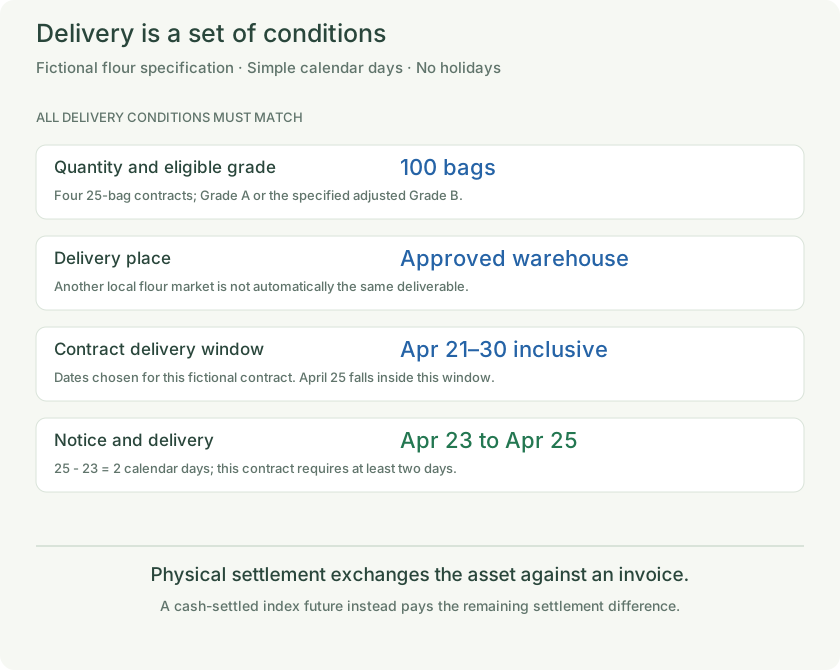
The April 21–30 window comes from our fictional contract specification. April 23 notice for April 25 delivery meets both timing conditions. Moving delivery to April 24 still meets the window rule but leaves only one day of notice.
This illustration shows the original April 25 proposal. Editing a calculation does not update the figure.
Exercise 4 — Finish only the remaining daily settlement
The long’s previous settlement was $22.50 and the final one is $23.00. Most gains from its $21.00 entry have already arrived. Calculate just the last daily payment on 100 bags.
Exercise 5 — What did the flour cost after the futures gain?
The bakery pays $2,300 for 100 bags of Grade A flour. It has also received $200 in total futures gains. Subtract that gain from the invoice to find the cost after the hedge.
Cost after the hedge = flour invoice − total futures gain.
Exercise 6 — Use a cash settlement when there is no delivery
A separate long holds two fictional index futures. The previous settlement is 2,010 points and the final reference value is 2,025. The multiplier is $10 per point. No shares are delivered. Run the original calculation, then change only the final reference from 2025 to 1990.
Read the picture
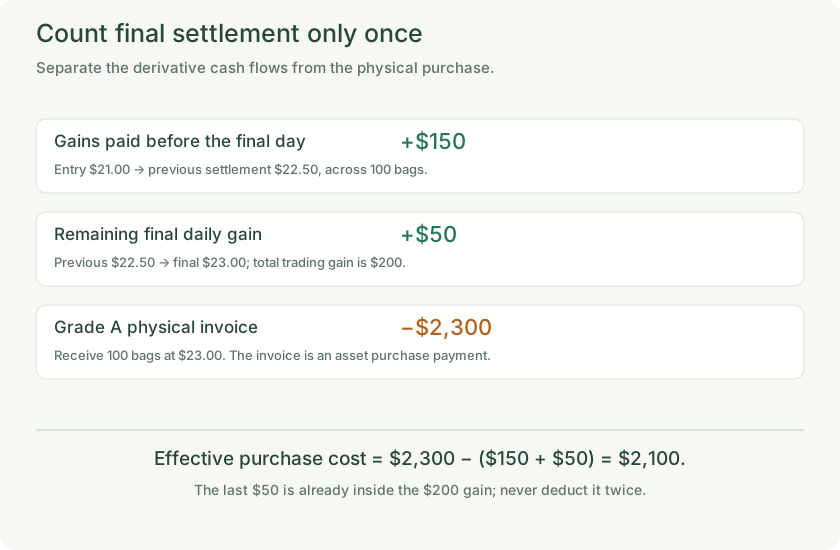
The Grade A buyer pays a $2,300 invoice and receives $200 total futures gains, of which $50 arrives on the last day; effective cost is $2,100.
This illustration uses the stated worked example. Editing a calculation does not update the figure.
Exercise 7 — Compare the short’s permitted delivery choices
Grade A costs the short $22.70 per bag delivered to the approved warehouse and invoices at $23.00. Grade B costs $22.10 there and invoices at $22.60 after adjustment. Calculate Grade B’s delivery margin minus Grade A’s for 100 bags. Ignore any earlier futures P&L, which is the same for this comparison.
Remember
Read quantity, grade, place, notice and date from the contract specification. Check the delivery window and the minimum notice period separately; the dates in this lesson belong to our fictional example. Daily settlement pays the derivative’s cumulative gain in installments. Physical delivery also exchanges an asset for the invoice; cash settlement does not. Match all terms before making a convergence argument, and value the short’s permitted choices using net delivered economics.