Who stands between the buyer and seller?
The bakery trades through a broker, but the broker may not be the institution guaranteeing settlement. Map the chain of promises before assuming that margin or a clearing house makes a trade riskless. Then compare a direct bilateral contract with an explicitly assumed netting and collateral arrangement.
Predict before running each calculation. Every cell stands alone. Make the requested edit before answering when an exercise specifies one. Enter numeric answers without units; round to two decimals unless stated otherwise. The calculations explain market mechanics, not a trading strategy.
Who owes whom after a trade?
In the centrally cleared example, the bakery is a client of a broker that uses a clearing member. The clearing member faces the central counterparty (CCP), which stands between it and the opposite clearing member. Novation replaces the original matched contract with CCP-facing obligations under the assumed rules. The bakery still has its own client relationship; it does not automatically become a direct CCP member.
In a bilateral OTC example, two named firms remain each other’s counterparties. They may agree collateral and closeout netting without transferring the trade to a CCP. Custom terms do not themselves prevent central clearing; eligibility and the actual arrangement matter.
| Measure | Meaning in this lesson |
|---|---|
| Current replacement value | Cost/value of replacing a contract at current market terms |
| Positive exposure | max(value owed to us, 0), before stated mitigants |
| Netting set | Trades legally permitted to be combined on default under our assumption |
| Collateral haircut | Reduction in the credited value of posted assets |
| Residual exposure | Positive net amount remaining after usable collateral |
The simplified unsecured exposure is:
Here, is the net replacement value and is the usable collateral.
This is not a complete future-loss model. Delays, closeout disputes, market moves, segregation and access to collateral can change realized recovery.
Clearing collects margin and has default-management resources; it redistributes and manages risk rather than abolishing it. Client, member, custodian, liquidity and CCP risks can remain. The sequence and availability of resources must be specified before using a default waterfall.
Scenario and assumptions
All collateral and waterfall rules below are hypothetical. For the bilateral examples assume enforceable same-counterparty closeout netting, immediately usable cash collateral and no other recovery; trades with other firms cannot enter this set. For the waterfall, apply only the explicitly listed resources. The figures are exposures or resources at one moment, not a probability-weighted CVA.
Exercise 1 — A negative value is not a receivable
A bilateral forward has current value −$120 to the bakery. Its positive exposure is max(value, 0). It owes value rather than being owed value. This does not measure how its exposure may change tomorrow.
Exercise 2 — Compare gross positive values with enforceable netting
Two trades with the same firm are worth +$300 and −$180 to the bakery. A gross positive-value view counts $300; under our netting assumption the combined replacement value is $120. Calculate the reduction in current positive exposure.
Exercise 3 — Subtract usable collateral, not the original notional
The net replacement value is +$120 and the bakery holds $100 usable cash collateral from the counterparty. Calculate unsecured exposure. Then change the collateral from 100 to 70 while leaving market value fixed.
Read the picture
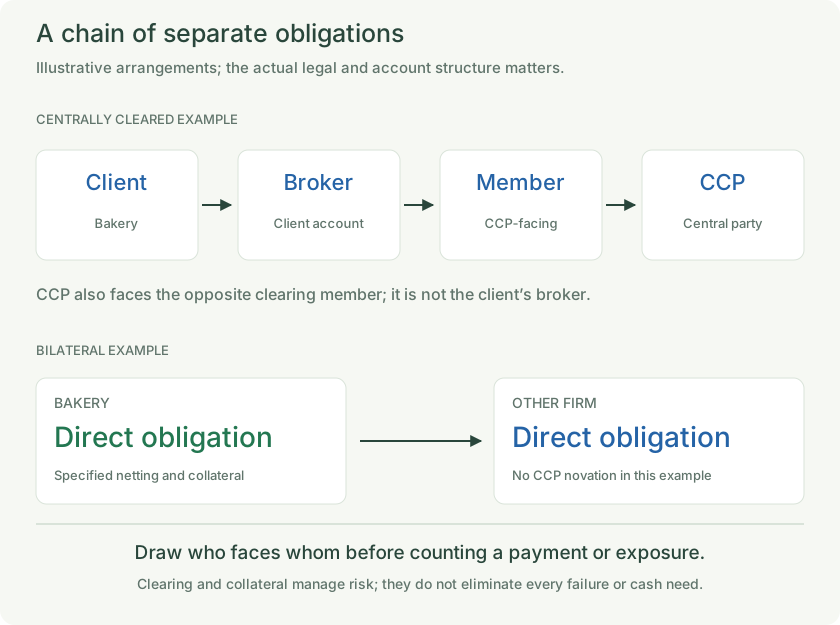
The client, broker, clearing member and CCP have distinct obligations; a bilateral trade instead retains the direct counterparty relationship.
This illustration uses the stated worked example. Editing a calculation does not update the figure.
Exercise 4 — Follow a cleared variation-margin payment
The bakery’s cleared long four flour futures lose $2 per bag at settlement. Each contract covers 25 bags. The bakery must fund its broker-facing account under the stated arrangement; the broker/member then meets its own clearing obligation. Calculate the bakery’s signed settlement cash.
Exercise 5 — Use only the resources in a stated default waterfall
A defaulting member leaves a $90 closeout loss. Our fictional waterfall first uses its $50 initial margin, then its $15 default-fund contribution, then $10 designated CCP capital. Calculate loss remaining before any mutualized resources.
Exercise 6 — A haircut changes credited collateral
A member posts securities with market value $200. Under a fictional 10% haircut, credited collateral is value × (1 − haircut). This provides a buffer against liquidation changes but cannot guarantee the securities keep their value.
Read the picture
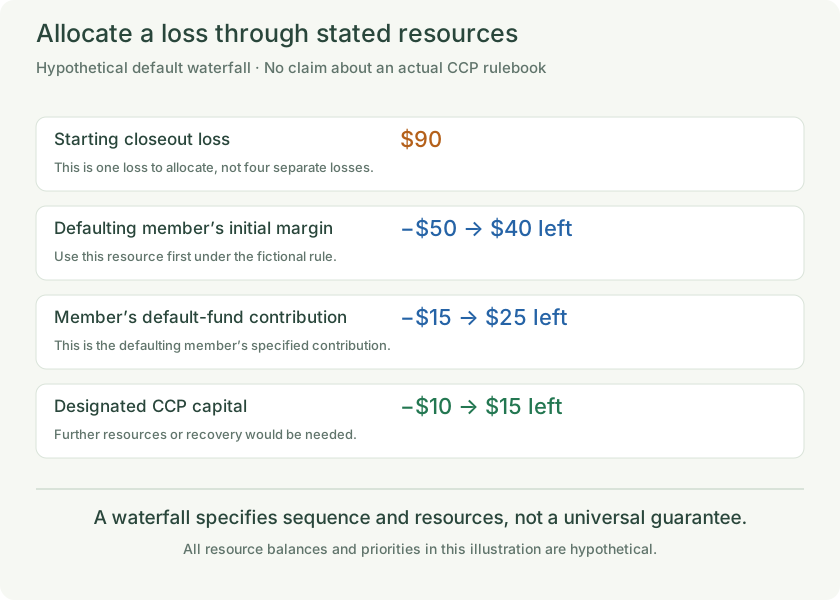
A $90 closeout loss consumes $50 member margin, $15 member default-fund resources and $10 CCP capital, leaving $15 before further resources.
This illustration uses the stated worked example. Editing a calculation does not update the figure.
Exercise 7 — Stress the gap after a collateral call
At the last margin exchange the net receivable and usable cash collateral were both $120. Before closeout the receivable rises to $175 and no more collateral arrives. Compute the shortfall. Consider client/member failure, collection delay and CCP concentration rather than declaring the structure safe.
Remember
Draw the obligations before calculating exposure. Netting needs a specified enforceable set, collateral needs a usable value and a default waterfall needs explicit resources and priority. Margin reduces some credit exposure while creating liquidity demands. A CCP manages and concentrates obligations; participants still face residual risks.