One economic position, different cash-flow records
A hedge can have a positive economic result while an account needs more cash. It can also produce different reported numbers when recognition dates differ. Build separate ledgers for economic gains, settlement cash, collateral and an illustrative reporting policy. The aim is reconciliation: every dollar belongs somewhere, but it should be counted only once.
Predict before running each calculation. Every cell stands alone. Make the requested edit before answering when an exercise specifies one. Enter numeric answers without units; round to two decimals unless stated otherwise. The calculations explain market mechanics, not a trading strategy.
Which ledger answers which question?
| Ledger | Question | What is not automatically profit? |
|---|---|---|
| Economic P&L | How much did the position gain or lose? | Investor contributions |
| Settlement cash | When were contract gains/losses actually paid? | A still-unpaid forward receivable |
| Collateral funding | How much own cash was tied up and later returned? | Initial margin and top-ups |
| Business cash flow | What did the underlying purchase or sale cost? | Futures notional as an upfront asset payment |
| Illustrative reporting | When does a stated policy recognize an amount? | Cash flow merely because it occurred |
For a no-interest futures account:
A withdrawal can include returned collateral, so it cannot all be labeled profit. For a forward settling once, a positive pre-settlement value is not necessarily cash already available.
The effective purchase cost is:
A futures final daily gain is part of total hedge gain, not an extra gain to deduct again.
Hedge designation documents the relationship, objective and measurement method under an applicable reporting framework. Economic protection alone does not guarantee any particular accounting treatment. Timing differences and ineffectiveness can leave reported earnings volatile. Tax treatment also depends on instrument, entity and jurisdiction. The reporting and tax rules below are deliberately fictional calculations, not advice about any actual standard.
Scenario and assumptions
Separate scenarios all use explicitly fictional rules. For the account example start with $600 collateral, add $200 and incur a $100 trading loss, leaving $700 before withdrawal. Exclude interest except exercise 5. For the reporting example alone, recognize derivative gains immediately in the default policy, but defer $100 of a $120 gain under a fictional documented-hedge policy. For the tax-reserve example alone, reserve 20% of a realized $200 hedge gain immediately and give no same-day reserve reduction for inventory cost. These policies illustrate timing only.
Exercise 1 — A forward gain can still be unpaid
A single-settlement long forward fixes $21 per bag for 100 bags. At maturity the matching market price is $23. Compute the economic payoff. Until settlement the amount may be a receivable, and delivery can exchange assets for $2,100 rather than separately transfer a $200 gain.
Exercise 2 — Reconcile daily futures gains
A separate long four 25-bag futures enter at $21, then settle at $22, $20 and $23. Add signed daily changes. The final day’s $300 gain offsets the prior net $100 loss; it is not the total holding-period profit by itself.
Exercise 3 — Contributions explain the account balance
In the separate collateral account start with $600, contribute another $200 and lose $100 through settlement. The ending account is $700. Recover trading P&L by subtracting total own contributions from the ending balance.
Read the picture
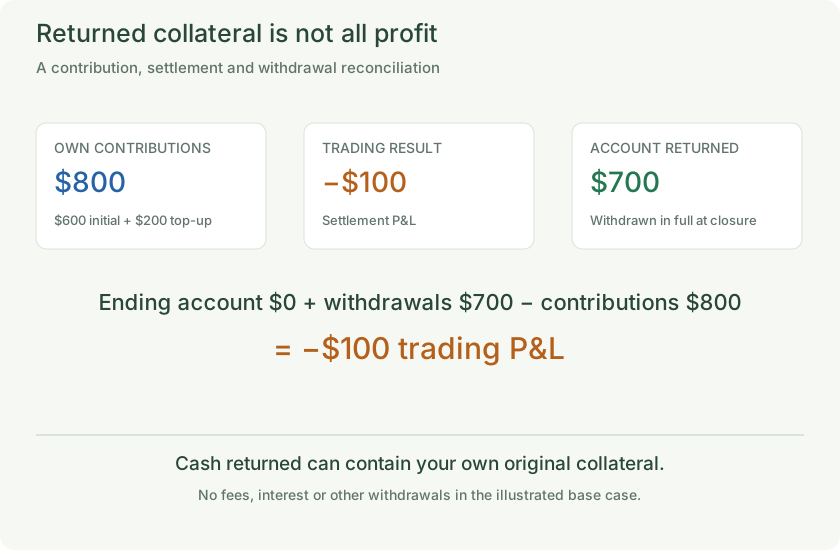
The same account has $800 total contributions, a $100 trading loss and a $700 final withdrawal; returned collateral is not a $700 profit.
This illustration uses the stated worked example. Editing a calculation does not update the figure.
Exercise 4 — Returned collateral is not a second gain
Withdraw all $700 from that account and close it at zero. Use ending balance plus withdrawals minus contributions. Run the cell, then change withdrawals from 700 to 650, keeping the ending balance at zero; the extra $50 is a stated closing fee in this edited scenario.
Exercise 5 — Fund collateral over time
A $600 initial deposit is tied up for 30 days and a later $200 top-up for 10 days. Borrow both at a stated 6% simple annual rate on a 360-day year, with no collateral interest received. Calculate funding cost, separate from trading P&L.
Exercise 6 — Compare a reporting policy with the economic result
In this separate fictional reporting example the hedge gains $120 while the forecast purchase has not yet entered earnings. The default policy recognizes $120 now. A documented-hedge policy defers $100 and recognizes $20 now as ineffectiveness. The code computes current recognized earnings under that stipulated policy, not under a real standard.
Read the picture
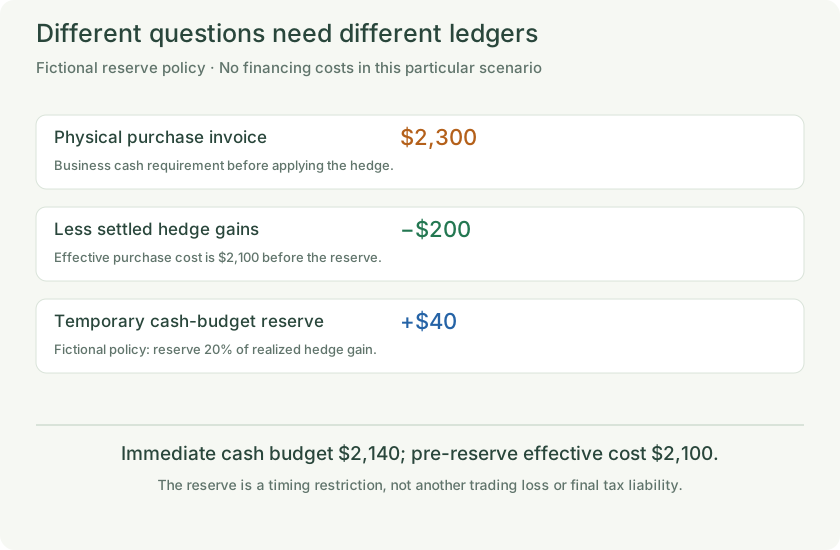
A $2,300 invoice minus $200 settled hedge gain gives $2,100 effective cost; a fictional $40 reserve raises the immediate cash budget to $2,140.
This illustration uses the stated worked example. Editing a calculation does not update the figure.
Exercise 7 — Combine business cash, hedge cash and a timing reserve
Return to the separate $200 futures-gain scenario with a $2,300 physical invoice. Before financing or tax reserve, effective cost is $2,100. Our fictional cash-budget policy also reserves 20% of the realized gain immediately. The reserve restricts spendable cash now; it is not another trading loss or a statement of final tax liability.
Remember
Reconcile economic P&L, actual settlement, collateral principal, funding interest and the business invoice separately. Reporting and tax timing may differ from both value and cash. A documented hedge needs stated rules and effectiveness measurement; its label does not make losses or funding needs disappear.