Forward prices when the asset pays income
Buying an asset now may bring more than the asset at delivery: the owner can receive cash along the way. A forward buyer normally receives neither those earlier payments nor their reinvestment. Extend the financing ledger from the no-income asset to a precisely dated distribution, and keep the old contract’s fixed delivery price separate from a new fair quote.
Predict first, then run each standalone calculation. Make a requested edit only in the named cell: other exercises retain their own stated inputs. Enter numbers without currency symbols or units, rounded to two decimals unless the check asks for four. None of the model prices is a forecast or a trading recommendation.
How does known cash income affect a forward?
| Symbol | Meaning in the example |
|---|---|
| Current asset price, $100 per unit | |
| and | Known $4 cash distribution in half a year |
| Forward delivery in one year | |
| Constant continuous annual financing rate, 5% | |
| Present value of distributions paid after today and before delivery | |
| Fixed delivery price in an existing contract, $102 |
The present value of the dated distributions is:
Here each is paid at time before delivery. The fair new forward is:
For a current long with the same remaining dates, . The short has value . Distribution dates and delivery entitlements must be specified; this example pays the distribution strictly before delivery.
The owner of a financed asset receives $4 at the intermediate date. Reinvesting it to delivery reduces the debt left to cover through the sale. Equivalently, finance only until the distribution date and use that payment to repay its short loan, while financing to delivery. The two loans together fund the full spot purchase . Do not subtract a future $4 directly from today’s $100 without discounting it.
After a distribution is paid, remove it from remaining . Use the then-current ex-distribution spot price and remaining maturity; do not keep an old dividend subtraction as well. Unknown distributions require estimates and can leave replication risk.
Cash-and-carry sells an expensive forward against a financed owned asset. The reverse trade shorts the asset, invests proceeds and buys the forward; the stock borrower must compensate the lender for the distribution. Free, reliable short borrowing and usable proceeds are assumptions, not consequences of the formula.
Scenario and assumptions
A fictional freely tradable investment asset pays a certain $4 at and delivers at . Use one unit, a flat 5% continuous borrowing/lending rate, no fees, default or taxes. Short-sale borrowing is available at no fee except in exercise 7, which explicitly removes it. The later ex-distribution snapshot in exercise 6 is a new valuation date; its spot price is an input, not a prediction from the first snapshot.
Exercise 1 — Discount the dated distribution
Find today’s value of the $4 paid six months from now. Its present value is smaller than $4 at a positive rate. This is for the one-year forward, because the payment falls before delivery.
Exercise 2 — Price a new forward with the distribution included
Remove the present value of the distribution from current spot, then finance the remainder to delivery. Compare the result with , the no-income forward. The forward buyer’s missing cash benefit explains why the income-paying asset has a lower quote.
Exercise 3 — Reinvest the cash rather than count it twice
The asset owner borrows $100 initially and owes at delivery. The $4 distribution grows from month six to month twelve at the same rate. Subtract that reinvested cash from the terminal debt. This second ledger must agree with the forward formula.
Read the picture
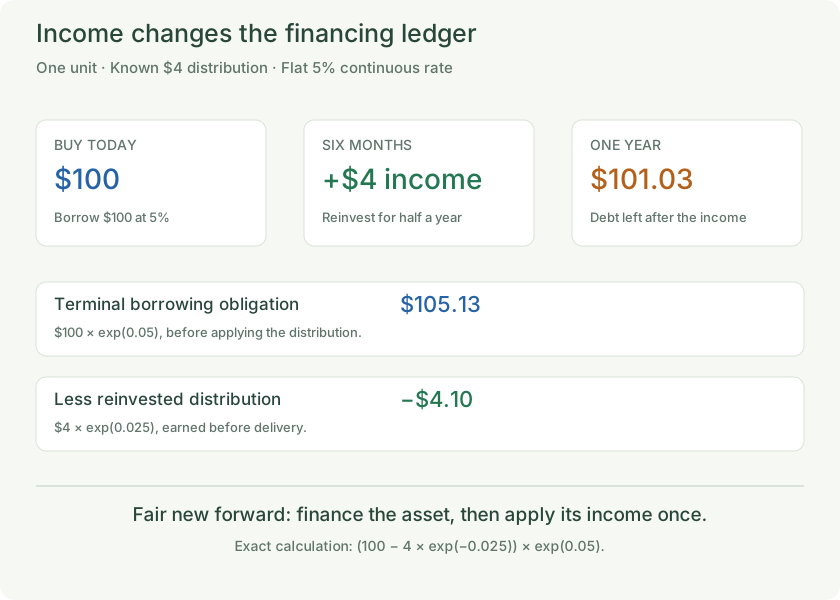
A $100 asset financed at 5% pays $4 at six months; reinvesting the payment leaves $101.03 of debt to cover at one-year delivery.
The figure shows a fixed worked example. Editing a calculation does not update this illustration.
Exercise 4 — Trace an overpriced forward through delivery
Suppose a matching forward can be sold at $104 while the stated borrowing, asset purchase and reinvestment are executable. Borrow $100, buy one asset, reinvest its distribution, deliver the asset for $104 and repay debt. Run the original calculation, then change the offered delivery price from 104 to 102.
Exercise 5 — Value an old contract without changing its promise
An existing long fixes . Today’s spot, income schedule and remaining maturity are the original inputs. Subtract both the present value of income the forward buyer misses and the discounted fixed delivery payment. A new quote below makes this old long unfavorable.
Exercise 6 — Move past the distribution date
In a later, separate snapshot the distribution has just been paid. Current ex-distribution spot is $97, delivery is six months away, remains $102 and no more income is due. Set remaining to zero. The observed $97 is not mechanically inferred from the earlier $100.
Read the picture
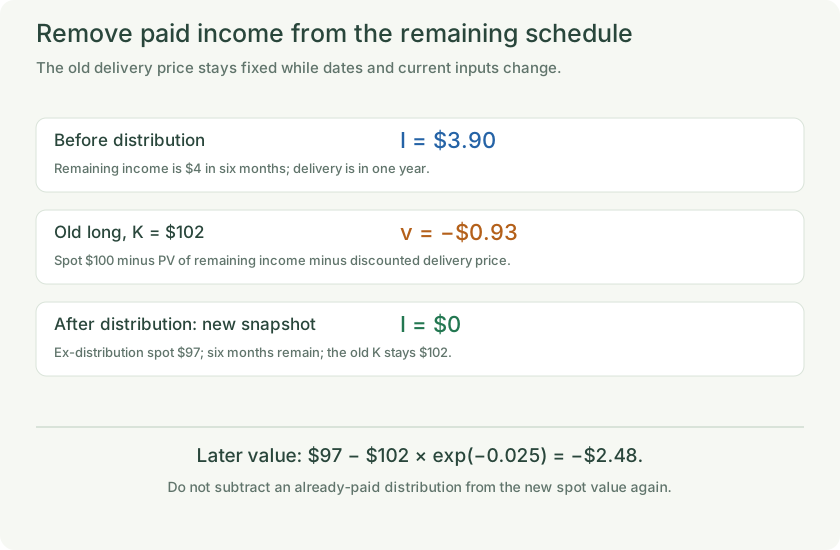
Before payment, subtract the present value of remaining income; after payment, use ex-distribution spot, remaining time and no second subtraction of that income.
The figure shows a fixed worked example. Editing a calculation does not update this illustration.
Exercise 7 — Challenge a reverse cash-and-carry claim
A forward quote of $99 is below the original income-adjusted model price. The code shows the quote-minus-model gap. Now assume no asset can be borrowed for short sale. A trader with no existing asset inventory cannot simply announce the reverse replication is executable. An owner may instead compare selling current inventory and replacing it through a forward.
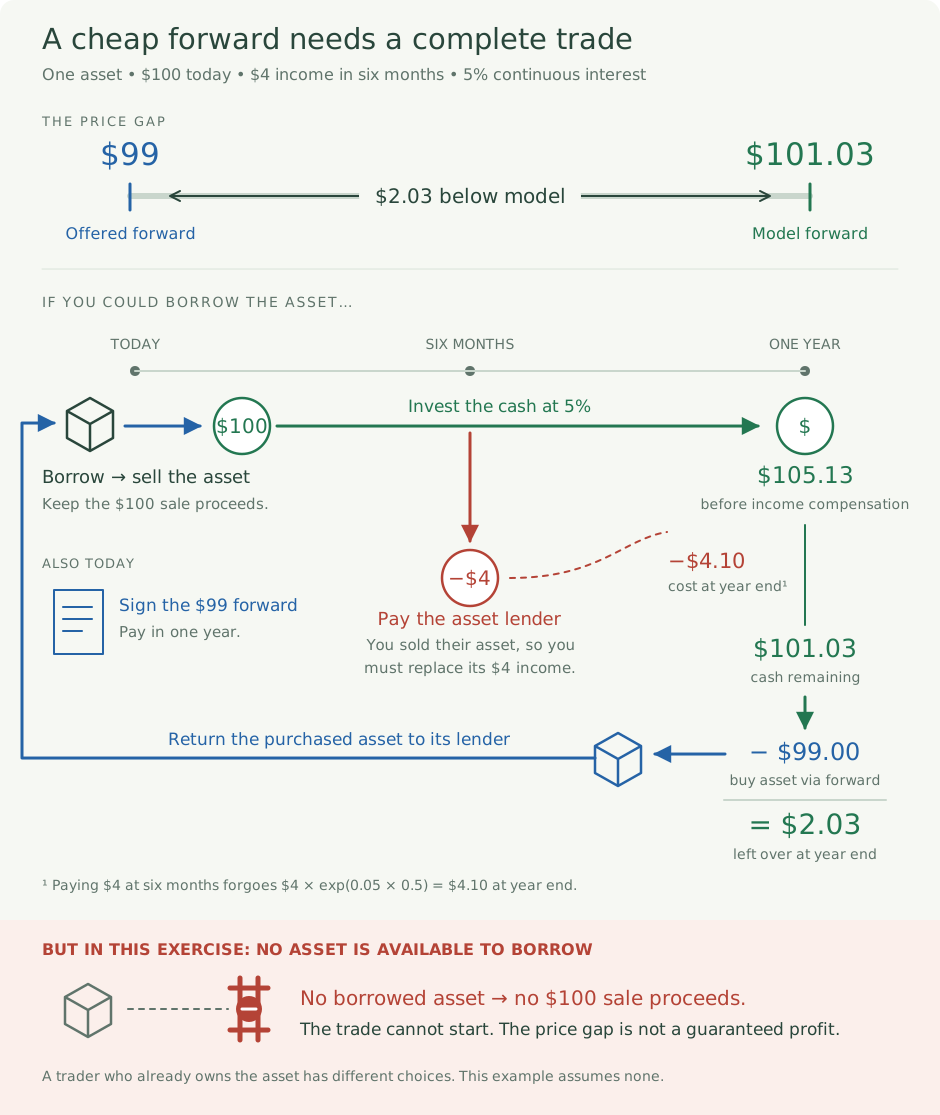
The diagram uses the fixed example inputs. Amounts are rounded for display; the calculation keeps full precision.
Why does the code show a minus sign but the diagram shows a profit?
The code calculates offered price minus model price:
The minus sign means the $99 offer is about $2.03 below the model price. This number is a price gap, not the trade’s profit or loss.
The diagram’s hypothetical trade uses the opposite subtraction: after investing the sale proceeds and compensating the asset lender for the $4 income payment, you would have about $101.03 left at year end. Buying the replacement asset through the $99 forward would leave:
Same difference, opposite subtraction order. The positive $2.03 is the hypothetical year-end profit if all the required trades can be carried out. In this exercise you cannot borrow the asset, so you cannot start that trade or lock in that profit. Both equations use rounded amounts; the code keeps full precision.
Remember
Discount each remaining cash distribution at its own date, then finance the net asset cost. Cross-check with a terminal debt-and-reinvestment ledger. An old stays fixed; paid distributions leave . Test the asset borrowing, distribution replacement and financing before calling a discrepancy arbitrage.