Dividend yields and index arbitrage
An index contains many securities and distribution dates. A proportional dividend yield is a useful simplified way to describe income on its replicating basket. The simplification changes the replication: reinvested income grows the number of basket units. Use that idea to price a forward, then allow explicitly stated trading costs before interpreting a small price difference.
Predict first, then run each standalone calculation. Make a requested edit only in the named cell: other exercises retain their own stated inputs. Enter numbers without currency symbols or units, rounded to two decimals unless the check asks for four. None of the model prices is a forecast or a trading recommendation.
How does a proportional yield enter index carry?
Let be a price-index basket value, a known continuous proportional dividend yield, a continuous financing rate and the horizon.
The fair forward is:
An existing long has per basket unit.
Buying basket units now and reinvesting every distribution grows the holding to one basket unit at delivery under this deterministic-yield model. Borrowing its initial cost leaves exactly debt. Do not buy a full unit, subtract the yield-adjusted prepaid cost and also count the same distributions as extra profit.
| Base assumption | Value |
|---|---|
| Basket spot | 2,000 index points, treated as dollars per basket unit |
| Continuous financing | 5% annually |
| Known proportional income yield | 2% annually |
| Delivery horizon | One year |
| Fixed for the old-contract example | 2,040 per basket unit |
An actual index contract has a multiplier and settlement rules. Our replication refers to the matching price-index basket. A total-return index already incorporates distributions; do not mechanically subtract a second dividend yield. Uncertain constituent payments and imperfect basket execution can prevent an exact lock.
To illustrate costs, stipulate separate feasible cash-and-carry and reverse trades, each costing 8 terminal points per basket unit including all assumed friction. Under those symmetric assumptions the simple candidate no-profit interval is . It is not a universal market spread or a substitute for modeling bid/ask, borrowing and financing separately.
Scenario and assumptions
Use the fictional basket and exactly known yield above. Flat borrowing/lending rates, continuous reinvestment, fractional basket holdings and reliable short borrowing are available. There are no frictions in exercises 1–4 and 7. Exercises 5–6 alone add the stated 8-point terminal cost to either complete arbitrage direction. All prices are model inputs; a forecast dividend yield is not a guaranteed tradable cash flow.
Exercise 1 — Buy the basket unit you need at delivery
A fully reinvested starting holding of units grows to one unit after a year. Multiply that starting quantity by the 2,000 spot price. This is a prepaid delivery cost, not the current cost of a full basket plus an extra discount coupon.
Exercise 2 — Finance the prepaid basket
Finance that unrounded prepaid amount for one year at 5%. This gives the index forward quote. A positive − means the forward exceeds current spot here, even though dividends reduce it relative to the no-income case.
Exercise 3 — Check the unit and financing ledger
Start with units and multiply by after reinvestment. The code returns the final basket quantity. The delivery forward sells exactly that basket; its proceeds repay the financed prepaid cost. Both the asset obligation and debt must match, not only one cash total.
Read the picture
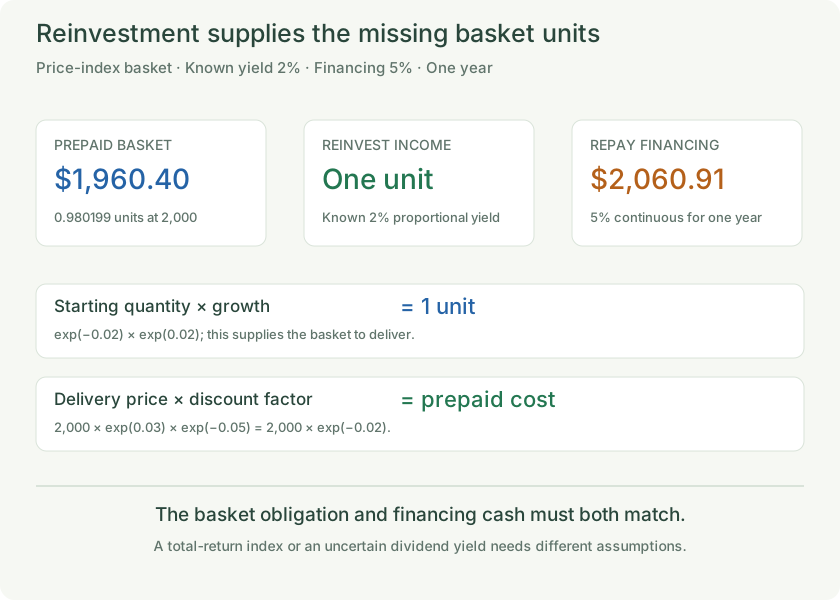
Buy 0.980199 basket units for $1,960.40, reinvest a known 2% yield to reach one unit and repay $2,060.91 financing at delivery.
The figure shows a fixed worked example. Editing a calculation does not update this illustration.
Exercise 4 — Change only the assumed income yield
Start with the original quote. Change from 0.02 to 0.03 while keeping spot, financing rate and maturity fixed. More income available to the replicating owner reduces the amount that must be recovered through the forward. This exercise changes a model assumption, not a forecast of the spot return.
Exercise 5 — Add a cost before selling an apparently expensive forward
Return to . A complete cash-and-carry costs 8 points per basket at delivery. Add this cost to the frictionless quote to find the upper threshold. The lower threshold is the frictionless quote minus the stated cost of a feasible reverse trade. Contract multipliers scale all of these points consistently.
Exercise 6 — Reject an apparent index arbitrage after costs
A matching forward can be sold at 2,065. Gross excess over frictionless value is positive. Deduct the complete 8-point terminal cost. Being above a model mid-price is not the same as being above a feasible sell-side threshold. If dividends are only estimated, even this simplified profit calculation loses its guaranteed character.
Read the picture
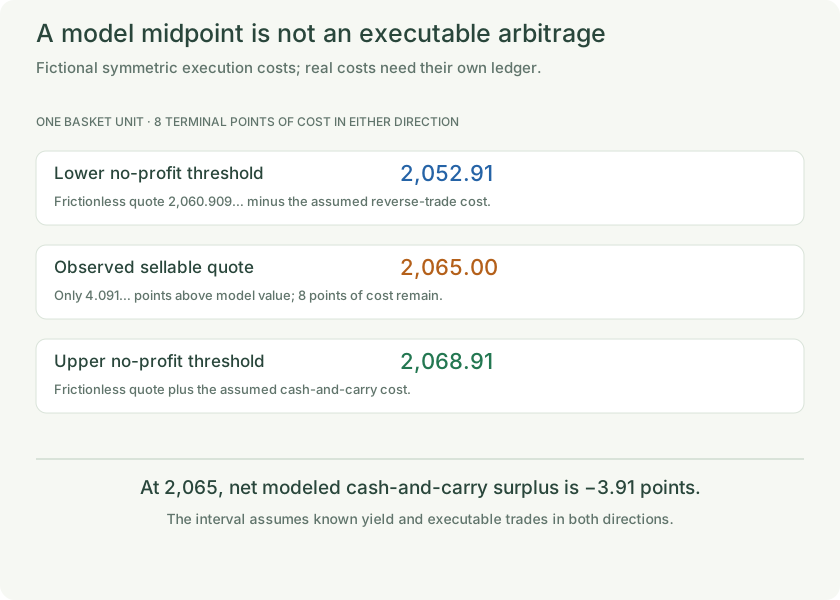
With an assumed 8-point terminal cost in either feasible direction, the no-profit interval runs from 2,052.91 to 2,068.91; a 2,065 quote is inside it.
The figure shows a fixed worked example. Editing a calculation does not update this illustration.
Exercise 7 — Value a previously agreed index forward
The original yield is 2%, current spot is 2,000 and the old long requires in one year. Discount the fixed payment and subtract it from the prepaid basket cost. Equivalently discount current . The two methods use the same remaining dividend assumption.
Remember
Known proportional income reduces net carry from to − . Reinvestment must deliver the right number of basket units, and financing must match the delivery cash. Test an executable cost band rather than a model midpoint. Forecast dividends, tracking mismatch, total-return definitions and shorting constraints can change what can actually be replicated.