Currency forwards use two interest rates
The bakery must pay a foreign supplier. Holding that supplier’s currency can earn interest before payment, while buying it now requires funding in the bakery’s own currency. There are therefore two rates in the replication. Write the currency units on every exchange rate before choosing which rate increases and which decreases the forward.
Predict first, then run each standalone calculation. Make a requested edit only in the named cell: other exercises retain their own stated inputs. Enter numbers without currency symbols or units, rounded to two decimals unless the check asks for four. None of the model prices is a forecast or a trading recommendation.
Which two rates belong in a currency forward?
Define domestic currency as USD and foreign currency as EUR in these fictional examples. means one euro costs 1.20 dollars. Domestic and foreign continuous rates are , with years.
The forward in USD per EUR is:
For foreign units, a long buying EUR at fixed has current USD value .
| Replication step | Currency and date |
|---|---|
| Deposit euros today | Grows to euros at delivery |
| Buy that deposit using USD per EUR | Costs dollars today |
| Borrow those dollars at the domestic rate | Repayment at delivery equals dollars |
| Use the matured foreign deposit to pay the supplier | No terminal spot purchase is needed |
The inverse quote is EUR per USD. Its forward is , obtained by also switching domestic and foreign rates; merely taking 1/ while keeping the original rate difference produces a wrong quote. A long euro forward does not become the same notional USD position just by relabeling units.
Covered interest parity describes the matching deposit-and-funding replication under the specified assumptions. It does not say the expected future spot equals . Different funding access, spreads, collateral conventions or currency basis can alter actual executable terms; advanced currency swaps address those effects later.
Scenario and assumptions
Use certain one-period deposits, the same rates for borrowing and lending within each currency, no fees, capital restrictions, tax, default or currency basis. The importer needs EUR 10,000 at six months. The 1.30 USD/EUR spot in exercise 7 is a separate terminal scenario. Every monetary result is in the specified currency; rates are decimals and continuous.
Follow the money before calculating
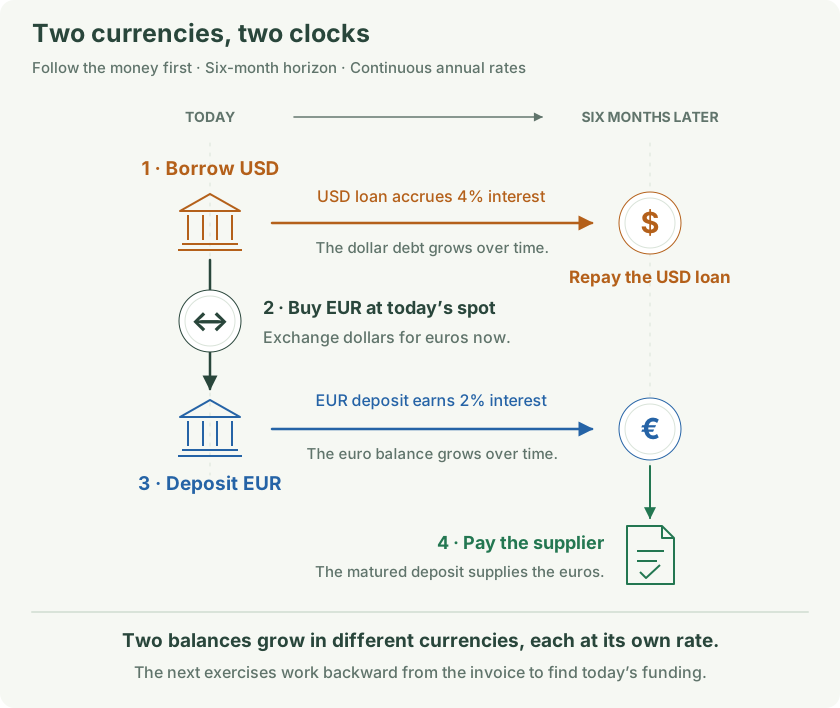
Two balances grow over the same period, each at its own currency’s rate. Start with the supplier’s euro invoice and work backward to the deposit and dollar funding needed today.
This is a conceptual overview. The worked numerical diagram follows exercise 3.
Exercise 1 — Discount domestic cash
Calculate for a USD payment in six months at a 4% continuous annual rate. The discount factor has no currency units. Do not use the foreign rate simply because the contract mentions euros.
Exercise 2 — Buy a foreign deposit that grows to the invoice
Discount EUR 10,000 at the EUR rate of 2% for half a year. This gives the euro deposit required today. Multiplying by 1.20 would convert that deposit into its present dollar cost; depositing the full EUR 10,000 now would leave excess euros at delivery.
Exercise 3 — Find the domestic-per-foreign forward
Finance the discounted foreign deposit in domestic currency. The domestic rate is higher, so the USD-per-EUR quote exceeds spot in this example. The result is a price per euro, not the full invoice payment and not an exchange-rate forecast.
Two currencies, one delivery date
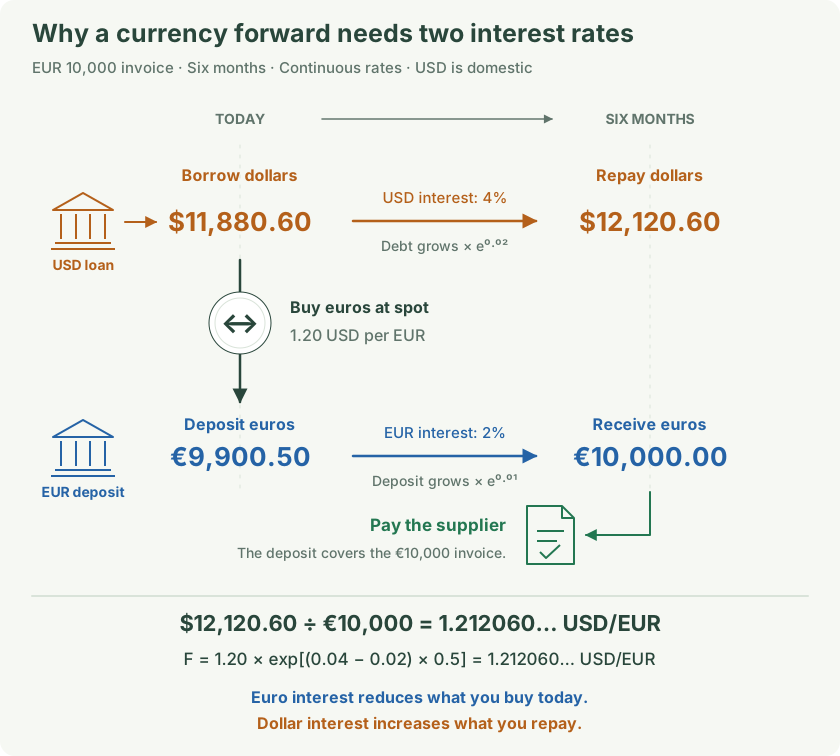
Euro interest reduces what you buy today; dollar interest increases what you repay. The two maturity amounts imply the USD-per-EUR forward.
The figure shows a fixed worked example. Editing a calculation does not update this illustration.
Exercise 4 — Reverse both the units and rate roles
Compute the forward in EUR per USD from 1/1.20 and the reversed rate difference r_EUR − r_USD. Its product with the original unrounded forward is one. A reciprocal applies to the quote, not automatically to a fixed trade notional or the sign of its value.
The same exchange read in opposite directions
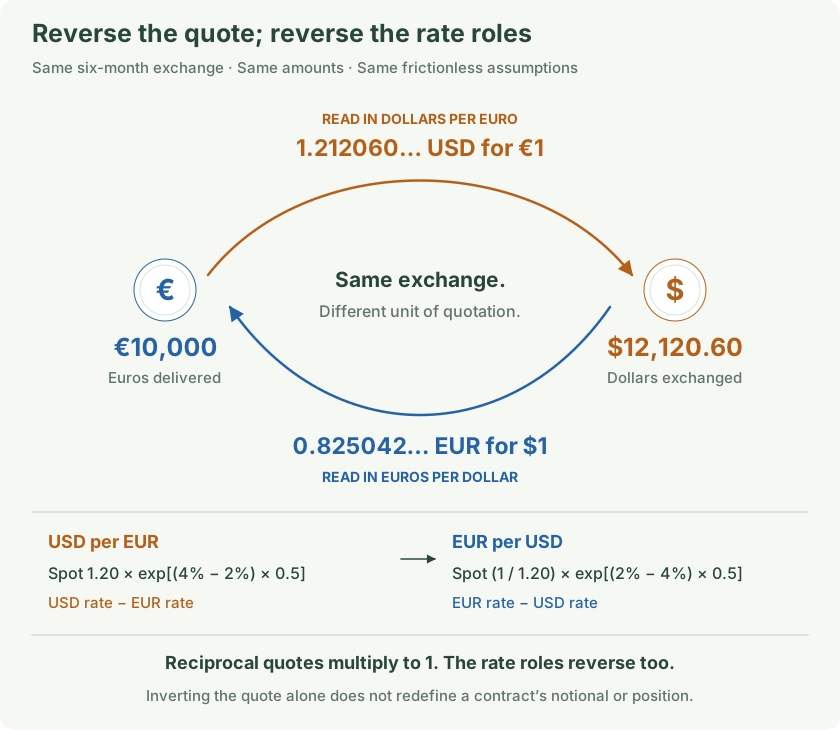
Reverse both the units and the rate roles. The exact reciprocal quotes multiply to one; quoting the exchange differently does not independently redefine the contract’s notional or position.
The figure shows a fixed worked example. Editing a calculation does not update this illustration.
Exercise 5 — Reconcile the full import payment
Multiply EUR 10,000 by the exact USD-per-EUR forward. Cross-check by financing today’s USD cost of the EUR 9,900.498… deposit. Both ledgers deliver EUR 10,000 and leave the same USD debt. Do not multiply the inverse quote by the euro invoice.
Exercise 6 — Value an old euro-buying forward
An existing long buys EUR 10,000 for USD/EUR in six months under the original current rates and spot. Run the valuation, then change only from 1.205 to 1.22. A less favorable fixed purchase price should reduce the long’s current dollar value.
Exercise 7 — Combine a terminal spot purchase with the hedge once
At delivery let spot be 1.30 USD/EUR. In a cash-settled version the importer pays spot for EUR 10,000 and receives from the forward. Subtract that gain once. A physically settled version instead exchanges the forward’s locked dollar amount directly for euros. These are alternative presentations, not two simultaneous extra gains.
One invoice, two alternative settlement methods
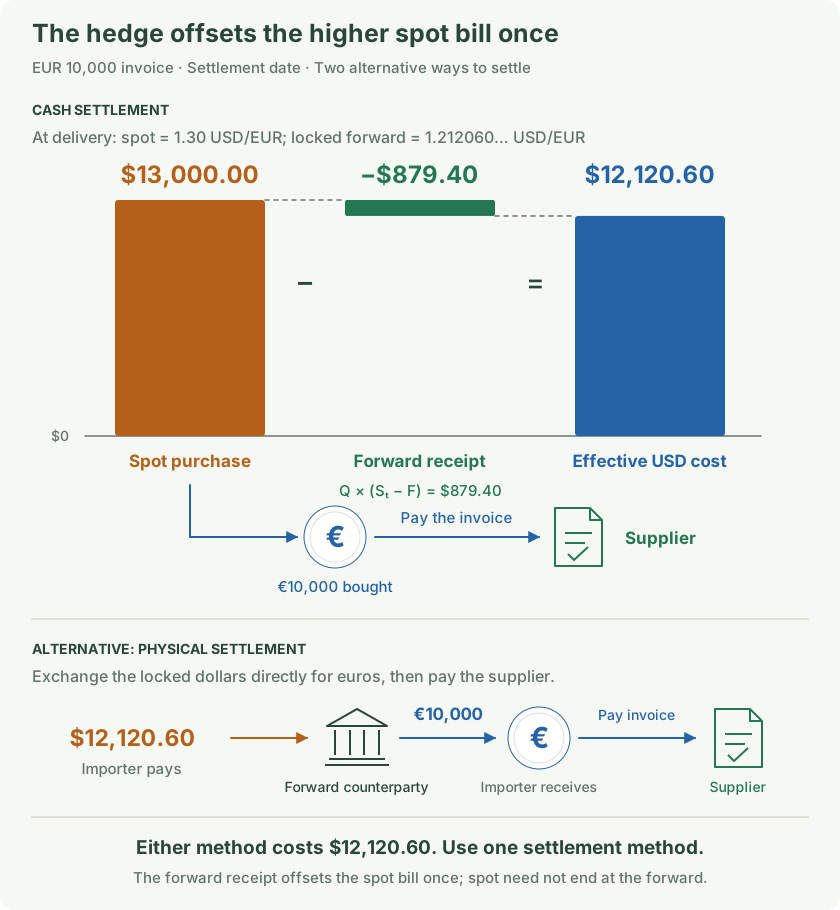
Subtract the forward receipt once from the spot bill. Physical settlement is an alternative way to obtain the euros, not an additional gain.
The figure shows a fixed worked example. Editing a calculation does not update this illustration.
Remember
Name domestic and foreign currencies, quote direction and each payment currency first. Foreign interest reduces the deposit needed today; domestic financing grows its dollar cost. Invert the rate roles when inverting a quote. Value old contracts with their fixed and combine a cash-settled hedge with the business purchase only once.