Storage, convenience and the futures curve
A warehouse receipt and a promise of future delivery are not always equally useful to a producer. Inventory costs money to store, but having it on hand may keep a production line running during a shortage. Extend carry pricing with those competing effects and distinguish an observed price relationship from a cash benefit that can actually be collected.
Predict first, then run each standalone calculation. Make a requested edit only in the named cell: other exercises retain their own stated inputs. Enter numbers without currency symbols or units, rounded to two decimals unless the check asks for four. None of the model prices is a forecast or a trading recommendation.
What changes when the asset must be stored?
If known storage cash costs have present value , an owned investment asset with no other income has the model forward
A separate continuous-rate specification writes , where is a stated proportional storage-cost rate and is convenience yield. Do not add and unless they represent genuinely separate costs.
| Input | Continuous-rate example |
|---|---|
| Spot | $50 per eligible physical unit |
| Financing | 4% continuous annually |
| Storage rate | 6% continuous annually in this model |
| Convenience yield | 2% continuous annually |
| Delivery horizon | Half a year |
Storage increases carry; convenience decreases it. Convenience yield is a modeled noncash benefit of accessible inventory, not a dividend or an interest account an arbitrageur can withdraw. For consumption goods, unavailable short inventory and operational benefits can prevent an exact two-sided spot-forward replication. An inferred explains a quote within a model; it is not separately observed cash income.
Under constant positive net carry, longer-dated quotes rise with maturity in this simplified curve, often called contango. Negative net carry gives a downward curve, often called backwardation. State the actual maturities being compared. These spot/curve relationships differ from normal backwardation, below expected future spot: the latter compares a quote with a forecast under a stated real-world probability model.
Delivery alternatives affect the contract’s economics. Grade and location adjustments belong in the cost of each eligible deliverable. A convenient physical unit for a local factory need not be the contract’s cheapest eligible delivery asset.
Scenario and assumptions
All commodity inputs are fictional. The one-off $2 storage bill in exercise 1 is paid today and is a separate specification from in exercises 2–7. Continuous-cost comparisons use the stated model rates, equal financing access, sufficient warehouse capacity and no other fees. The storage-only cash-and-carry upper comparison assumes the physical purchase, storage charges and delivery are all lockable; we do not assume an unrestricted consumption-asset short sale.
Exercise 1 — Finance a known storage bill
For this exercise only, spot is $50 and storage costs $2 paid immediately for the full six-month period. Finance the entire $52 at continuously. Do not treat the $2 as a percentage or add the separate rate from later exercises.
Exercise 2 — Balance financing, storage and convenience
Now use the separate continuous-rate model: , , , . Net carry is 8% annually. The result incorporates a noncash inventory benefit, so its equality is a commodity model relation, not proof that any trader can collect convenience income.
Exercise 3 — Infer convenience yield from a quote
Suppose the observed matching forward equals the previous model’s exact quote. Solve . The code inserts the exact price rather than its rounded $52.04 display. Multiplying by 100 reports the inferred annual percentage.
Read the picture
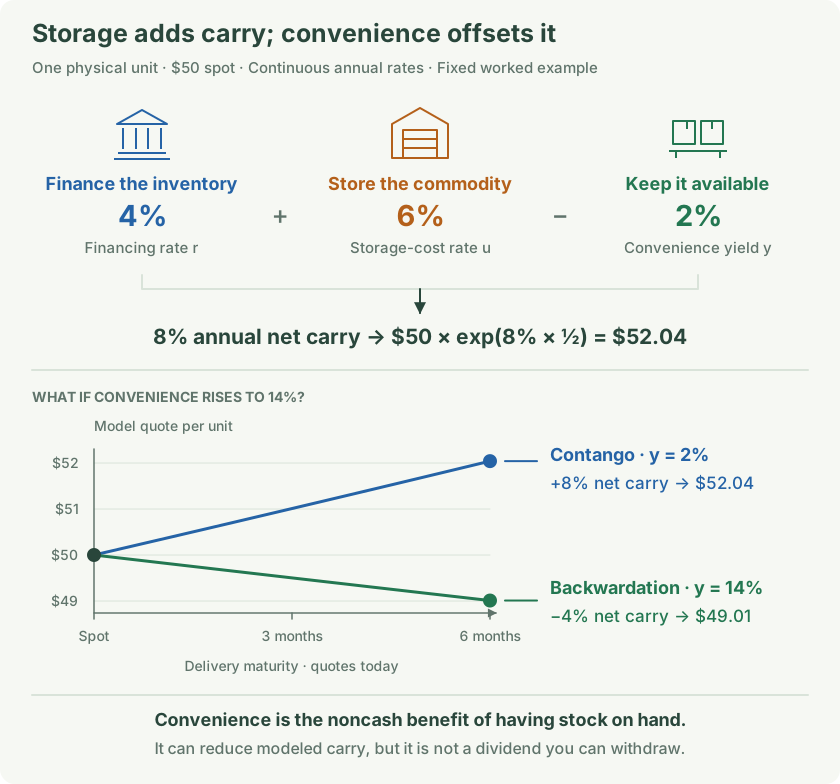
Financing plus storage adds 10% annual carry; a modeled 2% convenience benefit leaves 8% net carry and a $52.04 six-month quote from $50 spot.
The figure shows a fixed worked example. Editing a calculation does not update this illustration.
Exercise 4 — A strong inventory benefit can reverse the curve
Run the base formula, then raise from 0.02 to 0.14 while leaving , and unchanged. Net carry becomes −4% annually. In this constant-parameter model the six-month forward falls below spot and longer delivery dates fall further. The benefit is not cash paid by the exchange.
Exercise 5 — Use a feasible one-sided storage comparison
Remove convenience benefits from the replicating trader’s cash ledger. Under the stated lockable proportional storage specification, financed stored inventory costs . A matching forward sale at $54 covers that cost. Count the potential terminal surplus, then ask which direction requires short physical inventory.
Exercise 6 — Separate contango from a spot-price forecast
Return to the 2% convenience model. Its six-month quote is about $52.04, above the $50 spot. Separately suppose a real-world forecast puts expected six-month spot at $54. Calculate forecast minus forward. This spread is not a sure profit, because the forecast is uncertain and does not create a matched delivery transaction.
Read the picture
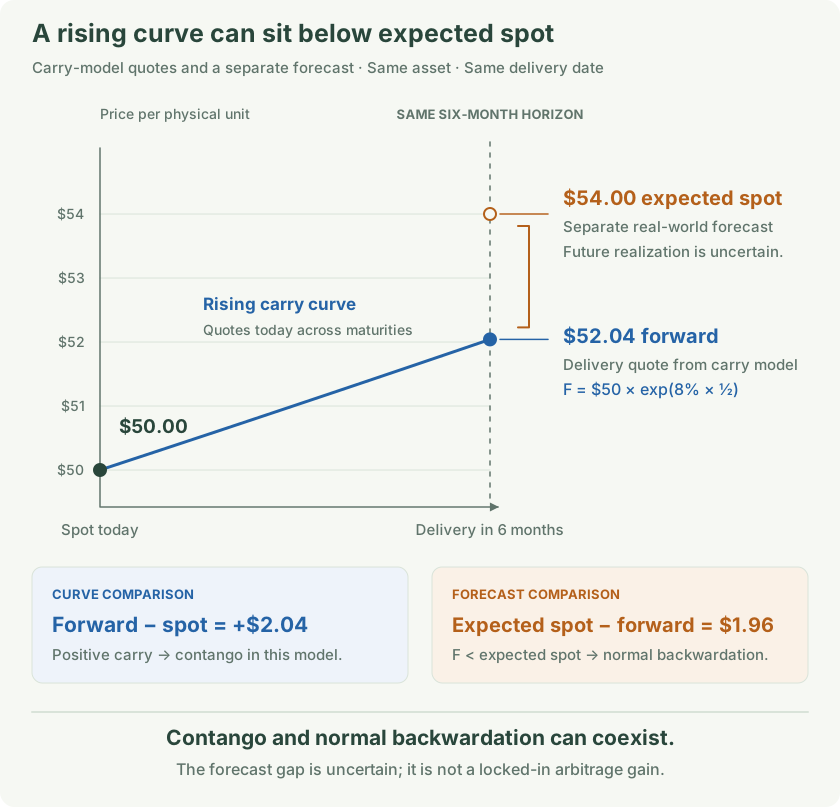
The same scenario can have spot $50, forward $52.04 and expected future spot $54: a rising carry curve does not make the forward a forecast.
The figure shows a fixed worked example. Editing a calculation does not update this illustration.
Exercise 7 — Choose only eligible adjusted deliverables
The short may deliver Grade A costing $50 now, or Grade B costing $47 now but receiving $2 less on the invoice at delivery. Both are at the approved location with otherwise equal terms. Finance and store each asset first. Then add Grade B’s $2 terminal invoice discount to its terminal carrying cost: the discount is due at delivery, so do not finance it as though paid today. Choose the lower terminal comparison.
Remember
Keep dated cash storage costs separate from proportional cost rates. Convenience is an inventory service benefit, not a free cash payment. Explain a curve using explicit carry and delivery assumptions, distinguish it from expected spot, and test which arbitrage direction is physically feasible. Always compare eligible delivered costs after contractual adjustments.