Protect shares you own against a market fall
You own $400,000 of Apple shares, $400,000 of Microsoft shares and $400,000 of Amazon shares. Together these investments are your portfolio, worth $1,200,000. You want to keep the shares but reduce losses if the wider stock market falls.
Which index are we watching?
The S&P 500 index is a scoreboard tracking roughly 500 large US companies. Your three-company portfolio is a different mix from that larger group, so it can move more or less strongly than the index.
Why multiply by 1.25?
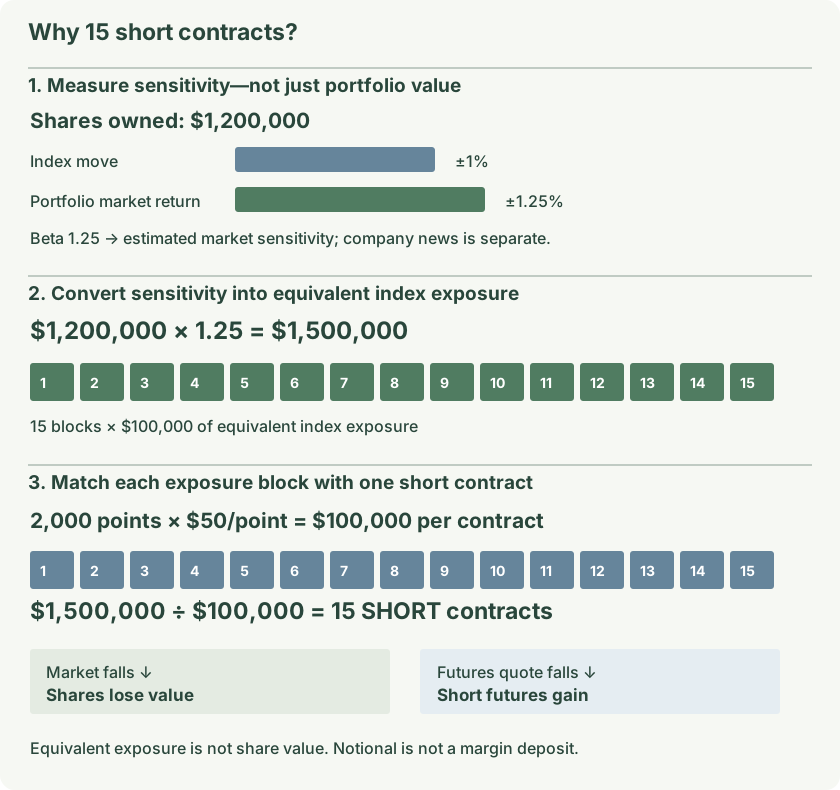
Assume comparisons of past portfolio returns with S&P 500 returns gave an estimated beta of 1.25. Beta describes how strongly your portfolio responds to this particular index. We supply 1.25 for this exercise; it is not a measured claim about these shares today.
If the S&P 500 falls 4%, the estimated market-related fall in your portfolio is 4% × 1.25 = 5%. “25% more strongly” means an extra quarter of the original movement: a quarter of 4% is 1%, making 5%. It does not mean a 25% loss.
What does “market-related” mean?
A broad market fall can pull Apple, Microsoft and Amazon shares down together. That part of your loss is the market component. Separate news, such as disappointing Amazon earnings, can cause an additional company-specific loss. The index measures the broader market; the market component describes its effect on your particular holdings.
Exactly what do you sell?
You keep all your shares and sell E-mini S&P 500 futures (ES), contracts linked to the S&P 500. Selling these futures is called going short: you gain when their price falls and lose when it rises. You are not selling your Apple, Microsoft or Amazon shares.
One ES contract represents $50 for each index point. Assume its starting quote is 2,000 points. This is an example price, not a current quote. The companies, index and futures product are real; allocations, beta, prices and news in this lesson are assumed.
We use a short-horizon model with zero interest and dividends. Assume futures percentage changes match index changes and beta stays constant. Actual share returns can differ.
Predict the result, run the calculation, then make the requested change. Each calculation stands alone. Use signed numbers without units for numeric checks; round decimals to two places (trailing zeros are optional).
Turn the example into a hedge size
One ES contract at our assumed quote represents 2,000 × $50 = $100,000 of index exposure. This exposure is called notional value. The $50 per point is the multiplier. It is not the cash deposit needed to open the position.
Because your shares react 1.25 times as strongly, their estimated index-equivalent exposure is 1.25 × $1,200,000 = $1,500,000. Divide by $100,000 per contract: sell 15 ES contracts.
P&L means profit or loss. A target beta of zero means aiming to cancel the estimated broad-market response, not eliminating every possible loss.
One contract’s notional = futures quote × currency multiplier per point. For a positive-beta portfolio and a target market beta of zero, contracts to short = beta × portfolio value / contract notional. This is a model estimate for a matching hedge horizon, not a guarantee of the portfolio’s future return.
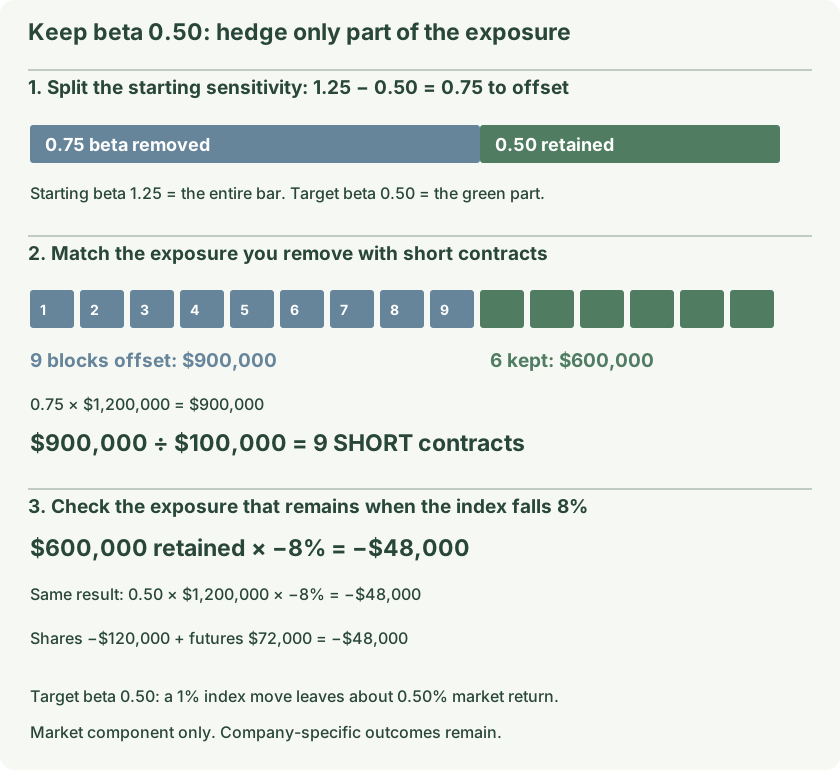
To reduce beta to a lower positive target, contracts to short = (current beta − target beta) × portfolio value / contract notional. Fractional results require a rounding decision. These examples have exact whole-contract targets.
Short futures profit is contract count × multiplier × (entry quote − closing quote). Notional value is not the upfront margin deposit. The hedge offsets modeled market moves in both directions and leaves stock-specific risk, beta estimation risk, basis risk and margin funding needs. Fees, financing, dividends and changing portfolio composition are excluded.
Exercise 1 — Read the index multiplier
A futures quote of 2,000 is measured in index points. Multiply by $50 per point to obtain currency exposure per contract. Do not treat the quote itself as a dollar notional or as the margin requirement.
Exercise 2 — Scale market exposure by beta
For beta 1.25, divide beta-adjusted portfolio value by the $100,000 contract notional. Then change beta to 0.75 while leaving portfolio value and the futures quote unchanged. Both examples use short futures to offset positive market exposure.
Exercise 3 — Calculate a short hedge’s gain
Restore the original beta 1.25 and fifteen short contracts. The S&P 500 and ES futures both fall 8% in this scenario; futures move from 2,000 to 1,840. Multiply the 160-point decline by the multiplier and contract count. This is cumulative futures P&L, distributed through daily settlement.
Exercise 4 — Estimate the portfolio’s market-driven change
In this teaching model, beta 1.25 turns an −8% index move into a −10% market-driven portfolio return. Apply it to $1,200,000. This estimates only the market component; it does not assume all holdings follow the index exactly.
An 8% fall plus an extra quarter of 8% (2%) gives 10%. This is the estimated effect of the broader market on your Apple, Microsoft and Amazon holdings.
Exercise 5 — Leave room for stock-specific loss
Suppose disappointing Amazon earnings cause an additional $18,000 loss in your portfolio. Add this company-specific loss to the modeled market loss. Combine the actual portfolio change with the futures gain. The futures contract hedges the index relationship, not unexpected news about each stock.
Read the picture
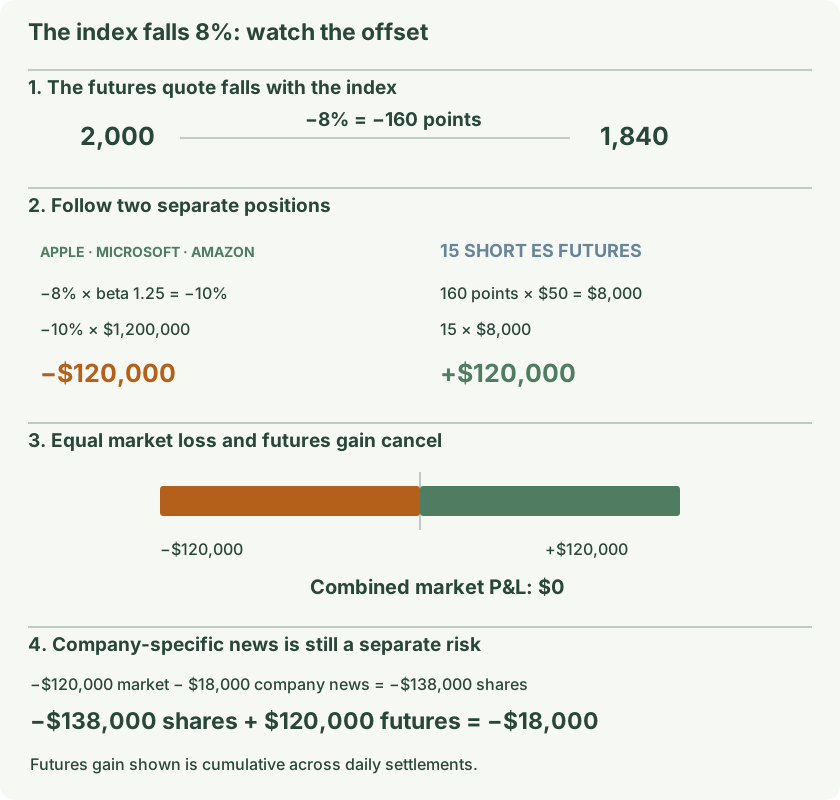
The diagram shows the stated worked example. Editing a calculation does not update the picture.
Exercise 6 — Choose a partial market hedge
Instead of targeting beta zero, target beta 0.50. Short enough futures to offset the difference between current beta 1.25 and target beta 0.50. The remaining positive beta deliberately keeps some market exposure.
Target beta 0.50 means keeping an estimated 0.5% response for each 1% S&P 500 move. You still own all three stocks; changing the number of short ES contracts changes how much market movement is offset.
Read the picture
The diagram shows the stated worked example. Editing a calculation does not update the picture.
Exercise 7 — Check the price of removing market exposure
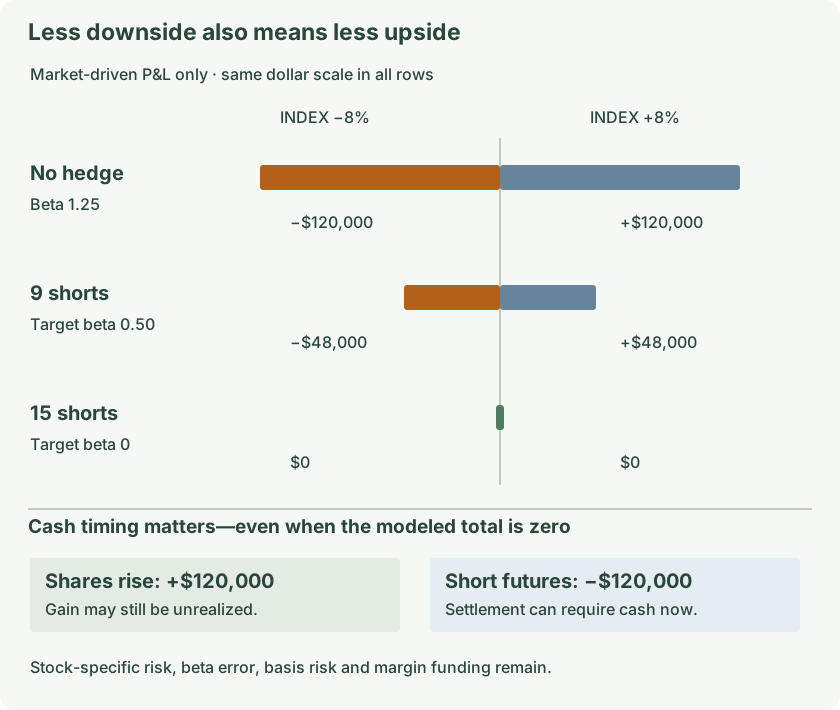
Return to fifteen shorts and assume no stock-specific news. If the index rises 8%, futures rise to 2,160. The modeled portfolio gain is offset by the short loss. Futures losses can require margin cash before any stock gains are realized.
Remember
Portfolio beta scales modeled market exposure; the futures multiplier converts index points to currency. A zero-target-beta hedge is not a guarantee of zero total risk. Partial hedging leaves deliberate market exposure and all counts depend on the stated inputs.