Why lock in a price?
Run the small calculations from top to bottom.
The bakery needs 100 bags of flour next month. It can see today’s price, but it cannot buy next month’s flour at that price unless someone agrees to it. The bakery sells bread at prices customers already expect. A bigger flour bill can leave less money for wages and rent.
Work through the seven exercises in order. First predict the outcome, then run the cell. Make the requested change and run it again before answering the check. For numeric answers, enter the number without units.
What is commodity price risk?
Commodity price risk is uncertainty about how a changing raw-material price will affect a business’s costs or revenue. A bakery that must buy flour is exposed to rising prices; a flour supplier is exposed to falling selling prices.
The purchase-cost formula is quantity × market price. For a fixed quantity, the change in cost is quantity × change in price. These describe the exposure before adding a hedge.
| Flour price per bag | Cost for 100 bags | Change from a $2,000 budget |
|---|---|---|
| $17 | $1,700 | −$300 |
| $20 | $2,000 | $0 |
| $25 | $2,500 | +$500 |
These are scenarios, not forecasts. The original business need is 100 bags; buying extra flour adds inventory exposure.
The model we are using
We compare a single future delivery date, matching bags of flour and dollar prices per bag. There are no storage charges, transaction fees or financing costs in these examples.
These simplifications let us understand the cash flows before adding market details. Write down what each number represents: a quantity, a price per bag, a total payment or a contract payoff.
Read the picture
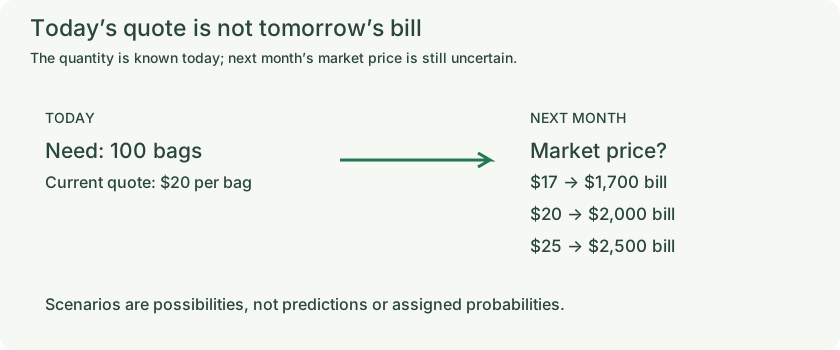
The bakery knows its quantity today but not next month’s market price. A quote today does not fix a future bill.
The figure uses the stated contract terms. Code edits do not change this illustration.
Exercise 1 — Separate quantity from price
The bakery needs 100 bags next month. A bag costs $20 today. Quantity tells us how much flour is needed; price tells us how much each bag costs. Predict the total before running the calculation. Then change the quantity to 120, keeping the price unchanged.
Exercise 2 — Stress the price, not the quantity
Restore the quantity to 100. Imagine that a poor harvest pushes the future price to $25. The bakery still needs the same flour. Calculate the new bill and its increase above the original $2,000 budget. Then replace 25 with 28 in both lines.
Exercise 3 — Let the price fall
Now try a good harvest: flour costs $17. Calculate the bill and the amount left from the $2,000 budget. Change 17 to 19. Lower costs help a buyer, but the supplier receives less. The same price movement affects the two businesses differently.
Exercise 4 — Find the range of possible bills
Our three prices are scenarios: possible outcomes, not forecasts or probabilities. Compare $17 with $25. Calculate the gap between the cheapest and most expensive bills. Then double the quantity in the expression. Bigger quantities amplify the same price uncertainty.
Read the picture
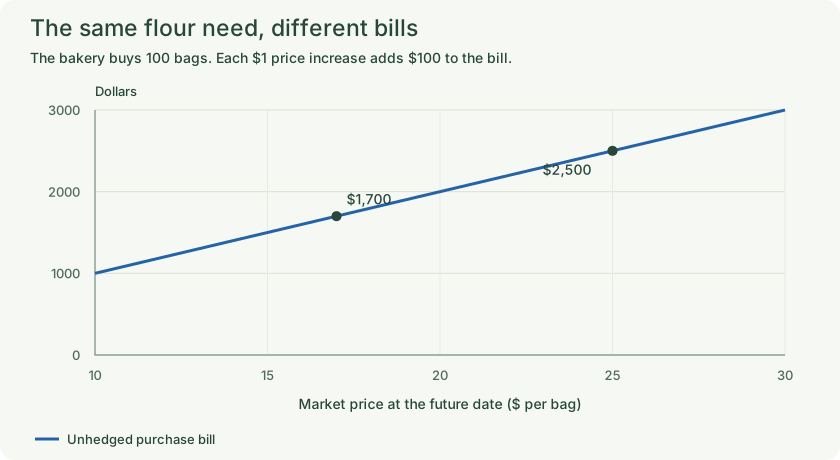
Each extra dollar per bag adds $100 to a 100-bag bill. The horizontal axis shows dollars per bag; the vertical axis shows the whole bill.
The figure uses the stated contract terms. Code edits do not change this illustration.
Exercise 5 — Connect the bill to the business
Suppose bread sales bring in $4,000, and wages and other costs total $1,500. What remains after flour is a simplified operating surplus. It is not the flour bill. Calculate the surplus at $20, then change only the flour price to $25.
Exercise 6 — Locate the budget limit
The bakery can spend at most $2,300 on 100 bags. Divide the budget by the quantity to find the highest affordable price per bag. Check your result by multiplying it by 100. Then lower the budget to $2,200. This is a planning threshold, not a market prediction.
Exercise 7 — Decide what needs protecting
A friend suggests buying 200 bags because prices might rise. The bakery only needs 100. Calculate the cost of that extra 100 at $25. Explain to yourself why taking extra inventory introduces a new exposure rather than simply protecting the original purchase. Storage and resale are separate decisions.
Remember
The quantity is known, but the future price is not. A predictable bill can help a business plan.
These examples ignore financing, fees other than the option premium, and failure to fulfill contracts. Flour quantity, quality and delivery date match exactly.