Agree today, buy next month
Run the small calculations from top to bottom.
A supplier offers the bakery an agreement: buy 100 bags next month for $21 per bag. They agree today, but the flour and payment change hands next month. The bakery promises to buy. The supplier promises to sell. Both promises matter.
Work through the seven exercises in order. First predict the outcome, then run the cell. Make the requested change and run it again before answering the check. For numeric answers, enter the number without units.
What is a forward contract?
A forward contract is an agreement made today to buy or sell a specified asset at an agreed price on a future date. The buyer has a long position and the seller a short position. Both have an obligation; neither has the option to walk away just because market prices change.
Forward payoff formulas at delivery
For quantity Q, delivery-date market price S and agreed delivery price K:
- Long payoff = Q × (S − K)
- Short payoff = Q × (K − S)
- Physical delivery payment = Q × K
For 100 bags, K = $21 and S = $25, the buyer pays $2,100 for delivery. The buyer’s $400 payoff measures the advantage over a $2,500 market purchase; it is not the delivery payment. The seller’s payoff is −$400. These expiration payoffs are not a formula for the contract’s value before delivery.
The model we are using
We compare a single future delivery date, matching bags of flour and dollar prices per bag. A forward is assumed to be honored. There are no storage charges, transaction fees or financing costs in these examples.
These simplifications let us understand the cash flows before adding market details. Write down what each number represents: a quantity, a price per bag, a total payment or a contract payoff.
Read the picture
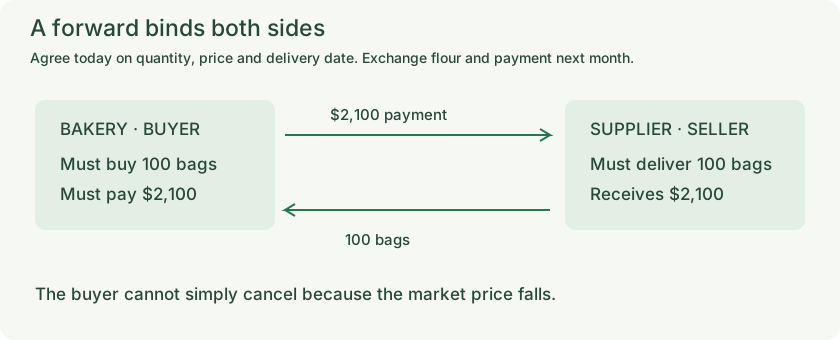
The arrows show actual delivery and payment obligations. These are separate from the contract payoff comparison.
The figure uses the stated contract terms. Code edits do not change this illustration.
Exercise 1 — Read the agreement
The bakery and supplier agree today: 100 bags, $21 per bag, delivery next month. The bakery must buy and the supplier must sell. This is a forward contract. Calculate the delivery payment. Then change the quantity to 150. The contract specifies a quantity as well as a price.
Exercise 2 — Understand the buyer’s advantage
Return to 100 bags. At delivery, market flour costs $25. Buying through the contract costs $2,100 instead of $2,500. The $400 difference is the buyer’s contract payoff relative to buying at market. The delivery payment itself remains $2,100. Change the market price to $26.
Exercise 3 — Allow a negative payoff
At a market price of $17, the agreement is inconvenient for the buyer, but it still binds both parties. Compute the buyer’s payoff without clipping negative values to zero. Then change the market price to $18. A forward is a promise, not an optional discount.
Exercise 4 — Stand on the other side
The supplier’s contract payoff is the reverse of the buyer’s: agreed price minus market price, multiplied by quantity. Calculate both at $25. Change both market prices to $17 and check that they still sum to zero. We are comparing contract payoffs, not either business’s overall profit.
Read the picture
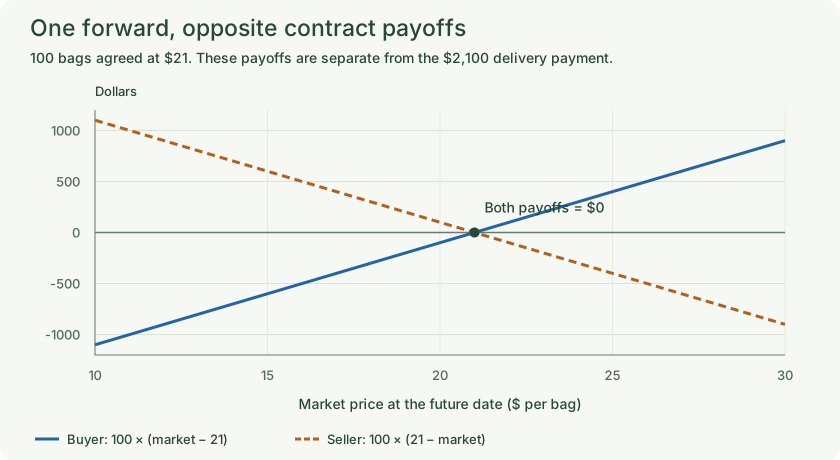
Buyer and seller payoffs cross zero at $21. Above that price the buyer benefits relative to the market; below it the seller benefits.
The figure uses the stated contract terms. Code edits do not change this illustration.
Exercise 5 — Find the neutral outcome
When market and agreed prices match, neither party has a contract advantage. Run the expression. Then change the agreed price to $22 while holding the market price at $21. The agreed price matters even when the market does not move.
Exercise 6 — Keep the units straight
A $4 difference per bag is not a $4 payoff for the entire order. Scale the per-bag difference by the number of bags. Change 100 to 250. Always label whether a number means dollars per bag, bags, or dollars for the whole contract.
Exercise 7 — Separate a promise from a forecast
A quoted forward price of $21 tells us the terms available for a future agreement. It does not guarantee that the future market price will be $21. Compute the payoff at a very different market price, $30. The agreement remains fixed even though the market outcome differs.
Remember
A forward fixes a price for a future transaction. Both parties are obligated to fulfill their side.
These examples ignore financing, fees other than the option premium, and failure to fulfill contracts. Flour quantity, quality and delivery date match exactly.