A call: the right to buy
Run the small calculations from top to bottom.
The bakery would like protection against expensive flour without being forced to buy above the market price. A supplier offers a choice. For $2 paid today, the bakery gets the right to buy one bag next month for $21. We use one bag now so each number is easy to follow.
Work through the seven exercises in order. First predict the outcome, then run the cell. Make the requested change and run it again before answering the check. For numeric answers, enter the number without units.
What is a call option?
A call option gives its buyer the right, but not the obligation, to buy an asset at a specified strike price. The buyer pays a premium for that right. Here we consider exercise only at expiration.
Call payoff, net profit and break-even
For one unit, expiration market price S, strike K and upfront premium p, ignoring financing and other fees:
- Call payoff = max(S − K, 0)
- Call net profit = max(S − K, 0) − p
- Break-even market price = K + p
- Protected purchase cost = S − max(S − K, 0) + p
With a $21 strike and $2 premium, the call has a positive payoff above $21 but a positive net profit only above $23. A matching call caps the buyer’s effective purchase cost at $23 per unit under these assumptions. Option profit and the business’s purchase cost are different measures.
The model we are using
We examine rights at one expiration date. Each right covers one bag unless stated otherwise. Premiums are paid upfront, and we ignore the financing of that payment. The bag, quantity and date match the option; the contract is assumed to be honored.
These simplifications let us understand the cash flows before adding market details. Write down what each number represents: a quantity, a price per bag, a total payment or a contract payoff.
Exercise 1 — Identify the choice
For $2 today, buy the right to purchase one bag for $21 at expiration. The $21 is the strike; $2 is the premium. At market $25, calculate the advantage of using the right before its fee. Then change the market price in the cell to $27. A call is a buying right.
Exercise 2 — Say no to an expensive purchase
At market $17, paying $21 is unattractive. A call buyer can let the right expire. Math.max selects the larger of the price advantage and zero. Change 17 to 20. The option payoff never becomes negative for the buyer, even though the premium can still be lost.
Exercise 3 — Account for the premium
Payoff leaves out what the right cost. Subtract the $2 premium to calculate the option’s net result. At market $25 this is $2. Change the market price to $22: the payoff stays positive, but it is smaller than the premium.
Read the picture
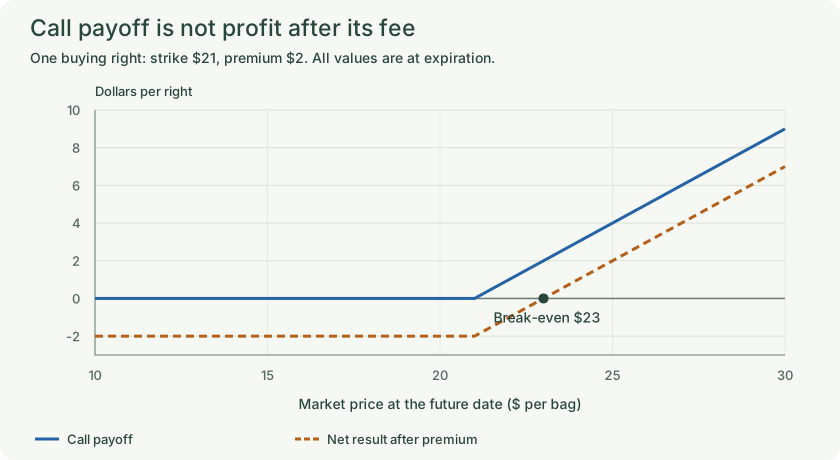
The net-result line sits $2 below payoff. Exercising is worthwhile above $21, but the net result turns positive only above $23.
The figure uses the stated contract terms. Code edits do not change this illustration.
Exercise 4 — Find the break-even price
To recover the $2 premium, the buying right must save $2. Add the premium to the $21 strike. Check by substituting the result into the second expression. Then increase the premium to $3 and work out the new break-even price. Ignore financing in these calculations.
Exercise 5 — Put the call beside the flour bill
The bakery still needs one bag. Model buying at market and subtracting the call payoff, then adding the $2 premium. At $25 the effective cost is $23. Change both market prices to $17. This measures the protected purchase cost, not just the option’s profit.
Exercise 6 — Scale the protection
Return to 100 bags. Assume one right per bag and a premium of $2 per bag. Scale the whole one-bag calculation, including the premium. At $25 the total is $2,300. Change both market prices to $30 and see why the bill does not rise further.
Read the picture
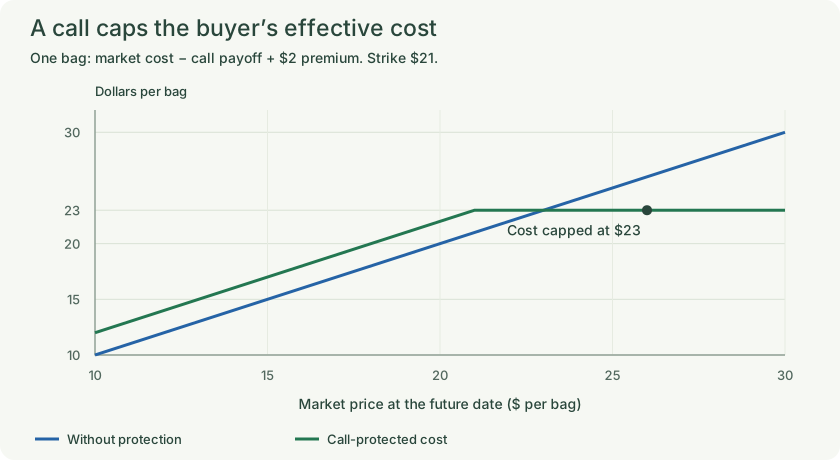
The call caps effective purchase cost at $23 per bag. Below the strike, the cost follows market price plus the $2 premium.
The figure uses the stated contract terms. Code edits do not change this illustration.
Exercise 7 — Compare protection with a promise
A matching forward fixes the one-bag cost at $21. The call costs $2 upfront and permits a cheaper market purchase. Compare both at market $17 and $25. There is no universally cheaper choice: the call preserves flexibility for a fee, while the forward fixes the price.
Remember
A call gives a buying right rather than an obligation. Payoff and net result differ by the premium.
These examples ignore financing, fees other than the option premium, and failure to fulfill contracts. Flour quantity, quality and delivery date match exactly. Options are considered at expiration.