A put: the right to sell
Run the small calculations from top to bottom.
Now stand beside the supplier. It owns one bag of flour and intends to sell it next month. Falling prices are bad news for this business. It buys a right to sell the bag for $21 next month, paying $2 today. This selling right is called a put option.
Work through the seven exercises in order. First predict the outcome, then run the cell. Make the requested change and run it again before answering the check. For numeric answers, enter the number without units.
What is a put option?
A put option gives its buyer the right, but not the obligation, to sell an asset at a specified strike price. An owner can combine an asset with a matching put to protect sale proceeds while retaining the benefit of a higher market price.
Put payoff, break-even and protected proceeds
For one unit, expiration market price S, strike K and upfront premium p, ignoring financing and other fees:
- Put payoff = max(K − S, 0)
- Put net profit = max(K − S, 0) − p
- Put break-even market price = K − p
- Protected sale proceeds = S + max(K − S, 0) − p
At a $21 strike and $2 premium, the put itself breaks even at $19. The owned asset plus put has a $19 floor on sale proceeds after the premium, assuming matching terms and performance. That floor is not business profit: production or acquisition costs still matter. Covering only part of the stock does not protect every unit.
The model we are using
We examine rights at one expiration date. Each right covers one bag unless stated otherwise. Premiums are paid upfront, and we ignore the financing of that payment. The bag, quantity and date match the option; the contract is assumed to be honored.
These simplifications let us understand the cash flows before adding market details. Write down what each number represents: a quantity, a price per bag, a total payment or a contract payoff.
Exercise 1 — Turn the buying right around
The supplier owns a bag and plans to sell it. It pays $2 for the right to sell at $21 at expiration. At market $17, selling at the strike is advantageous. For a put, subtract market from strike. Change the market price to $15.
Exercise 2 — Let an unnecessary right expire
At market $25, the supplier can obtain more by selling at market than by exercising at $21. Calculate the put payoff and then subtract its premium. Change 25 to 24. An unused right can still have served as protection during the period.
Exercise 3 — Combine the sale and the protection
To avoid double-counting, represent the transaction as a market sale plus the put payoff minus the premium. At $17, that is $17 + $4 − $2. Do not also add a $21 exercise sale: these are two alternative ways to describe the same protection.
Read the picture
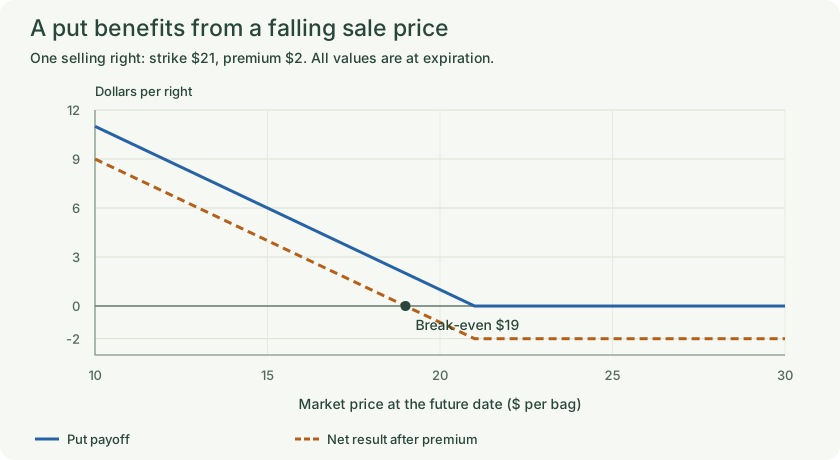
The put payoff grows as the market sale price falls. Subtracting the $2 premium shifts the net-result line down; the option itself breaks even at $19.
The figure uses the stated contract terms. Code edits do not change this illustration.
Exercise 4 — Find the floor
Repeat the protected-sale calculation at market $10. The price falls another $7, but the put payoff increases by $7. Then try market zero. Under our matching-contract assumptions, the sale proceeds after the fee cannot fall below strike minus premium.
Exercise 5 — Keep the benefit of a higher sale price
Calculate protected proceeds at $25 and compare with an unprotected sale. Change both market prices to $30. Above the strike, the put is unused and protected proceeds increase with the market, but stay $2 below the unprotected sale because of the premium.
Exercise 6 — Check whether all the stock is covered
The supplier owns 100 bags but buys put protection on only 60, paying $2 per covered bag. Combine total market revenue, 60 put payoffs and the premium bill. At $17, net proceeds are $1,820. Change both market prices to $10. The uncovered 40 bags have no floor.
Read the picture
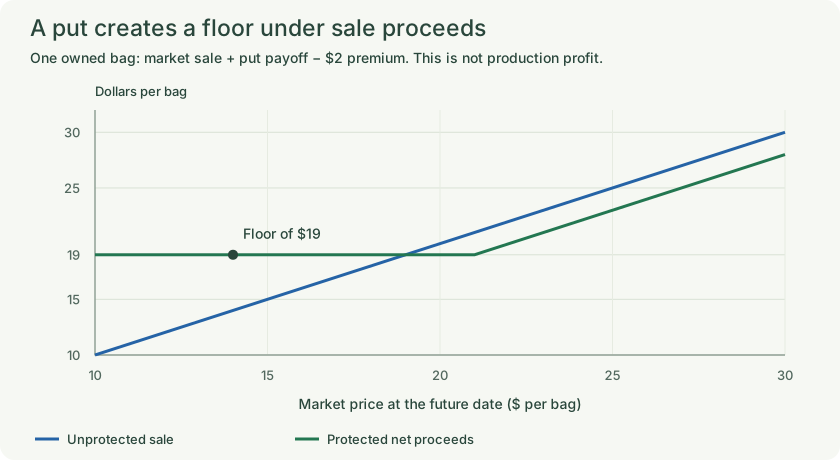
For the owned bag and put together, proceeds after the premium have a $19 floor and rise when market prices exceed the $21 strike.
The figure uses the stated contract terms. Code edits do not change this illustration.
Exercise 7 — Choose the right protection for the need
The bakery fears expensive purchases; the supplier fears cheap sales. Compare a call and put payoff at market $15. A contract is useful because of how it interacts with an existing need, not because its name sounds protective. Explain which right each business needs before looking at the numbers.
Remember
A put gives a selling right. Combined with an owned asset, it can protect sale proceeds while keeping the benefit of rising prices.
These examples ignore financing, fees other than the option premium, and failure to fulfill contracts. Flour quantity, quality and delivery date match exactly. Options are considered at expiration.