Same contract, different reasons to trade
The bakery and a trader can buy exactly the same contract for very different reasons. The bakery already needs flour; the trader may only want to benefit from a price movement. Look at the whole situation before labeling a trade.
Predict first, run the calculation, then make the requested change. Each exercise has a check; enter numbers without units.
Hedging, speculation and arbitrage: what is the difference?
The same contract can hedge one participant’s business and speculate for another. Classify the whole exposure and its cash flows, rather than the instrument’s name.
| Activity | Purpose | Example |
|---|---|---|
| Hedging | Offset an existing exposure | A bakery buys a forward to offset rising flour costs |
| Speculation | Take exposure to an uncertain outcome | A trader with no flour need buys a forward expecting a price rise |
| Arbitrage | Lock in a discrepancy through offsetting transactions | Buy and simultaneously sell an identical transferable asset at executable prices |
Our arbitrage example assumes matching settlement and executable quantities. Net spread = sale price − purchase price − buying costs − selling costs per unit. Buying now and merely hoping to sell higher tomorrow is speculation, not a locked-in arbitrage.
Exercise 1 — Find the existing exposure
The bakery must buy 100 bags next month. Prices rising from $21 to $25 increase its bill. Calculate that increase. This risk exists before the bakery enters any derivative. Change the final price to $27 and check what is at stake.
Exercise 2 — Offset rather than add
A long forward at $21 pays the bakery when flour gets dearer. Compare that payoff with the increase in its purchase bill. Change 25 to 27 in both lines. They move together, so subtracting the payoff offsets the higher bill.
Exercise 3 — Use the same contract for a different purpose
A trader who has no flour purchase to make also buys the 100-bag forward. Its payoff is identical to the bakery’s contract payoff. The difference is the missing business exposure: the trader has added a price bet instead of offsetting an existing need.
Read the picture
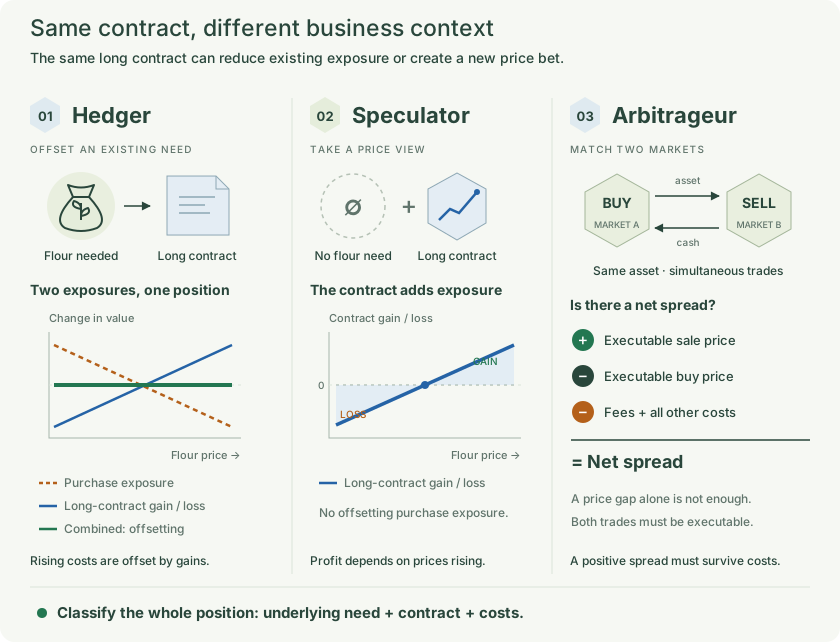
Distinguish hedging, speculation and arbitrage by the exposure and the cash flows.
Exercise 4 — Scale the bet
The trader increases the position to 300 bags. The price falls to $18. Work out the signed payoff, then compare it with the same trade on 100 bags. Bigger positions scale losses as well as gains; confidence about a price direction does not change the arithmetic.
Exercise 5 — Compare simultaneous prices
An identical transferable asset is offered for $20 in one venue and can simultaneously be sold for $21 in another. Assume both quotes are executable for 100 units, with matching settlement and no costs. Calculate the locked-in difference. No forecast of tomorrow’s price is required.
Exercise 6 — Deduct both trading costs
Each side of that transaction costs $0.60 per unit. Subtract the buying cost and the selling cost. A visible price gap is not enough: its proceeds must exceed all costs. Change each fee to $0.40 and run again.
Read the picture
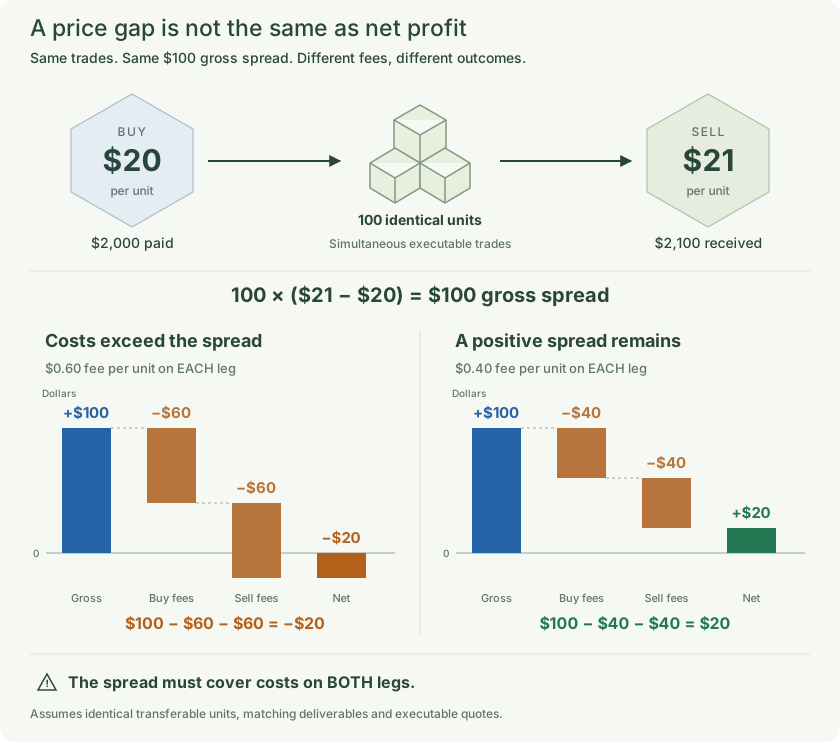
Compare the picture with the calculations above. The figure shows its stated original values; editing a cell does not change it.
Exercise 7 — Do not call a forecast arbitrage
Someone instead buys at $20 hoping to sell tomorrow at $21. Calculate the result if tomorrow’s price is $18. There is no locked-in sale in this story. Distinguish an uncertain exit price from two executable offsetting transactions.
Remember
Distinguish hedging, speculation and arbitrage by the exposure and the cash flows.
These are simplified examples with matching terms unless a mismatch is explicitly introduced. Quotes and margin rules are fictional. Fees, financing and withdrawals are excluded unless stated.