Futures come in standard sizes
A customized forward can name exactly the bakery’s quantity. An exchange-traded future comes with standard terms. We will use a fictional flour future covering 25 bags, quoted in dollars per bag, with a specified grade, location and delivery month.
Predict first, run the calculation, then make the requested change. Each exercise has a check; enter numbers without units.
What does futures contract size mean?
Futures contract size is the quantity of the underlying asset represented by one standardized contract. A futures quote is not necessarily the total contract value or the cash needed to open the position.
Contract quantity and notional formulas
- Represented quantity = number of contracts × contract size
- Notional value = number of contracts × contract size × quoted price per unit
- Quantity-matching contract count = business quantity ÷ contract size
The last expression may not be a whole number; rounding leaves a gap or creates excess exposure. It is a quantity match, not an optimal hedge-ratio model.
| Specification | Fictional flour future |
|---|---|
| Contract size | 25 bags |
| Price quotation | Dollars per bag |
| Delivery month | September |
| Grade and location | Must match the stated contract specification |
Four contracts at $21 represent 100 bags and $2,100 notional. Notional is not initial margin. Matching quantity does not remove date, grade or location mismatches.
Exercise 1 — Read the agreement before the price
One contract covers 25 bags of the specified grade for September delivery. The quoted $21 is a price per bag, not a price for the whole contract. Calculate the quantity represented by one contract. Compare a 100-bag purchase with this standard size.
Exercise 2 — Turn contracts into bags
The bakery buys four contracts. Multiply by the 25-bag size to find the represented quantity. Change four to three and compare the result with the bakery’s original 100-bag need. A contract count alone does not tell you the exposure without its multiplier.
Exercise 3 — Interpret the quotation
At $21 per bag, four contracts represent $2,100 of underlying flour. This is a notional amount, not the upfront cash deposit and not an option premium. Change the quoted price to $24 while keeping the contract count and size fixed.
Read the picture
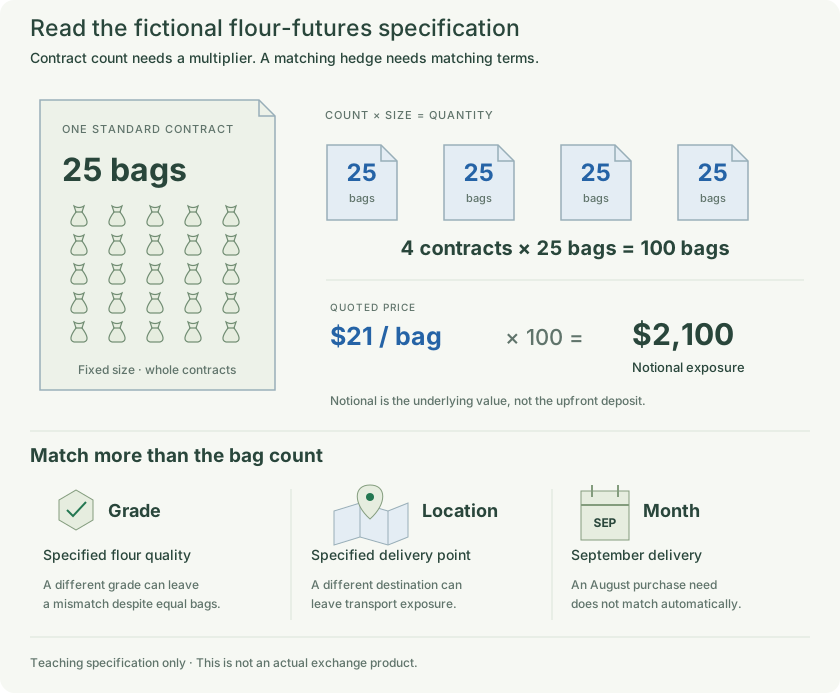
Read a futures specification and match contract quantity to an actual business need.
Exercise 4 — Match a round quantity
For exactly 100 bags, divide the need by the size of one contract. This gives an exact match. Compare that with a customized 100-bag forward: the quantity agrees, but other futures mechanics still differ. Daily settlement will be introduced later.
Exercise 5 — Leave a small gap
Now the bakery needs 110 bags. Four contracts cover only 100. Calculate the uncovered quantity. The standard contract size prevents a perfect match using whole contracts. Do not silently round the business need down when measuring what remains exposed.
Exercise 6 — Compare rounding upward
Five contracts cover 125 bags. Calculate how far that exceeds the 110-bag need. Four contracts leave a gap; five introduce excess exposure. There is no exact whole-contract match here. Choosing between them needs an explicit risk decision.
Read the picture
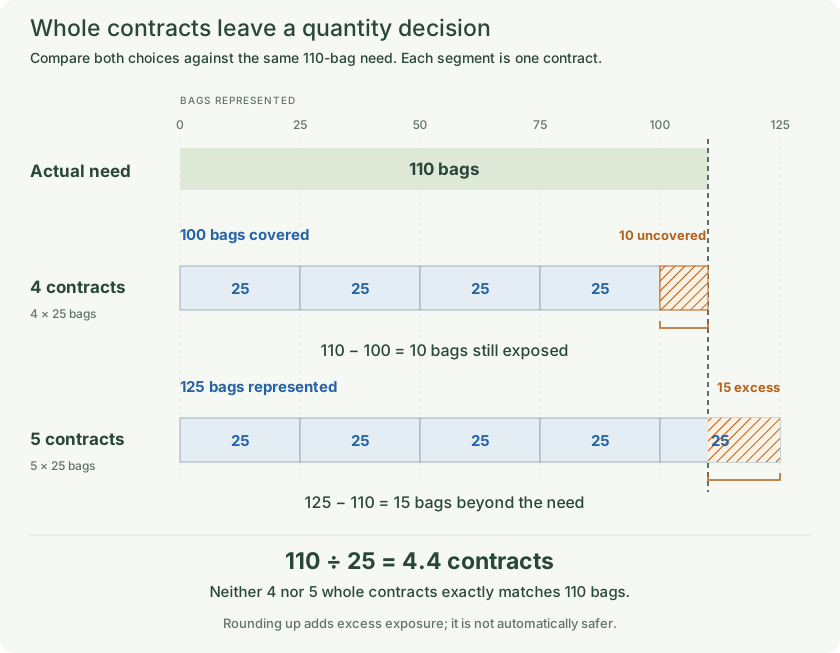
Compare the picture with the calculations above. The figure shows its stated original values; editing a cell does not change it.
Exercise 7 — Check more than quantity
Four contracts may cover 100 bags, but September delivery is different from an August purchase need. Another flour grade or delivery location also matters. Exchanges standardize contracts; clearing interposes a counterparty and manages obligations, but does not make every business mismatch disappear.
Remember
Read a futures specification and match contract quantity to an actual business need.
These are simplified examples with matching terms unless a mismatch is explicitly introduced. Quotes and margin rules are fictional. Fees, financing and withdrawals are excluded unless stated.