Why a hedge may need extra cash
Daily settlement can create a cash demand before a business hedge reaches its goal. Use the same 100-bag long position. Our hypothetical broker requires $600 initial margin and $450 maintenance margin. If the balance falls below $450, top up to $600. There are no withdrawals. These are teaching rules, not universal market requirements.
Predict first, run the calculation, then make the requested change. Each exercise has a check; enter numbers without units.
What triggers a futures margin call?
Initial margin is collateral required to open a position. Maintenance margin is the account threshold used to determine when more collateral is needed. In this lesson’s fictional rule, a balance below $450 triggers a deposit restoring the account to $600; a balance exactly at $450 does not. Broker and exchange requirements can differ.
Top-up = required restored balance − balance before deposit when the rule triggers. The initial deposit is not the purchase price, an option premium or a maximum loss.
Same final loss, different funding needs
Both paths use 100 bags of long exposure and start at $21 with $600 deposited. There are no withdrawals, interest or fees.
| Measure | Path A: $21 → $19 → $22 → $20 | Path B: $21 → $22 → $21 → $20 |
|---|---|---|
| First-day balance before any deposit | $400 | $700 |
| Additional cash required | $200 | $0 |
| Total contributed cash | $800 | $600 |
| Final account balance | $700 | $500 |
| Trading P&L | −$100 | −$100 |
Trading P&L = final balance − total contributions, given no withdrawals, interest or fees. Depositing money does not reverse a trading loss. Daily settlement can create funding needs even when a hedge offsets the business’s price exposure.
Exercise 1 — Identify the collateral
The position represents 100 bags at $21, but its initial margin is $600. Compare those amounts. The collateral is not the full purchase payment, an option premium or a maximum permitted loss. Do not infer a loss limit from the amount initially deposited.
Exercise 2 — Calculate before topping up
The futures price falls from $21 to $19. Start with $600 and apply the long’s $200 loss. Calculate the balance before any extra deposit. Keeping this intermediate number visible makes the margin call understandable. Do not overwrite the loss with the deposit.
Exercise 3 — Test the actual threshold
Our rule triggers a top-up only below $450. Compare $400 and $450 with the threshold. A balance equal to $450 is different from one dollar below it. Real brokers can use different rules; here we apply the stated one precisely.
Read the picture
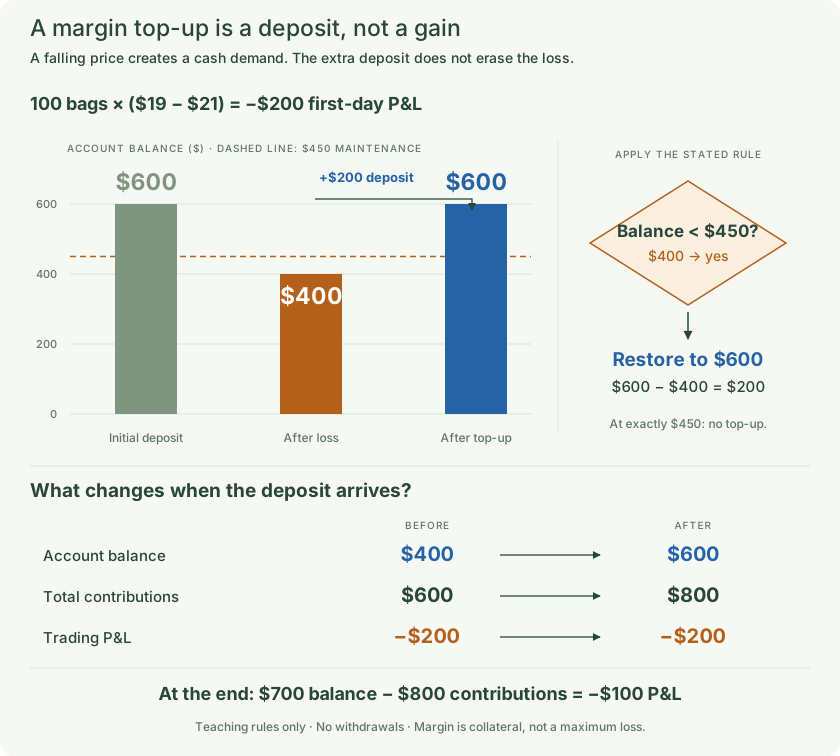
Follow maintenance margin, top-ups and funding needs without counting deposits as profit.
Exercise 4 — Restore the initial balance
After the first-day loss, the account has $400. Deposit enough to restore it to $600, rather than merely to the $450 maintenance threshold. This $200 is additional contributed money, not a recovery of the trading loss.
Exercise 5 — Continue after the deposit
After the top-up the balance is $600. Price rises from $19 to $22, then falls from $22 to $20. Apply those daily changes without making further deposits or withdrawals. Track the account balance separately from cumulative trading P&L.
Exercise 6 — Reconcile every contribution
The ending balance is $700. Contributions were $600 initially plus the $200 top-up. Subtract all contributed cash to find P&L. Counting only the initial deposit would incorrectly make the trade look profitable. Deposits change available cash, not the market outcome.
Read the picture
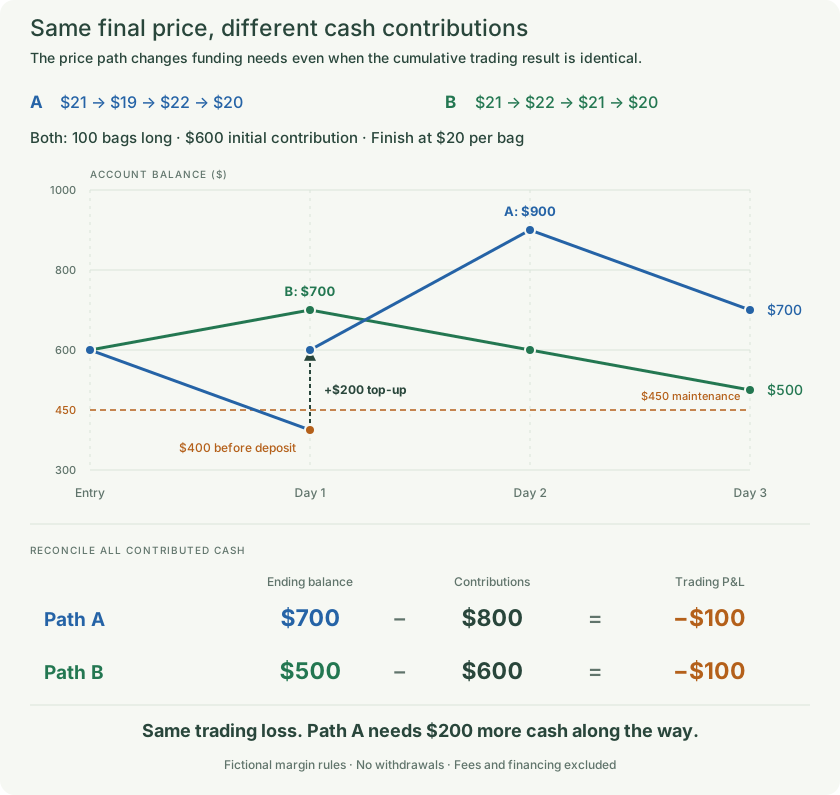
Compare the picture with the calculations above. The figure shows its stated original values; editing a cell does not change it.
Exercise 7 — Compare two paths to the same endpoint
Path B is $21 → $22 → $21 → $20. From $600, its balances are $700, $600 and $500. No call occurs. Both paths finish at $20 and lose $100, but Path A required an extra $200 along the way. A hedge can be economically useful and still require ready cash.
Remember
Follow maintenance margin, top-ups and funding needs without counting deposits as profit.
These are simplified examples with matching terms unless a mismatch is explicitly introduced. Quotes and margin rules are fictional. Fees, financing and withdrawals are excluded unless stated.