Futures gains and losses arrive every day
Unlike our simple forward examples, futures settle gains and losses day by day. Use four 25-bag contracts: 100 bags of long exposure. Settlement quotes follow $21 → $19 → $22 → $20. Begin with a $600 account balance; for now, deliberately exclude top-ups and withdrawals.
Predict first, run the calculation, then make the requested change. Each exercise has a check; enter numbers without units.
What is futures mark-to-market?
Mark-to-market updates a futures position using settlement prices. Daily gains are credited and daily losses debited to the account. For a constant-size long position, daily P&L = quantity × (today’s settlement − previous settlement); use entry price for the first interval. A short reverses the sign.
Worked daily settlement ledger
For 100 bags of long exposure entered at $21, start with $600 collateral and exclude top-ups, withdrawals, interest and fees:
| Day | Settlement price | Daily P&L | Cumulative P&L | Account balance |
|---|---|---|---|---|
| Entry | $21 | — | $0 | $600 |
| 1 | $19 | −$200 | −$200 | $400 |
| 2 | $22 | +$300 | +$100 | $700 |
| 3 | $20 | −$200 | −$100 | $500 |
Daily P&L sums to 100 × ($20 − $21) = −$100. The $500 remaining balance includes contributed collateral; it is not $500 of profit. Maintenance margin and extra deposits are introduced in the next lesson.
Exercise 1 — Measure one day’s move
The first settlement quote is $19 after entry at $21. Subtract yesterday’s quote from today’s quote. For a long position, a negative change means a loss. The price change is dollars per bag; it is not yet the account’s whole loss.
Exercise 2 — Apply all the quantity
Four contracts each cover 25 bags. Multiply the first-day change by both contract count and size. Forgetting the multiplier understates the cash movement. Compare the result with a one-contract position to see the effect of changing size.
Exercise 3 — Post a loss to the account
Start with $600 and add the signed first-day P&L. The resulting account balance includes collateral as well as trading changes. A $400 balance does not mean a $400 profit. Maintenance thresholds are intentionally left out until the next notebook.
Read the picture
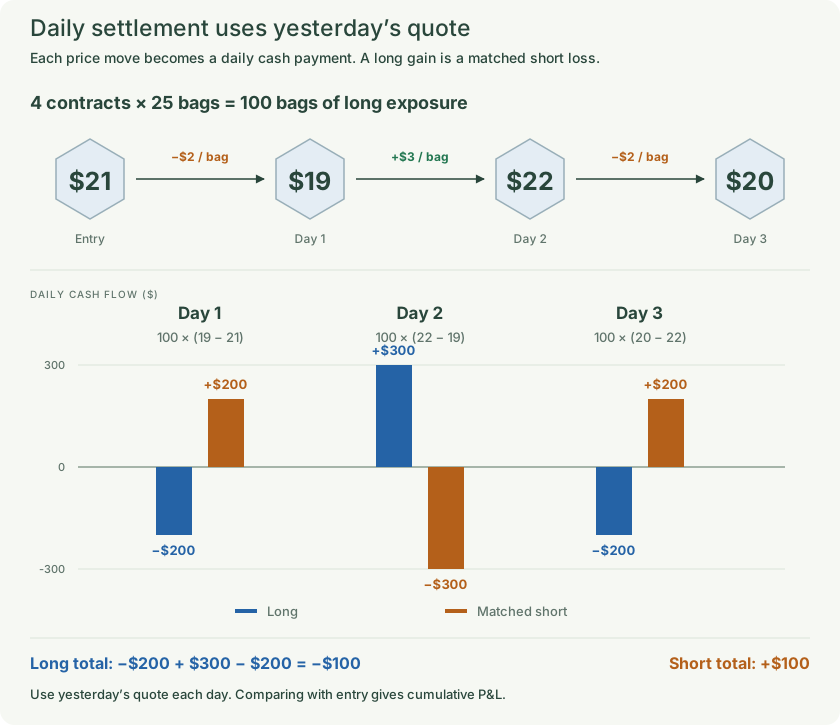
Build a daily settlement ledger and distinguish daily cash flows, cumulative P&L and account balance.
Exercise 4 — Use yesterday’s settlement
Day two settles at $22. Use $19, not the original $21, as the previous settlement quote. The day-two gain is calculated only for that day’s change. Comparing with entry gives a cumulative result instead, which is a different question.
Exercise 5 — Add the final day
Day three settles at $20 after day two’s $22. Add all three signed daily changes. Large gains on one day can coexist with an overall loss. Keep the sequence visible so you can explain where each amount came from.
Exercise 6 — Reverse the cash flows for a short
For a short position, yesterday minus today reverses the sign. Calculate all three daily amounts for the same 100 bags. Each long gain is a short loss in this simplified matched example. The two sides are not both making money from the same price movement.
Read the picture
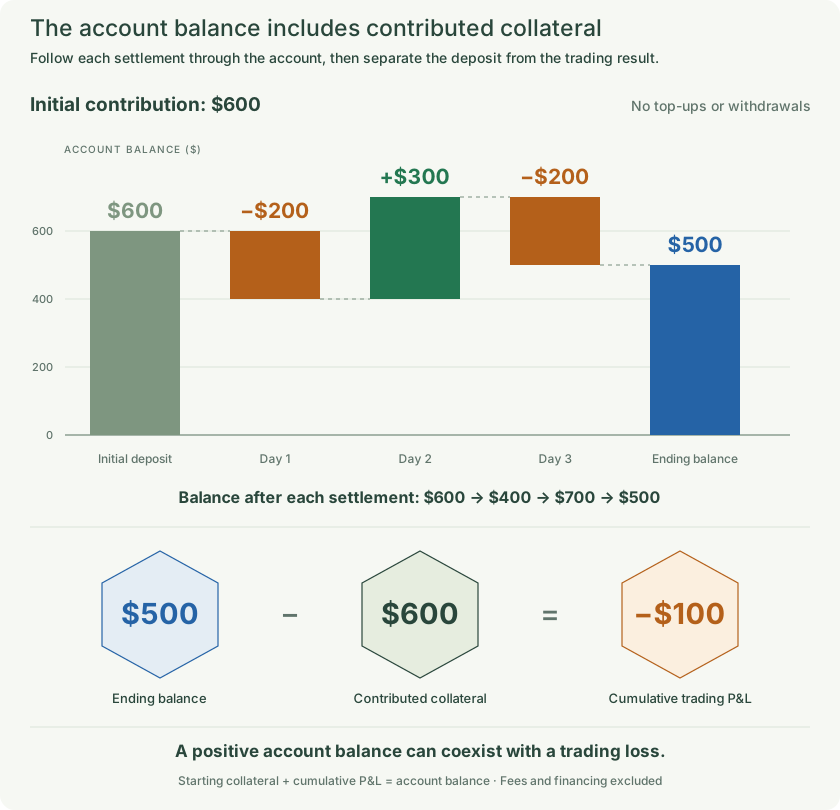
Compare the picture with the calculations above. The figure shows its stated original values; editing a cell does not change it.
Exercise 7 — Separate account balance from profit
The long started with $600 and lost $100 overall. Calculate its ending balance and subtract the initial contribution to recover trading P&L. No top-ups, fees or withdrawals are included here. Compare this with saying the account made $500: that would count the deposited money as profit.
Remember
Build a daily settlement ledger and distinguish daily cash flows, cumulative P&L and account balance.
These are simplified examples with matching terms unless a mismatch is explicitly introduced. Quotes and margin rules are fictional. Fees, financing and withdrawals are excluded unless stated.