A hedge can work even when you pay more
Run the small calculations from top to bottom.
The bakery has agreed to buy 100 bags for $21 each. Next month, the market price falls to $17. Someone says the agreement failed because flour is cheaper elsewhere. But what was the bakery trying to achieve: the lowest possible bill, or a bill it could plan around?
Work through the seven exercises in order. First predict the outcome, then run the cell. Make the requested change and run it again before answering the check. For numeric answers, enter the number without units.
How does a forward hedge work?
Hedging offsets an existing exposure. A buyer exposed to rising commodity prices can use a long forward; a seller exposed to falling prices can use a short forward. Success means meeting the risk objective, rather than guaranteeing the best eventual market price.
Full hedge vs partial hedge vs oversized hedge
For a buyer, effective cost = purchase quantity × market price − forward quantity × (market price − agreed price). This cash-equivalent model represents a price lock; do not also add a separate physical forward purchase.
| Hedge for a 100-bag need at $21 | Effective cost at market $17 | Effective cost at market $25 |
|---|---|---|
| None | $1,700 | $2,500 |
| Partial: 60 bags | $1,940 | $2,260 |
| Full: 100 bags | $2,100 | $2,100 |
| Oversized: 140 bags | $2,260 | $1,940 |
The full hedge fixes the bill under matching-contract assumptions. Partial hedging leaves risk; an oversized hedge adds exposure beyond the business need.
The model we are using
We compare a single future delivery date, matching bags of flour and dollar prices per bag. A forward is assumed to be honored. There are no storage charges, transaction fees or financing costs in these examples.
These simplifications let us understand the cash flows before adding market details. Write down what each number represents: a quantity, a price per bag, a total payment or a contract payoff.
Exercise 1 — Name the risk before the hedge
The bakery needs to buy 100 bags. Rising prices hurt its budget. A supplier planning to sell flour faces the opposite exposure. Calculate the unhedged bill at $25, then at $30. Before adding a contract, identify whose cash flow gets worse when prices rise.
Exercise 2 — Combine the need and the contract
The bakery buys flour at market and receives the cash-equivalent payoff of a matching long forward at $21. Subtract the contract payoff from the market bill. This is an alternative way to model the same price lock as physical delivery, not an additional contract layered on top.
Exercise 3 — Check the unpleasant scenario
At $17, the forward has a negative payoff. Subtracting that negative number increases effective cost. Work through the signs carefully. Compare the result with the $1,700 unhedged bill. Predictability has a trade-off: the bakery gives up the benefit of cheaper flour on the hedged quantity.
Read the picture
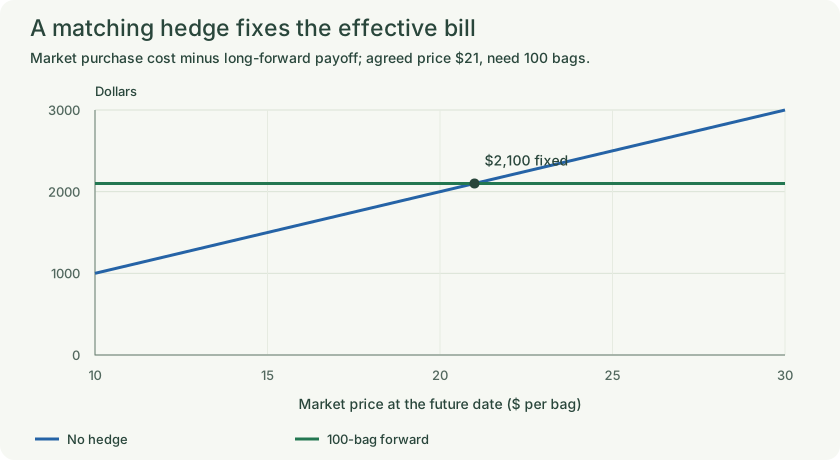
The flat green line is the matching hedge. Below $21 the bakery gives up savings; above $21 it avoids a higher bill.
The figure uses the stated contract terms. Code edits do not change this illustration.
Exercise 4 — Hedge only part of the need
Suppose the forward covers 60 bags while the bakery buys 100. The remaining 40 bags still depend on market prices. Calculate effective cost at $25, then change both market prices to $30. Partial protection reduces exposure without eliminating it.
Exercise 5 — Spot an oversized hedge
Now the forward covers 140 bags, but the bakery needs only 100. At $25, the extra long exposure happens to help. Change both market prices to $17 and observe what happens. A hedge larger than the real need introduces a directional bet on the extra quantity.
Read the picture
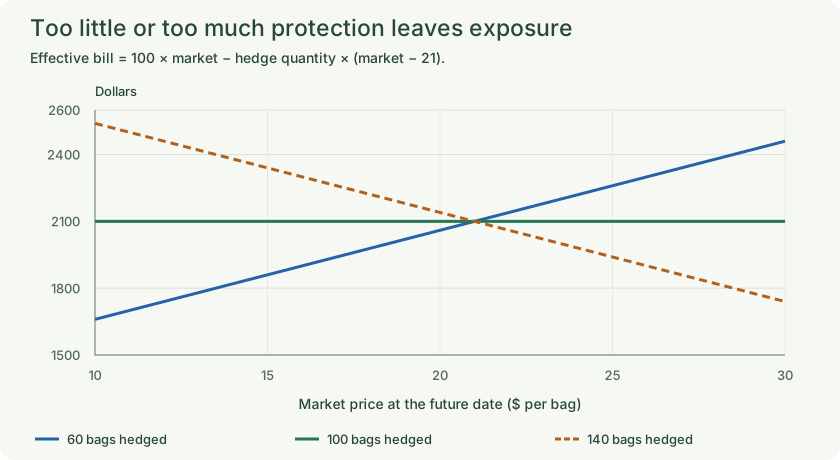
Only the 100-bag hedge is flat. A 60-bag hedge leaves some buying risk; a 140-bag hedge introduces an extra bet in the opposite direction.
The figure uses the stated contract terms. Code edits do not change this illustration.
Exercise 6 — Protect the seller’s revenue
The supplier plans to sell 100 bags. It uses a short forward: it benefits when market prices fall. Add the short-forward payoff to market revenue at $17. Then use $25 throughout. A seller’s hedge has the opposite direction from a buyer’s hedge.
Exercise 7 — Choose a measure of success
The bakery’s target was a bill no higher than $2,200. The matching forward fixes it at $2,100. At a market price of $17, compare the hedged bill with the target rather than only with the market alternative. Then explain the difference between budget certainty and beating the market.
Remember
A hedge reduces an existing uncertainty. It does not promise to beat the eventual market price.
These examples ignore financing, fees other than the option premium, and failure to fulfill contracts. Flour quantity, quality and delivery date match exactly.