Economic value and net interest income
A fictional lender reports that higher rates help next year’s interest income. Its fixed-rate assets can still lose economic value. Build both ledgers for the same shock, then check whether either ledger supplies cash for withdrawals.
Predict, run the provided Java calculation, then make the requested edit before answering. Each exercise uses its own stated inputs. Enter numbers without units; round final answers to two decimals unless four are requested. Keep intermediate precision. Code supports the finance rather than teaching Java syntax.
Why can income and economic value move differently?
Economic value of equity (EVE) is . It compares the value of cash flows over their modeled lives. A duration-based shock estimate is
, with positions and effective sensitivities measured consistently. Here positive net DV01 is the equity loss magnitude per upward basis point.
Net interest income (NII) over the next year is interest earned minus interest paid within that stated horizon. In this simplified accrual ledger it excludes principal, valuation marks, credit losses, fees and operating expenses. A repricing gap describes amounts that reset in a time bucket; cash rates, pass-through and the length of time after reset are needed to turn it into income. Neither EVE nor NII alone measures funding liquidity.
| Balance today | Amount | Stipulated rate behavior |
|---|---|---|
| Fixed-rate assets | $600,000 | Earn 5% for the coming year; effective continuous-rate duration 5 |
| Floating-rate assets | $400,000 | Earn 6% base; reset immediately with full shock; effective duration 0 at reset |
| Deposits | $900,000 | Pay 3% base; reset after half a year; pass through 50% of the shock |
The asset PVs total $1,000,000 and deposit modeled PV is $900,000. Deposits have a supplied effective duration of 1, incorporating toy behavioral assumptions; they are not one-year zeros or a claim that demand deposits have a universal duration. Asset principal balances equal their starting PVs by stipulation. Rates for the income ledger are simple annual accrual rates. Apply the same small decimal shock to both ledgers as an explicit scenario approximation; full valuation would model curve changes and behavior directly.
Scenario and assumptions
No balances change and there are no defaults in the base income scenario. Fixed interest stays unchanged; the $400,000 floating balance earns the shock for a full year; deposits pay the passed-through shock for only the last half-year. EVE uses supplied local sensitivities, including modeled deposit behavior. The withdrawal in exercise 7 is a separate liquidity stress, not part of the unchanged-balance income projection. Its $20,000 available cash is part of existing assets, not extra equity.
Exercise 1 — Value the starting equity
Subtract positive liability PV from total positive asset PV. This is economic value under supplied assumptions, not an accounting capital or regulatory ratio.
Exercise 2 — Net the dollar sensitivities
Use fixed assets’ duration 5, floating assets’ duration 0 at the immediate reset and deposits’ supplied duration 1. Convert the net dollar duration into dollars per basis point.
Exercise 3 — Estimate the economic-value shock
Apply a +100 bp shock = 0.01 to net dollar duration. Keep the minus sign and report the change, not ending EVE.
Same rate shock, different horizons
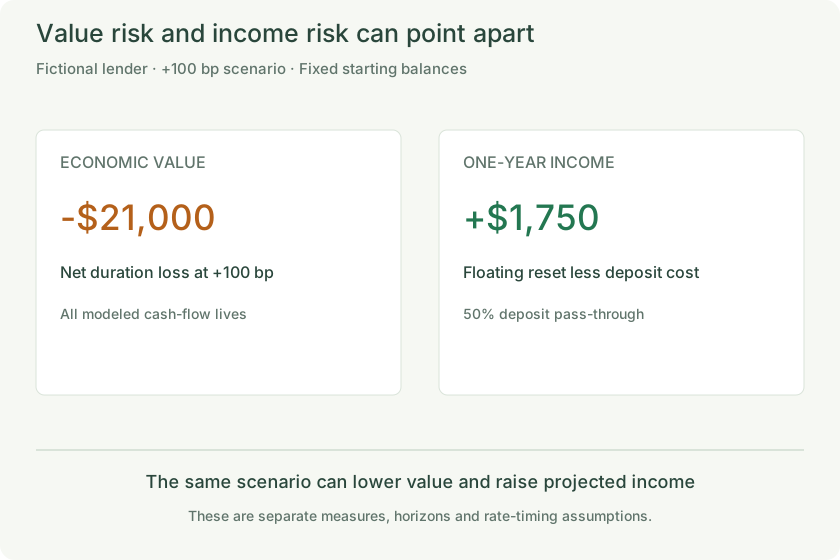
At +100 bp: estimated EVE change −$21,000; one-year NII change +$1,750 with 50% deposit pass-through. These ledgers answer different questions.
The illustration uses fixed worked inputs. Editing code does not update it.
Exercise 4 — Build the unshocked one-year income
Earn 5% on fixed assets and 6% on floating assets; pay 3% on deposits for the full year. Do not include either principal or a valuation loss in NII.
Exercise 5 — Apply reset dates and partial pass-through
Floating income increases immediately by . Deposit cost increases by . Fixed income does not reset.
Exercise 6 — Stress deposit pass-through
Run the base change, then replace the first 0.5 (pass-through) by 1.0, keeping the final 0.5-year exposure unchanged. This is a separate scenario with 100% pass-through; do not change the EVE duration assumptions silently.
Behavior and cash availability matter
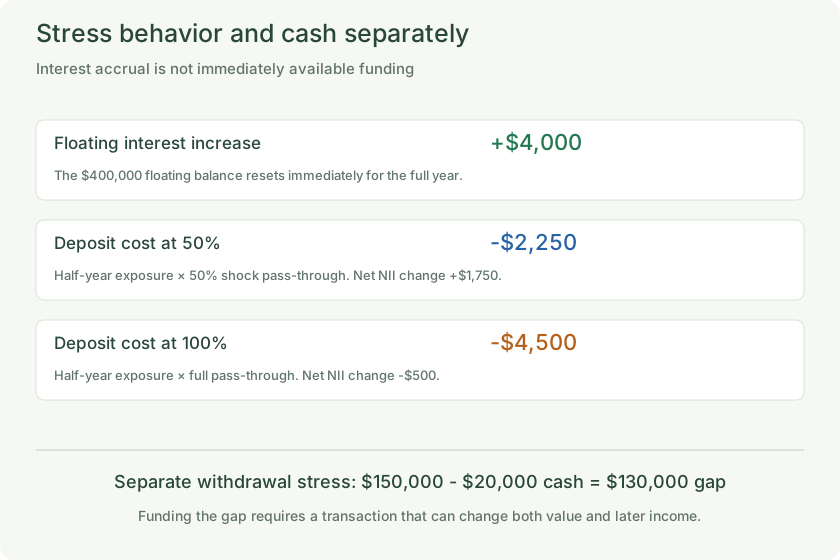
At 100% pass-through, NII change becomes −$500. Separately, a $150,000 withdrawal against $20,000 cash needs $130,000 funding.
The illustration uses fixed worked inputs. Editing code does not update it.
Exercise 7 — Check liquidity independently
In a separate immediate stress, depositors withdraw $150,000 and only $20,000 of existing assets is available cash. Calculate the funding gap before security sales or borrowing. Positive modeled equity and future interest accruals cannot pay today’s cash call on their own.
Remember
Specify the horizon, reset dates and pass-through before calculating income risk. Keep PV changes, interest accruals and principal cash funding in separate ledgers. Behavioral deposit assumptions and balance-sheet actions can change all three.