Match assets and liabilities
The bakery owes $1,100 for equipment in three years. It can buy one- and five-year zeros. Match value and rate sensitivity today, then challenge whether those two matches guarantee the cash will be available on the invoice date.
Predict, run the provided Java calculation, then make the requested edit before answering. Each exercise uses its own stated inputs. Enter numbers without units; round final answers to two decimals unless four are requested. Keep intermediate precision. Code supports the finance rather than teaching Java syntax.
What must an immunized balance sheet match?
Let surplus be . Under a small parallel continuous-rate shift,
Matching duration numbers alone is insufficient: match PV, , and dollar duration, . All liabilities are valued as positive obligations before subtracting them from assets.
At a flat continuous 4%, the single $1,100 year-three liability has , duration 3 and convexity 9. A barbell of one- and five-year zeros has duration , where is the fraction of asset market value at year one. Equal market-value weights give duration 3 but convexity , exceeding the liability’s 9.
For an instantaneous parallel shift, the second-order surplus is approximately . This is local immunization with a positive curvature cushion, not dated cash-flow matching. Holding a year-three zero with exactly $1,100 face would instead match the one promised payment, subject to its credit and settlement terms.
A year-one receipt must be reinvested to year three. The year-five claim must be sold at year three. Both create assumptions that a current PV and duration calculation alone cannot guarantee.
Scenario and assumptions
Use certain tradable zeros, continuous compounding, fractional holdings, no costs and a flat initial 4% curve. The $1,100 liability remains payable in three years. Exercises 4–6 revalue instantly today without passage of time. Exercise 7 is a separate future-path scenario with no rebalancing: first-year proceeds reinvest at 0%, while the five-year zero can be sold at year three using a 4% remaining two-year yield.
Exercise 1 — Value the liability
Discount the actual $1,100 payment for exactly three years. Today’s funding target is its present value, not the terminal face amount.
Exercise 2 — Solve the duration weight
Solve for the one-year market-value weight. Report the weight as a percentage, not the face allocation.
Exercise 3 — Turn the long bucket’s PV into face
Allocate half the unrounded liability PV to the five-year zero and grow that PV at the initial continuous 4% over five years. This determines the actual year-five payment purchased.
Match PV and dollar duration
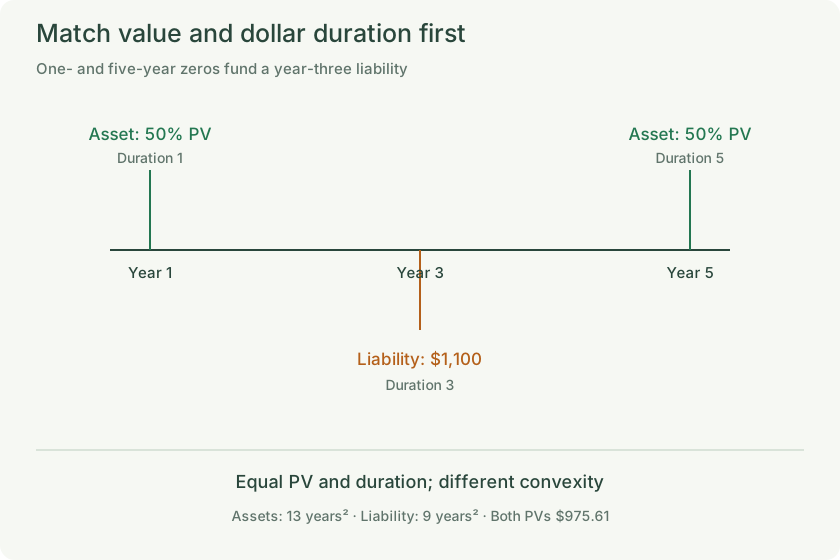
Liability PV $975.61, duration 3. Allocate $487.81 PV to each of years 1 and 5. Asset duration is 3, convexity 13.
The illustration uses fixed worked inputs. Editing code does not update it.
Exercise 4 — Check the convexity cushion
For a +100 bp parallel shift, use the asset-minus-liability convexity difference. Both initial PV and first-order dollar duration are already matched.
Exercise 5 — Reprice both sides and reverse the shock
The code calculates exact asset PV minus liability PV for +100 bp. Change all three 0.01 inputs to -0.01 for a separate downward parallel shift. The initial faces remain fixed.
Exercise 6 — Break the parallel-shift assumption
Keep the one-year and liability’s three-year nodes unchanged but raise the five-year node by 100 bp. Reprice the long asset only; the liability PV does not change.
A payment date is still a payment date
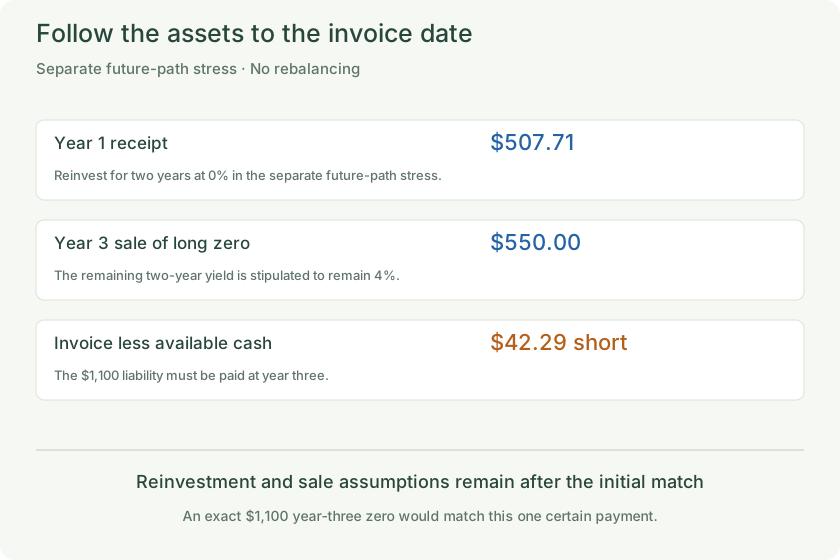
Year-one proceeds need reinvestment; the year-five zero needs sale at year three. Under the separate 0% reinvestment path, the invoice shortfall is $42.29.
The illustration uses fixed worked inputs. Editing code does not update it.
Exercise 7 — Follow cash to the liability date
At year one the short zero pays half of . In this separate path it earns zero until year three. At year three the long zero sells for $550 because its remaining yield is still 4%. Subtract the $1,100 invoice.
Remember
Match present values and dollar durations before calling a position immunized. Compare convexities, stress curve shape, and follow actual cash to each liability date. A local value match does not guarantee liquidity or reinvestment outcomes.