Hedge several parts of the curve
Two portfolios can have equal total DV01 while reacting differently to a steepening curve. Divide the bakery’s reserve cash flows into maturity buckets, try a single hedge, then match each bucket and explain why the toy result is unusually exact.
Predict, run the provided Java calculation, then make the requested edit before answering. Each exercise uses its own stated inputs. Enter numbers without units; round final answers to two decimals unless four are requested. Keep intermediate precision. Code supports the finance rather than teaching Java syntax.
Why can a zero total DV01 leave risk?
A key-rate DV01 measures a position’s loss for a one-basis-point bump at one specified curve node, with the other nodes held fixed under a stated interpolation rule. Here all payments fall exactly on the one-, three- and five-year nodes, so no interpolation is needed. A continuous zero with current market value V and maturity has node DV01 . Positive signed holdings have positive loss sensitivities; a short hedge contributes a negative sensitivity.
For a vector of node shocks in basis points,
Summing the DV01s only tests an equal move at every node. A twist need not cancel.
| Portfolio cash-flow date | Current PV at flat continuous 4% | Key-rate DV01 ($/bp) |
|---|---|---|
| Year 1 | $20,000 | 2 |
| Year 3 | $30,000 | 9 |
| Year 5 | $10,000 | 5 |
Each hedge unit is a tradable zero with current market value $1,000, not $1,000 face. Units at years 1, 3 and 5 carry DV01 0.1, 0.3 and 0.5 respectively. Signed units are negative for short positions. Fractional units are allowed. Hedge notionals and sale proceeds must be financed and managed; they are not gains.
Scenario and assumptions
The reserve consists of fixed certain payments whose current PVs are given above. Use frictionless zero-coupon claims at identical dates and under the same continuous curve, with shorting, fractional units and a cash account available. Shocks are instantaneous at today’s valuation. A one-unit zero paying at has fixed face ; after a node shock it is worth .
Exercise 1 — Aggregate the parallel exposure
Sum all three loss sensitivities. This number predicts a parallel shift only; it does not erase the maturity labels.
Exercise 2 — Try one three-year hedge
Divide negative total portfolio DV01 by the three-year hedge unit’s 0.3. A short holding offsets the long portfolio’s parallel sensitivity.
Exercise 3 — Inspect the middle bucket after that hedge
All −16 hedge DV01 sits in the three-year bucket. Its residual becomes 9 − 16; the one- and five-year buckets remain +2 and +5.
Zero total does not mean zero buckets
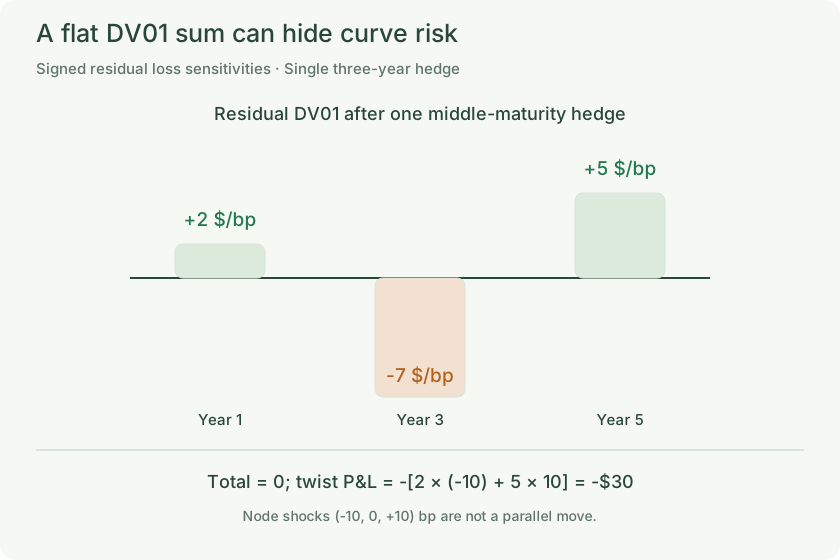
One three-year hedge leaves DV01 (+2, −7, +5). The total is zero. A (−10, 0, +10) bp twist still loses about $30.
The illustration uses fixed worked inputs. Editing code does not update it.
Exercise 4 — Stress a twist
Move the one-year rate down 10 bp, leave three years unchanged, and move five years up 10 bp. Apply the shock separately to every residual bucket.
Exercise 5 — Replace the single hedge with a bucket hedge
Short 20 one-year units to offset 2/0.1 and 30 three-year units to offset 9/0.3. Calculate the five-year units needed to offset 5/0.5. These replace the earlier −53.3333… middle units; do not add them on top.
Exercise 6 — Change the steepening stress
Return to the single middle hedge for comparison. Run the original twist, then change the final shock from 10 to 20 bp while keeping the one-year shock at −10 bp.
Three dates, three matching claims
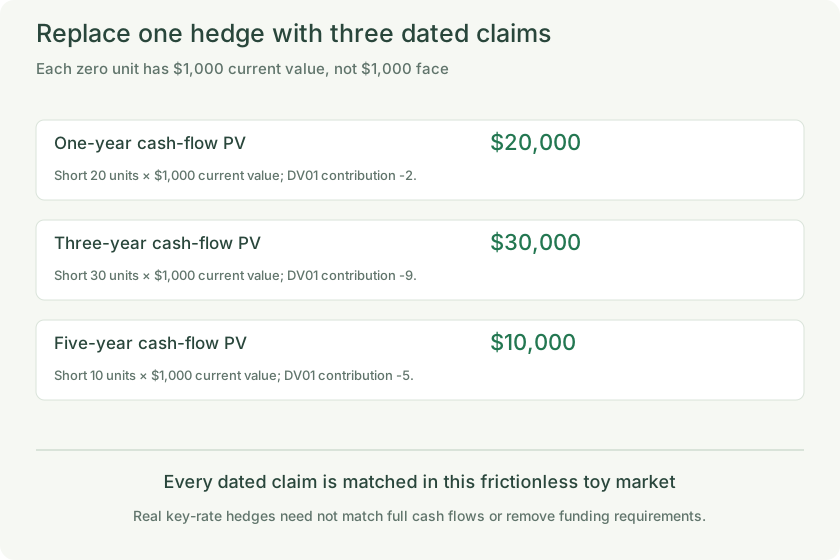
Replacement short zero units: −20 at year 1; −30 at year 3; −10 at year 5. Every cash-flow date is matched in this toy market.
The illustration uses fixed worked inputs. Editing code does not update it.
Exercise 7 — Reprice the full bucket hedge
Reprice the original cash flows under the edited twist and add all three replacement hedges. The code uses value changes, so hedge sale proceeds are not counted as profit.
Remember
Retain maturity buckets when aggregating risk. Test parallel, steepening and flattening scenarios separately. A key-rate hedge usually provides local protection; this example becomes exact only because every cash flow can be matched with a tradable zero.