Calendar dates change interest payments
Two contracts can state the same annual percentage and still pay different cash amounts. They may count a different number of days, use a different denominator or shift a payment to another business day. Add the calendar and quotation details that a bare rate number leaves out, then reconcile a bond’s screen quote with its settlement invoice.
Predict the result, run the standalone calculation, then make any requested edit before answering. Each exercise retains its own stated inputs. Enter numeric answers without units and round to two decimals unless four are requested. Code is provided to explore the finance; no new Java syntax is required.
Which dates and conventions determine interest?
ACT/360 uses actual elapsed days divided by 360. ACT/365 Fixed uses actual elapsed days divided by 365, including in a leap year. An Actual/Actual convention needs its specific year or coupon-period rule; the name alone does not determine one universal formula.
| Example term | Rule stipulated in this notebook |
|---|---|
| Date interval | Include the start, exclude the end when counting elapsed days |
| 30/360 illustration | Treat each month as 30 days, cap each date’s day number at 30; ignore other February variants |
| Following | Move a nonbusiness payment date to the next business day |
| Modified Following | Use Following unless it crosses into the next month; then move backward |
| Business day | Monday–Friday only; no holidays in this fictional calendar |
The accrual start/end, fixing date, payment date and settlement date can be different. A payment adjustment does not automatically change the accrual end: read whether the schedule is adjusted or unadjusted. Interest does not simply stop accruing during every weekend; the convention supplies the weighting.
A bond’s clean price excludes accrued interest; , under the stated no-ex-coupon assumptions. A quote per 100 face must be multiplied by face amount / 100 to obtain cash. On an actual-day coupon-period basis here, .
These are specified teaching rules, not a complete catalogue of bond, repo or derivative conventions. Another contract may use different holidays, leap-year treatment, day-count endpoints, ex-coupon rules or settlement terms.
Scenario and assumptions
Loan examples use a $100,000 principal and 6% simple annual quote. January 15 to February 15, 2026 has 31 actual days. The separate bond pays a $3 semiannual coupon per $100 face; its unadjusted January 15–July 15, 2026 coupon period has 181 days, and April 15 settlement is 90 days after January 15. Assume the buyer receives the full next coupon, with no fees, taxes, default or ex-coupon adjustment. The calendar-adjustment example is separate from the bond.
Exercise 1 — Count elapsed calendar days
Use the supplied Java date calculation to count January 15 through February 15, 2026 as an elapsed interval. January has 31 days. The calculation implements the stated start-inclusive/end-exclusive interval; it does not decide the financial day-count denominator for you.
Exercise 2 — Apply ACT/360 to the loan
Use 31 actual days and divide by 360 under this loan’s rule. Do not replace 31 with 30 merely because the interval spans one calendar month. A day count and a year denominator are separate inputs.
Exercise 3 — Change the denominator to ACT/365 Fixed
Keep principal, rate and the same 31 actual days, but use a different contract that specifies ACT/365 Fixed. Compare its interest with exercise 2; a lower amount does not imply a lower quoted 6% annual number. The units of that quotation have changed.
Read the picture
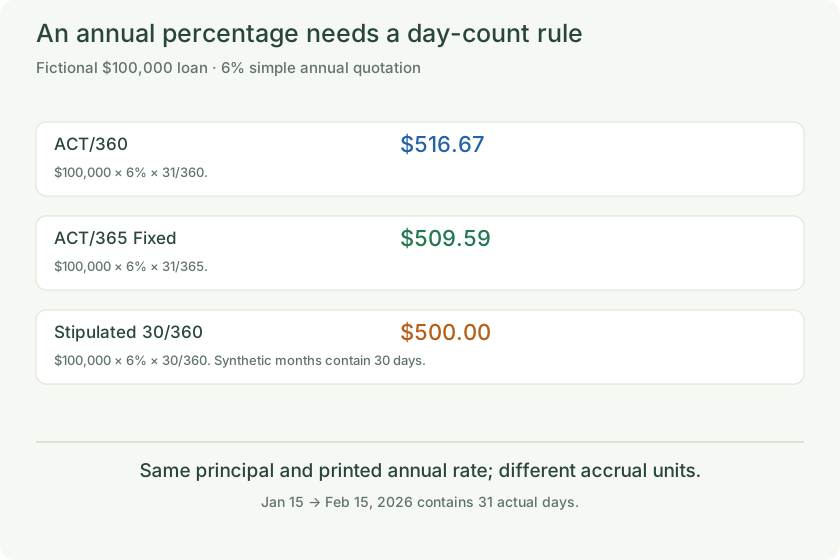
The same 31-day loan at 6% pays $516.67 on ACT/360, $509.59 on ACT/365 Fixed and $500 on the separately stipulated 30/360 basis.
The illustration is a fixed worked example. Editing a calculation does not update it.
Exercise 4 — Use the stipulated synthetic 30/360 interval
Under this notebook’s stated 30/360 rule, January 15 to February 15 contains thirty synthetic days. Calculate interest with 30/360. The example does not resolve all month-end and February variants used by actual contracts; their exact definitions would need to be supplied.
Exercise 5 — Accrue a bond coupon using its full coupon period
For the separate bond, the next coupon is $3 per $100 face and the whole unadjusted coupon period has 181 days. At settlement 90 days have elapsed. Allocate 90/181 of the coupon to the seller as accrued interest. This is a coupon-period ratio, not the loan’s 90/360 rule.
Exercise 6 — Turn clean price into the settlement cash invoice
The clean quote is 99.20 per 100 face, with the exact accrued interest from exercise 5. Add accrued interest before scaling to $10,000 face, a factor of 100. Run the base invoice, then change only clean price from 99.20 to 98.70. Keep the settlement date and accrued interest fixed.
Read the picture
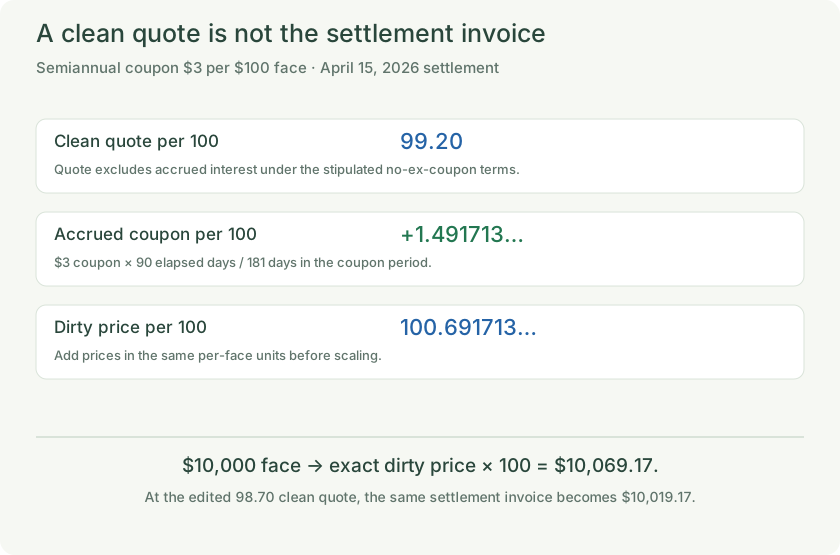
The bond invoice adds 90/181 of its $3 coupon to a 99.20 clean quote per 100, then scales by 100 for $10,000 face.
The illustration is a fixed worked example. Editing a calculation does not update it.
Exercise 7 — Move the payment date without inventing an accrual rule
May 31, 2026 is Sunday. With the stated weekend-only calendar, Following pays Monday June 1. Modified Following instead pays Friday May 29 because June 1 crosses the month boundary. The code measures the three-day gap between those alternatives. Suppose the contract separately fixes its unadjusted accrual end at May 31.
Remember
Keep calendar days, synthetic days, year denominators and coupon-period fractions separate. Specify business-day adjustments rather than guessing from a date. A clean quote is not the settlement cash invoice: add accrued interest in the same per-face units, then scale once to the trade’s face amount.