Which rate belongs in this calculation?
The bakery’s financing discussion now includes an unsecured loan, secured borrowing and a derivative with cash collateral. Calling all three quotations “the interest rate” hides different promises and risks. Identify the instrument and payment currency before deciding which rate determines its cash flow or present value.
Predict the result, run the standalone calculation, then make any requested edit before answering. Each exercise retains its own stated inputs. Enter numeric answers without units and round to two decimals unless four are requested. Code is provided to explore the finance; no new Java syntax is required.
What does an interest-rate quote actually describe?
| Rate family | What it describes | What must still be checked |
|---|---|---|
| Treasury or government yield | A specified sovereign instrument’s market return | Currency, maturity, liquidity, tax and sovereign risk assumptions |
| Repo rate | Cash financing against specified securities and terms | Haircut, collateral quality, specialness, access and liquidation risk |
| Overnight reference | A defined overnight funding observation | Secured/unsecured design, observation dates and compounding |
| Term unsecured borrowing | An issuer’s borrowing over a stated period | Credit exposure, funding access, tenor and liquidity |
| Collateral remuneration | Interest paid on agreed cash collateral | Currency, agreement, coverage, timing and eligible collateral |
A “risk-free rate” is a modeling benchmark, not a guarantee that every government security, deposit or repo has identical risk. A credit-sensitive loan rate can include more than expected default loss; funding, liquidity, term and institutional terms matter too.
for a simple-interest loan. Overnight observations used over several days generally compound factors (with the rate and the day fraction for observation ) under the specified rule; one quoted overnight observation does not fix all future days.
Projection and discounting answer different questions. A supplied projected interest cash flow can use one rate while its present value uses a specified collateral-consistent discount curve. This lesson stipulates the model rather than deriving the full multiple-curve framework. A bank’s own loan rate should not be mechanically added to every derivative discount rate.
Always identify the cash-flow currency before choosing a curve. Discounting EUR at a USD rate without the associated currency conversion/hedge is not a valid shortcut. The two-rate replication from the currency-forward lesson remains necessary when converting values across currencies.
Scenario and assumptions
Every numerical quote is fictional. Loan/repo interest uses simple ACT/360 with day counts supplied directly; the calendar mechanics follow in the next lesson. Continuous rates are explicitly labeled for valuation examples. Assume complete usable cash collateral and no residual credit or additional funding adjustment only where that valuation model is stipulated. No example supplies current market quotes or prescribes an actual collateral agreement.
Exercise 1 — Apply the rate in the actual borrowing contract
The bakery borrows $10,000 unsecured for 90 stated accrual days at an 8% simple ACT/360 rate. That quotation determines the promised interest. Replacing it with a lower government yield would change the loan’s terms rather than value the same obligation more accurately.
Exercise 2 — Use the cash lent in a repo, not just the security’s value
A fictional repo lends cash equal to 98% of a security’s $10,000 market value, a 2% haircut. Its cash principal is $9,800. At 3% simple ACT/360 for 30 days, calculate interest on that cash amount. The haircut is collateral protection, not an extra interest charge or a guaranteed recovery.
Exercise 3 — Infer a yield from a government zero-coupon price
A fictional one-year government instrument pays $100 with price $98. Assume certain payment for this calculation and no interim income. Solve the continuous annual yield as −log(price / face). The resulting percentage is a quotation for this instrument under these assumptions, not a universal rate for the bakery’s credit.
Read the picture
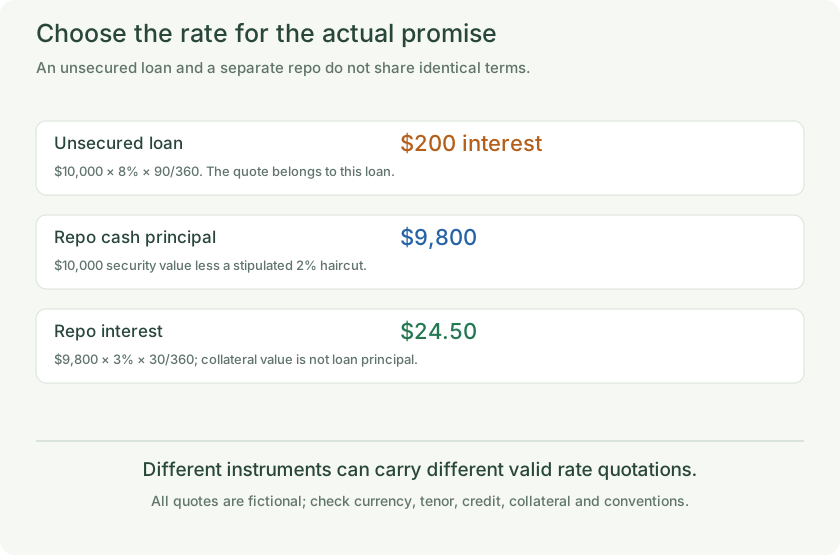
An unsecured $10,000 loan at 8% earns $200 over 90/360, while a separate $9,800 repo loan at 3% earns $24.50 over 30/360.
The illustration is a fixed worked example. Editing a calculation does not update it.
Exercise 4 — Compound two already known overnight observations
A separate $10,000 balance earns 4% simple ACT/360 for one day, then 6% for the next day. Both observations are assumed already known, with no holiday weighting in this two-day example. Multiply the two daily factors and subtract principal. This is realized compounded interest, not a forecast made from day one alone.
Exercise 5 — Discount under an explicitly stated collateral model
For this independent example, a certain USD $1,000 payment in one year belongs to an ideal fully USD-cash-collateralized valuation model. Its stipulated continuous discount rate is 2%. Calculate present value, then change only the payment horizon from 1 to 2 years. Assume the same model rate over that whole horizon.
Exercise 6 — Separate the amount projected from the discount factor
A supplied toy valuation model projects one-year interest on $10,000 at a 4% projection rate, giving $400 in pricing-measure expected cash. The model discounts that projected payment at 2% continuously. This is a stipulated projection/discount split, not a claim that a currently quoted 4% will certainly be the realized floating fixing.
Read the picture
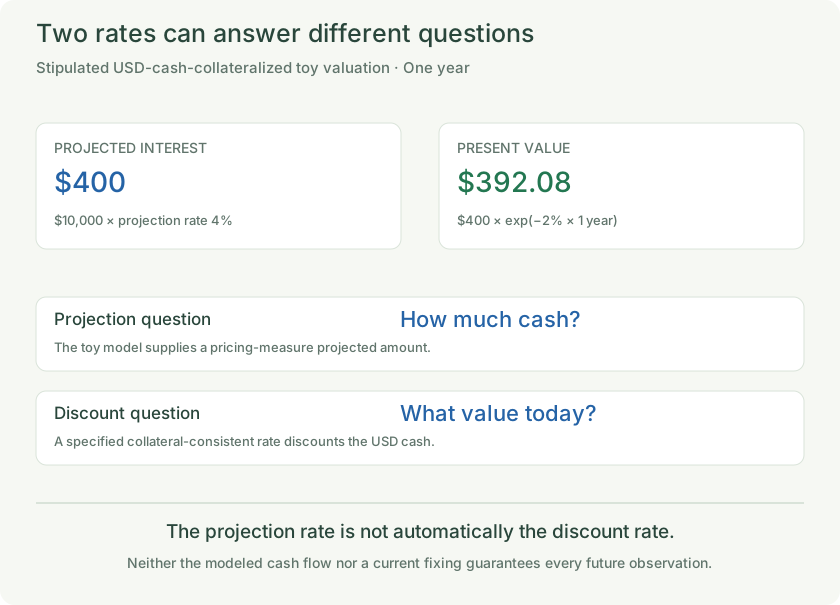
A model projects $400 using a 4% projection rate, then discounts that cash at 2% to $392.08; the projection and discount steps have different purposes.
The illustration is a fixed worked example. Editing a calculation does not update it.
Exercise 7 — Keep the currency of the claim explicit
A final independent claim pays EUR 1,000 in one year. The stated EUR valuation curve is 1% continuous, while an unrelated USD curve is 4%. Calculate the value in euros. A USD value would also require a consistent conversion or FX hedge; simply selecting the larger rate does not perform that conversion.
Remember
Name the instrument, issuer or collateral, currency, tenor and quotation before using a rate. Contractual interest, realized overnight accrual, projected cash and discounted value are different quantities. Benchmark rates are proxies with assumptions; secured financing and collateral do not remove all credit, liquidity or timing risks.