Bond yield, par yield and zero yield
The bakery can price a bond from dated payments, but its screen also shows a single yield. That number compresses a price into one quoted discount rate; it is not the same thing as the bond’s coupon or every maturity’s zero rate. Work through one bond and a small curve to keep these similar-looking percentages separate.
Predict the result, run the standalone calculation, then make any requested edit before answering. Each exercise retains its own stated inputs. Enter numeric answers without units and round to two decimals unless four are requested. Code is provided to explore the finance; no new Java syntax is required.
Which yield answers which question?
| Quantity | Definition in this annual-payment example |
|---|---|
| Coupon rate | Contract rate determining the bond’s promised coupon |
| Annual zero yield | Single-payment rate with |
| Yield to maturity | One rate discounting this bond’s own coupons/principal to its price |
| Par yield | Coupon rate making a hypothetical matching-maturity bond worth face |
For $100 face with a $5 coupon in one year and $105 in two years, . With , is $99.35 on the stated coupon date, so clean and dirty prices coincide here.
The bond’s annual YTM solves
For this two-payment example a supplied quadratic solution gives . The positive root matches positive discount factors. General bonds usually need a numerical root-finder; no quadratic formula is assumed to solve every bond.
For a two-year annual par coupon in dollars per $100, , hence . With $100 face the annual coupon amount is numerically equal to the coupon rate in percent, though dollars and percentage are still different units.
YTM is a price summary for specified cash flows. It does not promise a realized holding-period return when coupons must be reinvested at unknown rates, or when the bond is sold early or defaults. A non-flat curve can give different YTMs to bonds with different coupons at the same maturity.
Scenario and assumptions
All payments are certain, annual and in one currency, with no fees, taxes or default. Valuation is immediately after a coupon payment: accrued interest is zero. Use annual compounding for every quoted yield in this lesson. Rates requested as percentages must be multiplied by 100. Keep the displayed 0.97 and 0.90 discount factors exact as the fictional curve inputs, not as rounded estimates.
Exercise 1 — Recover the promised coupon
A $100-face bond has a contractual annual coupon rate of 5%. Calculate its annual coupon amount. This rate fixes the promised payment; it does not say that investors currently require a 5% return or that every discount factor is generated by 5%.
Exercise 2 — Price the bond from maturity-specific factors
Use and . The year-two cash flow includes the final $5 coupon and $100 principal. This prices the bond using the entire supplied curve rather than first guessing a YTM.
Exercise 3 — Solve the one yield that reproduces this price
Insert the $99.35 price into the supplied positive-root expression. It returns annual YTM as a percentage. Check the idea by inserting the unrounded decimal into 5/(1+) + 105/(1+)^2: it must reproduce $99.35. This does not require that equal either zero yield.
Read the picture
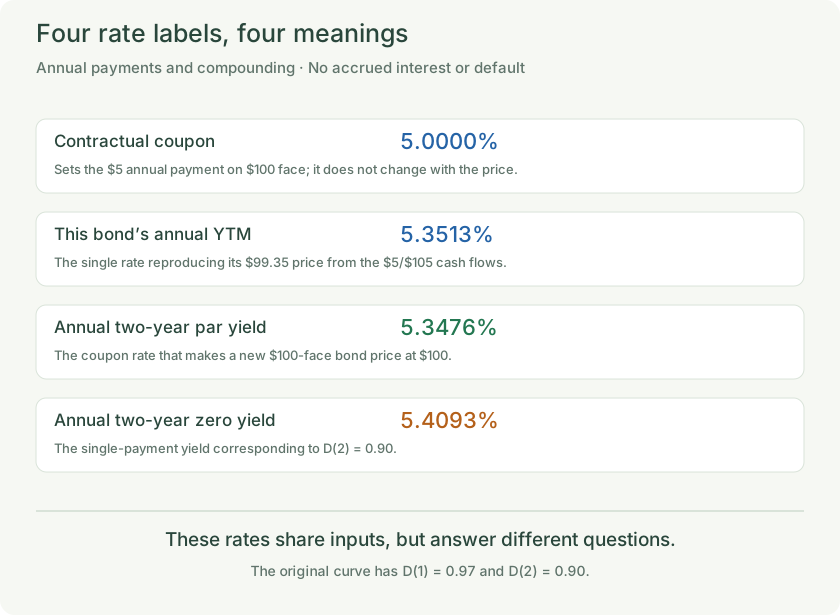
The same curve gives a $99.35 price for the 5% coupon bond, 5.3513% YTM, 5.3476% par yield and 5.4093% two-year zero yield.
The illustration is a fixed worked example. Editing a calculation does not update it.
Exercise 4 — Find a par coupon from the curve
Replace the $5 coupon with an unknown annual , keeping $100 face and the same two discount factors. Solve . Express the resulting coupon rate as percent of face; at $100 face it has the same numerical value as dollars.
Exercise 5 — Convert a zero factor to its own annual yield
The two-year factor 0.90 prices a single $1 payment at year two. Solve . This zero yield is about 5.4093%; the one-year factor 0.97 instead implies about 3.0928%. Different maturities need not share one yield.
Exercise 6 — Raise an assumed common yield and reprice
For a separate yield-sensitivity comparison, value the original $5/$105 cash flows using one common annual yield of 5%. Then change both uses of 0.05 to 0.07. This is a new repricing scenario, not an instruction to overwrite and in the original curve.
Read the picture
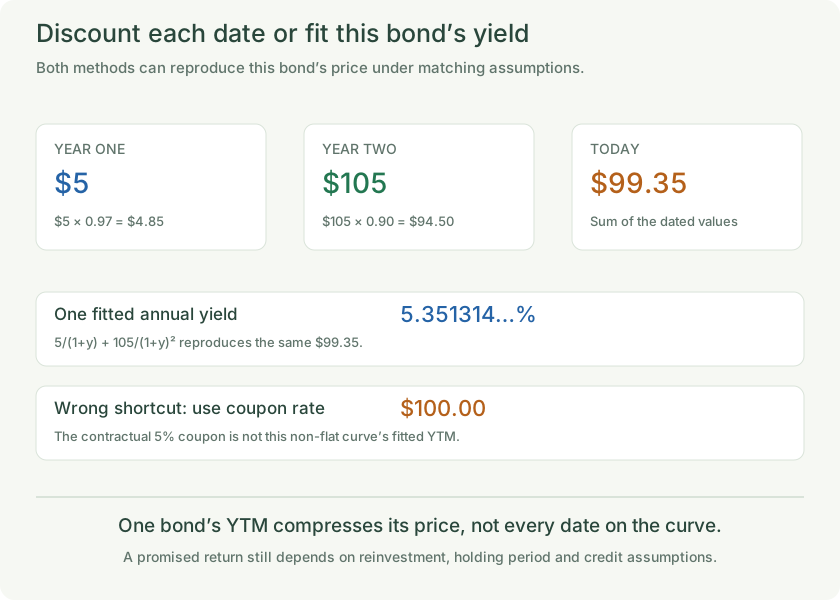
The $5 year-one coupon and $105 year-two cash flow use discount factors 0.97 and 0.90; a single fitted YTM reproduces only this bond’s price.
The illustration is a fixed worked example. Editing a calculation does not update it.
Exercise 7 — Reject the coupon-as-discount-rate shortcut
Compare the curve-based $99.35 price with discounting all cash flows at the contractual 5% coupon rate. The latter gives $100. The code reports curve price minus that shortcut. A suitable different YTM can reproduce the bond price, but one fitted bond yield need not price every other bond on the same curve.
Remember
Coupon rate sets promised interest, zero yields price individual dates, par yield solves for a hypothetical coupon and YTM fits an existing bond’s price. State compounding and payment frequency with each rate. A quoted YTM is not a guarantee about reinvestment, early-sale proceeds or default.