Forward rates and the shape of the curve
A yield curve prices cash flows starting today. The bakery also wants terms for borrowing or lending during a future interval. Compare two discount factors to isolate that interval’s growth factor, then construct matching cash flows to see why the rate is implied by today’s prices rather than a guaranteed forecast.
Predict the result, run the standalone calculation, then make any requested edit before answering. Each exercise retains its own stated inputs. Enter numeric answers without units and round to two decimals unless four are requested. Code is provided to explore the finance; no new Java syntax is required.
How do discount factors imply a future-period rate?
Let be today’s value of a certain unit at date under one consistent curve. For , define interval length using the stated accrual convention. The forward growth factor is .
The simple forward and continuous forward are:
Thus . These rates describe the same interval’s growth under different quotations; their printed numbers need not be equal.
| Base date | Factor |
|---|---|
| Today | |
| Year one | |
| Year two | |
| Year three, used only in exercise 7 |
For a future one-year loan of 1,000 from year one to year two, the implied repayment is . Buying that face amount of a year-two zero and shorting a 1,000-face year-one zero has zero net initial cost at these prices. It pays out 1,000 at year one and receives the implied repayment at year two. The reverse replicates future borrowing when all reverse trades are feasible.
This is a no-arbitrage reinvestment relationship, not a claim that actual future overnight rates are known. Pure expectations, term-risk compensation, liquidity preference, investor demand at particular maturities and market segmentation can all be relevant hypotheses for curve shape. The factors alone cannot identify the expected future short rate or separate these effects.
If exceeds , the interval’s implied forward may be negative. Positive discount factors and a positive growth factor can still be consistent; imposing “all forward rates must be positive” would add an extra assumption.
Scenario and assumptions
Use certain tradable zero-coupon claims in one currency, the same valuation basis for all maturities, fractional holdings, reliable shorting and no trading costs. The interval from year one to year two is exactly one year for both simple and continuous quotations here. Exercise 5 changes only in a separate scenario. A supplied 5% real-world forecast in exercise 6 is independent of the market-implied pricing curve.
Exercise 1 — Extract the simple interval rate
Divide by , subtract one and divide by the one-year interval. Multiply by 100 to express the result in percentage terms. The relevant interval starts at year one, so this is neither the one-year spot zero rate nor the two-year annual zero rate.
Exercise 2 — Quote the same growth continuously
Take the logarithm of the factor ratio and divide by the same interval length. This gives a smaller printed percentage than the simple annual quote while preserving exactly the same terminal growth. Do not use the log of the difference .
Exercise 3 — Calculate the future loan’s repayment
At year one a lender advances 1,000; at year two it receives principal plus the implied simple interest. Multiplying by the exact factor ratio avoids rounding either forward quotation before using it. The future principal advance is an actual cash flow, unlike a futures contract’s notional.
Read the picture
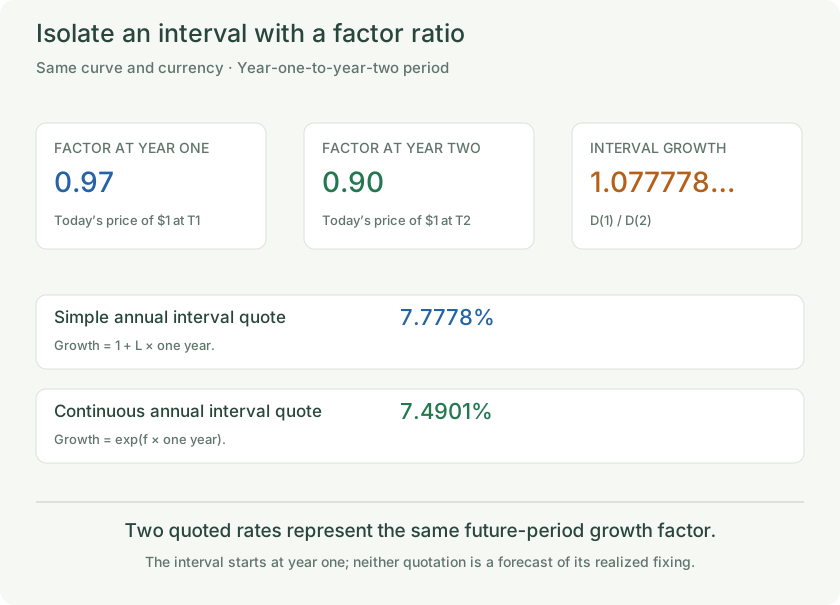
The ratio 0.97/0.90 gives 1.077778 growth from year one to year two: 7.7778% simple or 7.4901% continuous.
The illustration is a fixed worked example. Editing a calculation does not update it.
Exercise 4 — Match both cash dates with zero-coupon claims
Buy a year-two zero paying the exact repayment from exercise 3 and short a year-one zero paying 1,000. The code computes the initial cost of the long claim minus the short-sale proceeds. At year one the short requires paying 1,000; at year two the long pays the repayment. Both obligations matter when calling the structure a future loan.
Exercise 5 — Allow an implied negative rate
Run the original simple forward, then change only from 0.90 to 0.99. The later factor now exceeds the earlier 0.97 factor. Compute the rate without clipping it to zero. Its growth factor remains positive, so it does not resemble the negative discount-factor failure in the bootstrap lesson.
Exercise 6 — Compare an implied forward with a separate forecast
Return to the original . Suppose an independent real-world forecast expects the relevant future one-year rate to be 5%. Subtract 5% from the simple forward and report the numerical percentage-point gap. That gap alone does not prove a clean, constant term premium: risk, liquidity, conventions and forecasting assumptions can contribute.
Read the picture
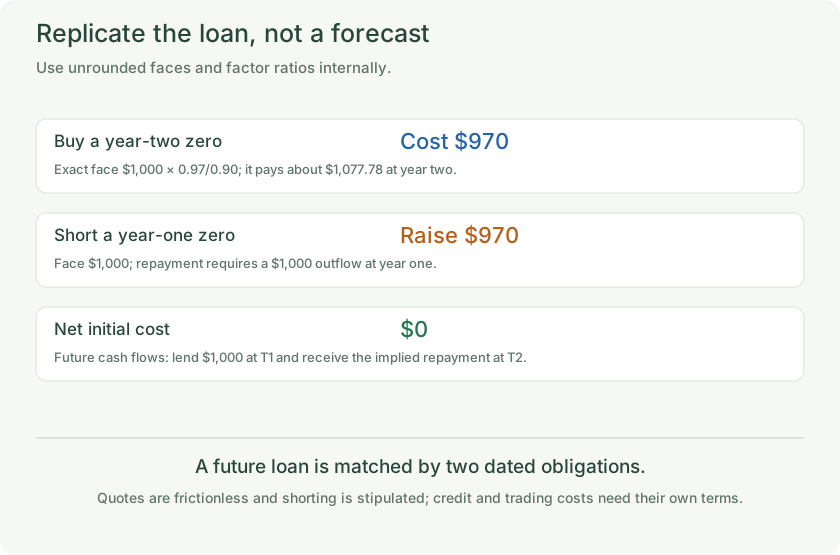
A year-two zero paying $1,077.78 costs $970; shorting a year-one zero paying $1,000 raises $970, matching the future loan at zero net initial cost.
The illustration is a fixed worked example. Editing a calculation does not update it.
Exercise 7 — Read a bend in the forward curve
Add the separate three-year factor . The year-two-to-year-three simple forward is . Compare it with the previous year-one-to-year-two segment. Both multi-year annual zero yields can still rise while these adjacent forward segments decline. A curve’s shape is not summarized by a single “rates will rise” statement.
Remember
Use factor ratios over explicit future intervals and keep simple versus continuous units straight. Check a forward loan by matching its advance and repayment, not just its initial value. Forward rates are implied prices under stated assumptions; forecasts, term premiums and liquidity explanations need additional information. Negative forwards can coexist with positive discount factors.