Duration turns a rate move into a price estimate
The bakery holds a fixed-rate bond to fund a future equipment purchase. A higher yield reduces its resale value before maturity. Measure the slope of that price change, then test how far a slope alone can take you.
Predict, run the provided Java calculation, then make the requested edit before answering. Each exercise uses its own stated inputs. Enter numbers without units; round final answers to two decimals unless four are requested. Keep intermediate precision. Code supports the finance rather than teaching Java syntax.
What does duration measure?
For certain annual payments , an annually compounded yield gives . Macaulay duration is the present-value-weighted payment time, in years. It is not simply the final maturity. Modified duration gives the local annual-yield sensitivity:
Yield changes enter as decimals: 20 basis points = 0.002, not 20 or 0.20.
Here define , the positive currency loss magnitude for a one-basis-point yield increase on a long ordinary bond. The signed price change is approximately −DV01 × shock in basis points. Other systems may report a signed DV01; check the convention.
For a continuous yield , , and the weighted payment time itself is the sensitivity duration: . At equivalent base yields , the base cash-flow weights agree, but a one-basis-point move in differs from a one-basis-point move in .
| Fictional bond, valued just after a coupon | Cash received |
|---|---|
| Year 1 | $6 |
| Year 2 | $6 |
| Year 3 | $106 (coupon plus principal) |
The annual yield is 4%; face is $100. All prices and DV01s in this lesson are for this one $100-face holding. Scale them by holdings before using a portfolio cash budget.
Scenario and assumptions
Use fixed certain cash flows, annual coupon dates exactly one, two and three years away, no accrued interest, no options, credit change, fees or tax. Shock the bond’s single yield with all cash flows fixed. A curve-wide hedge would require assumptions about how different maturities move.
Exercise 1 — Value each dated payment
Add discounted coupons and principal. Keep full precision for the sensitivity weights; the $100 face is not today’s market value.
Exercise 2 — Weight the payment times
Multiply each discounted cash flow by its payment time and divide by the same price. The last payment contributes , not .
Exercise 3 — Convert time into annual-yield sensitivity
Divide Macaulay duration by 1.04 because this yield compounds annually. The divisor would depend on coupon/yield frequency under other conventions.
Payment times determine the weights
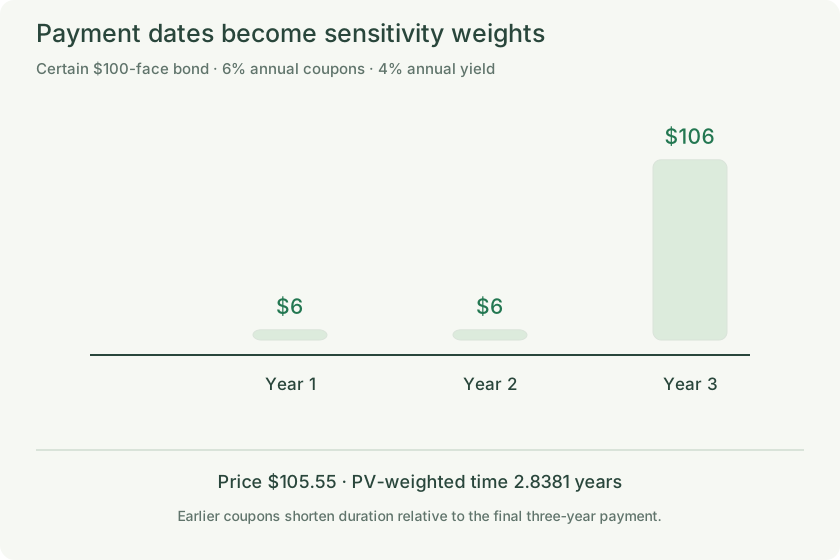
Year 1: $6; year 2: $6; year 3: $106. At 4% annual yield, price is $105.55 and Macaulay duration is 2.8381 years.
The illustration uses fixed worked inputs. Editing code does not update it.
Exercise 4 — Put the slope into cash units
Multiply price, modified duration and one decimal basis point. This gives dollars per basis point for $100 face, rather than a percentage price change.
Exercise 5 — Estimate a 20 bp rise
Apply the negative slope to a move from 4.00% to 4.20%. Report the estimated new price, not just the signed loss.
Exercise 6 — Reprice a larger changed input
First run the exact price at 4.20% and compare it with exercise 5. Then change all three 0.042 inputs to 0.05, representing a separate +100 bp move from the original base. Compare the exact result with the original duration estimate at a 0.01 shock. Each exercise starts from the original bond.
Estimate versus full repricing
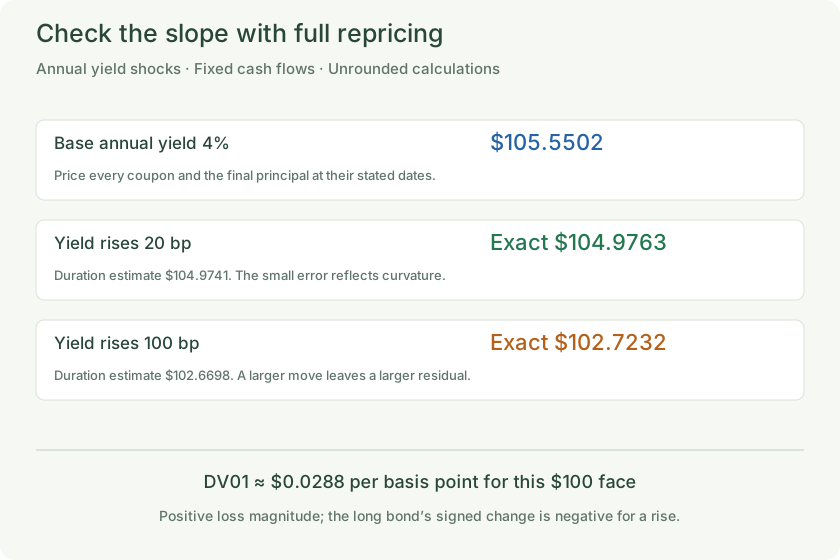
At +20 bp: duration estimate $104.9741; exact $104.9763. At +100 bp: estimate $102.6698; exact $102.7232.
The illustration uses fixed worked inputs. Editing code does not update it.
Exercise 7 — Keep the quotation attached to DV01
At the equivalent continuous base yield log(1.04), compute the continuous-rate DV01. It is larger than the annual-yield DV01 because the printed rate move is measured differently.
Remember
Duration is a local slope under a stated yield convention. Convert basis points to decimals, scale by market value, and test the estimate by repricing. A fixed maturity, Macaulay duration and modified duration answer different questions.